Science and technology
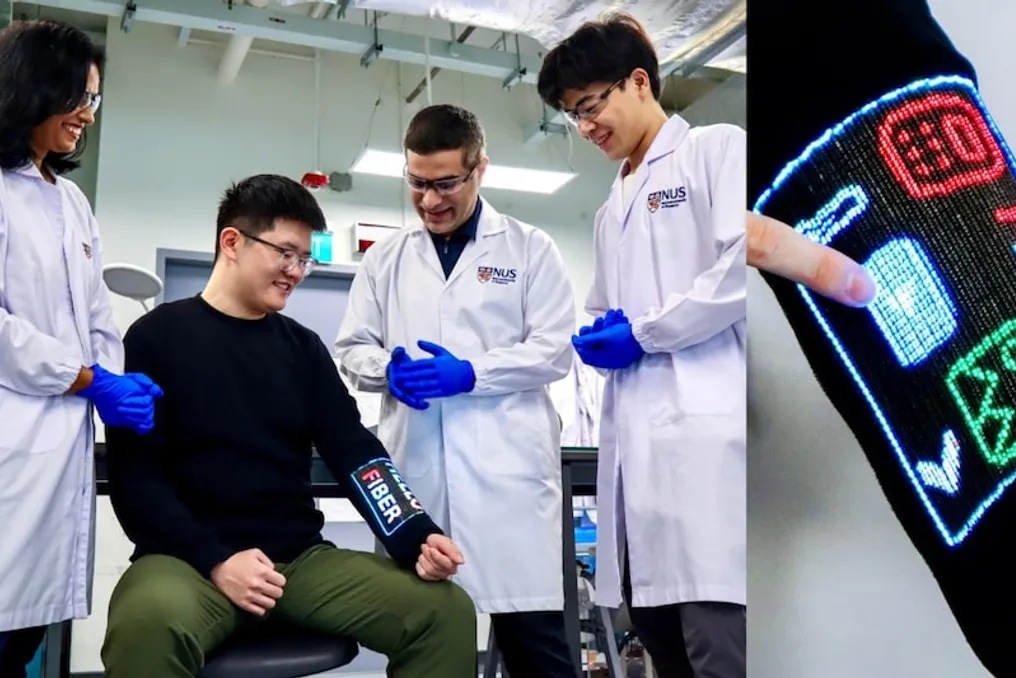
Singaporean Scientists Develop Sensor Sleeve Insert Integrated into Fabric
Imagine being able to check body temperature, view videos, or use a calculator without taking your phone out of your pocket. This is now becoming a reality thanks to a new invention. Scientists from the National University of Singapore (NUS) have created a sensor sleeve insert that can be easily woven into clothing, transforming ordinary fabric into a digital interface. This smart prototype is capable of displaying images and videos, responding to touch, and connecting wirelessly to other devices. Notably, after 50 cycles of washing in a machine, its brightness and touch sensitivity remained unchanged. The research, published in the prestigious journal 'Nature' on October 21, 2026, describes a flexible textile display made from specially developed electronic fibers. The researchers claim this is the first sensor screen in the world integrated directly into fabric. Unlike traditional screens, this does not use rigid panels; instead, the electronic components are embedded within the fibers, allowing them to be easily woven into clothing. The team, led by Assistant Professor Tural Khudayev, created a screen measuring 168 mm in length and 105 mm in width using 54-pixel fibers. This display has a resolution of 96x54 pixels and can refresh at a rate of 30 frames per second. When this fiber is pressed, the sensor layer is activated, the system detects the point of contact, and the corresponding pixel begins to light up. The capabilities of this prototype are not limited to displaying images. It can play videos, function as a calculator, show photo galleries, act as a compass, receive voice commands, and receive photos via Bluetooth. Furthermore, the researchers added a microphone, speaker, and various sensors capable of measuring temperature, movement, light level, and magnetic direction. A specifically installed temperature sensor under the sleeve can measure body temperature and display it on the screen, making this technology potentially revolutionary for future health monitoring. The main challenge when working with flexible electronics is that the fabric undergoes bending, stretching, and regular washing, which hinders the durability of fragile components. However, the NUS team demonstrated that their smart sleeve insert maintained its original excellent condition even after 50 washes with detergent. Moreover, it withstood 1000 bends within a 5 mm radius without any damage. The fabric remains as elastic and breathable as regular clothing. Although this technology is currently at the research prototype stage and will not replace smartphones yet, the team's next goal is to improve screen resolution and integrate artificial intelligence. The success of these efforts could lead to clothing becoming not just an item of apparel, but a direct screen and sensor for our digital lives.
October 23, 11:30OpenAI failed to trace 53 personal photos uploaded by its own AI agents
October 23, 09:59Apple introduces 'Made for iPhone Duo' badge for apps optimized for foldable devices
October 23, 09:57Chandrika Deb from Canva India: Artificial Intelligence Democratizes Creativity by Removing Skill and Resource Barriers
October 23, 09:31Elon Musk's flying Tesla Roadster sparks debate on social media
October 23, 07:30Explanation of WAP-7 and WAG-9 Codes on Indian Railways Locomotives
October 23, 07:10OpenHarmony and NearLink Event in Shenzhen Focuses on Protocol Stacks, Chips, and Metro Gates
October 23, 04:52Ant Digital Technologies releases LingDT-Decision-1.0 model for fast corporate decision-making
October 23, 04:51iFLYTEK Unveils Spark X2.6 Model Trained on Domestic Computing Power and Releases 4B Model for Devices
October 23, 04:51Huawei introduces Stellar AI Fabric design to alleviate KV Cache bottleneck in storage and network
October 23, 04:51DeepSeek and MiniMax Complete AI Export Registration and Begin International Licensing
October 23, 04:51Artemis 2 Mission Commander Discusses Moment of Fear During Lunar Orbit Flight
October 23, 04:37
Analysis of 5 Recommended Aiwa Smart TV Models for Purchase in 2026
Aiwa has established its position in the Brazilian television market by combining current technologies, sophisticated design, and a good balance between cost and benefit. The brand's Smart TVs are distinguished by their extremely thin bezels, the Android TV operating system, and features such as Blue Protect, which aims to increase visual comfort by reducing blue light emission. Tecnoblog presents five Aiwa Smart TV models available in Brazil that are considered good purchases for the year 2026, detailing the pros and cons of each to aid in the purchasing decision. Aiwa AWS-TV-55-BL-01-A The Aiwa AWS-TV-55-BL-01-A is a 55-inch 4K Smart TV, featuring ultra-thin 1.4 mm bezels and an IPS D-LED panel. Although consumers report high resolution and good viewing angles, the color depth may disappoint more demanding users, particularly in red and green tones. Additionally, its refresh rate is limited to 60 Hz, which can be a limiting factor for gamers. This TV supports HDR10 and Dolby Vision, along with a quad-core processor with artificial intelligence. In terms of audio, it features two 10W RMS speakers and is compatible with Dolby Atmos, offering good sound quality for its category. Its connections include four HDMI 2.1 ports, two USB ports, optical audio output, and an RJ-45 network port. The Blue Protect feature contributes to visual comfort, and the use of Android TV allows for integrated Chromecast and voice commands via Google Assistant. Aiwa AWS-TV-50-BL-02-A The Aiwa AWS-TV-50-BL-02-A is a 50-inch Smart TV focused on low cost, suitable for medium-sized rooms or large bedrooms. It features a VA panel with 4K resolution and HDR10 support, although its brightness is restricted in HDR content, which is typical of entry-level models. The operating system is Android TV, running on a quad-core processor, but there are reports of initial slowness during first use or when installing packages until the system stabilizes. This model also incorporates the Blue Protect feature to mitigate blue light emission and offers Dolby Audio certified surround sound. Regarding connectivity, it has three HDMI inputs, two USB ports, an Ethernet connection, in addition to Bluetooth 5.1 and Wi-Fi 4 support. Aiwa AWS-TV-43-BL-02-A The Aiwa AWS-TV-43-BL-02-A represents good value for money compared to competitors in the same price range. With a D-LED screen and IPS panel, it supports HDR10, providing a good visual experience, especially regarding viewing angles. However, this TV only has Full HD resolution, which puts it at a disadvantage against market models that offer 4K support. In terms of connectivity, the AWS-TV-43-BL-02-A has two HDMI inputs, two USB ports, optical audio output, and an RJ-45 network input. Its design is elegant thanks to the ultra-thin 1.4 mm bezel, and the support for Blue Protect technology helps reduce blue light emission, preventing eye strain. Aiwa AWS-TV-24-01-G The Aiwa AWS-TV-24-01-G is a compact Smart TV, ideal for those seeking portability. Weighing only 4 kg, it is truly portable as it includes an integrated handle and an internal battery that allows up to 3 hours of playback without being connected to the power outlet. This Smart TV has Full HD resolution, which is considered a positive point, given that it is difficult to find models with higher than HD resolution in devices under 40 inches. The screen of this model features an anti-reflective matte finish, making the viewing experience comfortable in outdoor and well-lit environments. It also supports HDR10 and Blue Protect to reduce blue light. The operating system is Android TV in the Google TV version, offering a better user experience and access to thousands of applications on the Play Store. The AWS-TV-24-01-G has one HDMI input, one USB, an Ethernet network port, and optical audio output. Aiwa AWS-TV-32-BL-02-A The Aiwa AWS-TV-32-BL-02-A is a simple 32-inch television, suggested for equipping smaller spaces, such as kitchens, offices, or small bedrooms. This Smart TV boasts an ultra-thin bezel of only 1.4mm, giving it a minimalist look in contrast to other brands' models. Its resolution is only HD (1366 x 768 pixels), but the D-LED IPS panel ensures a wider viewing angle, and the Blue Protect feature helps reduce blue light that causes eye fatigue. In terms of audio, the Smart TV has two 6W RMS speakers and Dolby Audio support. Like other Aiwa models, the AWS-TV-32-BL-02-A operates with Android TV, ensuring wide application availability. The device includes two HDMI inputs, two USB ports, optical audio output, and an RJ-45 network port. Criteria for Choosing the Best Aiwa TV When selecting the best Aiwa TV, it is important to consider that all of them use the Google Android TV operating system. The great advantage of this system is the vast range of available applications, covering practically all streaming services present in the Brazilian market. Furthermore, Aiwa TVs come with built-in Chromecast, facilitating content mirroring from mobile phones. Aiwa TVs can be a advantageous alternative for consumers with moderate demands, as they offer models with good cost-benefit when compared to more well-known manufacturers. A notable difference is the adoption of Android TV, which grants access to thousands of applications on the Play Store. Aiwa offers one year of warranty in Brazil and maintains a good reputation on Reclame Aqui. In Brazil, the production of Aiwa TVs is carried out by Grupo MK, which also manufactures the Mondial and XZone brands. It is relevant to note that Aiwa is a Japanese company that licensed its brand to Grupo MK. The Best Cost-Benefit Option Among the listed models, the Aiwa AWS-TV-32-BL-02-A stands out as the best cost-benefit option. This 32-inch Smart TV uses Android TV, has an IPS panel, and is indicated for smaller environments, such as kitchens, offices, and bedrooms. Although TCL is a more established brand in the Brazilian television scene, Aiwa also presents itself as an interesting alternative. The same company behind Aiwa is the manufacturer of the Mondial home appliances. Both companies have good ratings on Reclame Aqui and provide a one-year warranty in Brazilian territory.
October 23, 02:54Winners of the international project "CanSat-2026" have been determined
October 23, 01:57App Store introduces badge for apps optimized for the iPhone Duo
October 22, 22:23Hackers attempted to exploit critical flaws in PHP before the official alert
October 22, 22:15Echo Dot available in various colors: a guide to choosing the smart speaker with Alexa
October 22, 21:47General Motors uses artificial intelligence to streamline vehicle development
October 22, 21:42Hangzhou Vanke Times Commune Project by DAGA Architects
October 22, 15:00