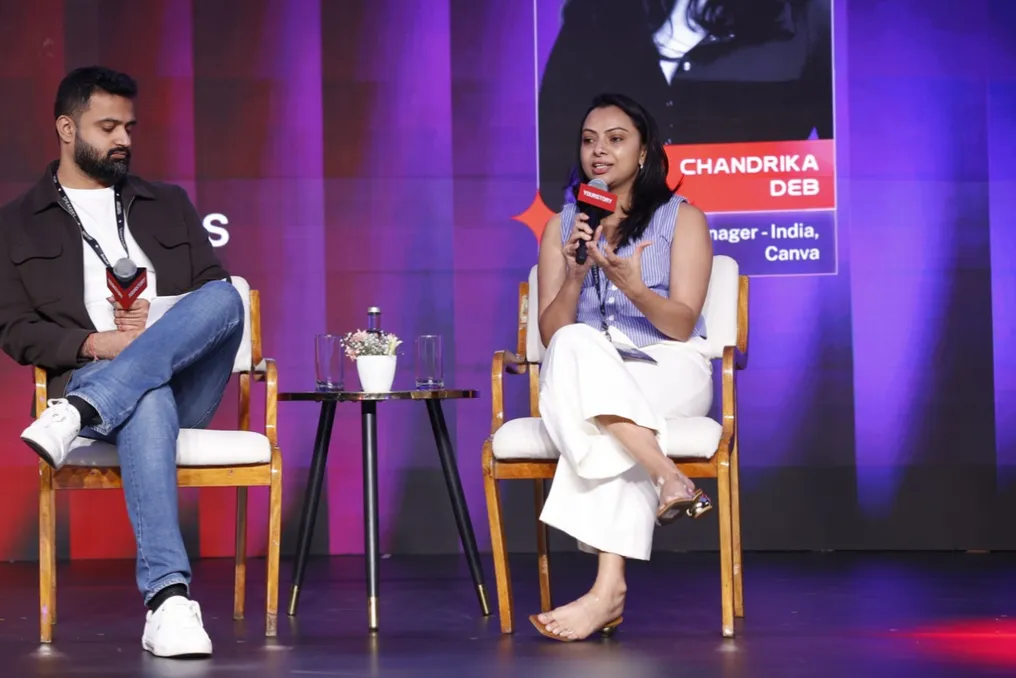
As AI-generated content and visuals nearly indistinguishable from human creations flood social media, a complex question arises about what remains uniquely human. At the TechSparks 2026 event, Chandrika Deb, Country Manager for Canva in India, offered a clear answer: judgment, intention, and perspective.
During a fireside chat titled 'The Tool as Co-creator: How AI is Rewriting the Creative Process' with Aditya Gurwara, co-founder and head of the Qoruz brand alliance, Chandrika noted that Canva views itself as a 'co-creator, partner, and assistant' in the creative process. According to her, artificial intelligence removes obstacles related to skills, resources, and knowledge.
She provided compelling statistics: 'We heard from 97% of marketers we surveyed that they use AI in some form. But the question is whether this is the best outcome I can get from a prompt I generated. Thus, judgment and intention, which come only from human nature, are important. This ensures you are using AI optimally and getting a result relevant to your audience,' she stated.
When asked if generative AI is moving from democratizing design to democratizing creativity itself, Chandrika replied: 'I think it's about democratizing the ability to act on one's creativity. We all have innate creativity. AI helps you realize it by overcoming barriers. It might be a mental block: I want to create a video, but I don't know what to make it about. AI helps overcome that idea barrier. Or it could be a resource barrier: I need a large team to make that video,' she explained.
Chandrika believes that AI allows a small business owner who has an idea but cannot visualize how the product should look and feel to achieve the desired result much faster and iterate more easily than before. She presented this as the next phase of Canva's evolution: if the company's first decade was about consolidating disparate and expensive design tools into one online editor, the current decade is dedicated to doing the same for scattered AI platforms and workflows so businesses can operate more efficiently.
Chandrika expects AI to change team structures, primarily through expanded participation. Founders, marketers, product employees, and salespeople can now begin shaping creative work even before specialized design teams intervene. She emphasized that historically the company relied on design teams for most creative content, but AI facilitates quicker involvement from founders, marketers, product staff, or salespeople, leading to an evolution in team structure. The key factor is who joins the process earlier.
However, she added that specialists who understand mastery, cultural nuances, and the audience remain indispensable, as do creative operations experts who ensure content aligns with the brand. She also pointed out the need for caution when working with young talent, as years of experience often bring judgment.
'As leaders, our job is to guide young professionals, give them feedback, and mentor them so that those just starting to work with AI in the workplace better understand how to apply their judgment and use AI more effectively and responsibly,' she added. Chandrika also touched upon the risk that AI-driven personalization could turn into noise rather than relevance. She stressed that AI should make content more pertinent to the people it aims to reach, not just scale personalization across more segments, formats, and languages.
Yet, in her view, the technology itself cannot guarantee relevance; 'ultimately, you have to make it relevant to them. Otherwise, it will just become noise,' concluded Chandrika. She is confident that AI will disprove the notion that creativity is a skill accessible only to the elite or those with resources. She mentioned the launch of Canva's campaign called 'Aap aur Canva, Jodi Wah Wah' to convey the idea that Canva is a partner helping overcome uncertainty in exploring one's creativity.
According to her, AI can play a huge role in alleviating the doubts or inhibitions people may feel when exploring their creativity. It helps everyone transition more smoothly from idea to outcome and refine their concepts. She also noted that in modern companies, AI enables everyone to participate in the creative process, covering the entire journey from idea to product and business. The company observes organic, bottom-up adoption of AI tools because they solve real employee problems. Since 95% of Fortune 500 companies use Canva and its AI features, the company sees real value and impact, ensuring a return on investment for these enterprises.