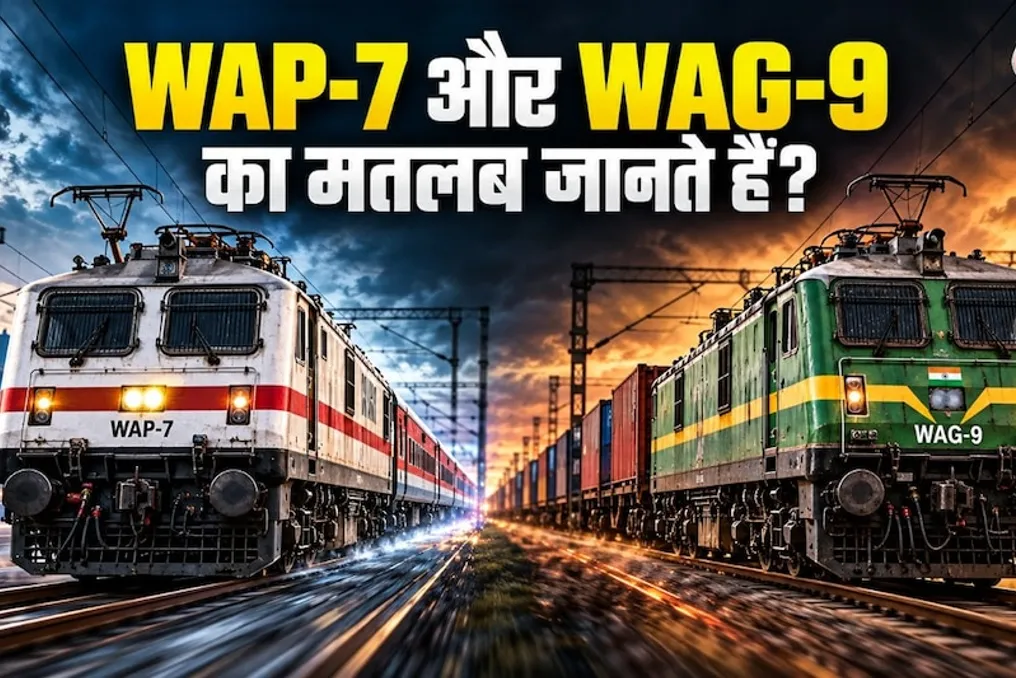
On railway stations, one often sees the inscriptions WAP-7 or WAG-9 on locomotives. This raises the question of what these letters and numbers mean—whether they are just identifiers or carry some special semantic meaning. In reality, these are not random numbers; Indian Railways uses these codes to determine the type and intended purpose of the locomotive. The letters indicate whether the locomotive is intended for passenger trains or for towing freight consists, while the numbers denote a specific model or category of locomotive.
Meaning of the WAP-7 Code
Let's first look at WAP-7. In this code, each letter has its own meaning. The letter W stands for Wide Gauge, meaning a locomotive designed to run on the wide gauge of Indian Railways. The letter A indicates AC Electric, meaning the locomotive operates using alternating current electricity. The letter P means Passenger, indicating that the locomotive is used for running passenger trains. The number 7 denotes a specific category or model of this locomotive. Thus, WAP-7 is an electric locomotive used for hauling passenger trains and is installed on many express and other high-speed passenger routes.
Meaning of the WAG-9 Code
Now let's turn to WAG-9. The first two letters have the same meaning as in WAP-7. However, the third letter is different. W again stands for Wide Gauge, meaning a locomotive for wide gauge. A stands for AC Electric, meaning the locomotive runs on alternating current. G stands for Goods, indicating that the locomotive is designed to tow freight trains. The number 9 identifies a specific category or model of the locomotive. WAG-9 is a powerful electric locomotive built for towing heavy freight consists. It is used in trains transporting coal, cement, grain, and other goods.
Differences Between WAP-7 and WAG-9
Both types of locomotives run on electricity and are used on wide gauge tracks. Nevertheless, they differ in design and purpose. WAP-7 is primarily intended for passenger trains and has the capability to quickly transport passengers from one city to another. On the other hand, WAG-9 is designed for towing heavy freight consists, where the ability to pull a large weight is critical. Simply put, the letter 'P' in WAP-7 indicates a passenger consist, whereas the letter 'G' in WAG-9 denotes a freight one.
The Necessity of Locomotive Numbering
Indian Railways possesses numerous types of locomotives to perform various tasks. If the identification of every locomotive were based only on its name, it could cause confusion. Therefore, the railway developed a coding system for locomotives. This helps railway staff understand the category, usage, and technical specifications of the locomotive. Furthermore, each locomotive has a separate number that serves to identify a specific unit. That is, WAP-7 indicates the locomotive model, while the full number on it identifies one particular locomotive.