The 31st Tashkent International Tourism Fair 'Tourism on the Silk Road' and the First International Tourism Investment Forum concluded in Tashkent, the capital of Uzbekistan. The events took place from November 25 to 27, 2026, at the CAEx Uzbekistan exhibition complex.
Over 600 foreign companies from more than 45 countries, along with about 20 international organizations, participated in the fair. The exposition presented various aspects of national tourism, including cultural and historical routes, resort areas, gastronomic and wellness offerings, as well as national tourism products.
Participating countries included Azerbaijan, Belarus, Vietnam, Germany, Georgia, India, Iran, Italy, China, Kyrgyzstan, Malaysia, Maldives, Russia, Tajikistan, Thailand, Turkmenistan, Turkey, and Czechia.
Uzbekistan showcased the tourism potential of all 14 of its regions, including Tashkent and the Karakalpakstan Republic. Historical cities, mountain and nature trails, national cuisine, handicraft traditions, and wellness opportunities were displayed.
Alisher Yunusov, a representative of the Dtour tourism company from Andijan, noted that his firm has been operating in the market for 12 years, attracting both local and foreign tourists through its website. He reported that foreign guests often prefer guesthouses where they can combine relaxation with master classes, especially in knife making. The company plans to include an animal husbandry farm in its itinerary next year, which will benefit all parties.
Alina Fatkhullina, a tourism manager at Versailles Travel from Andijan, emphasized the importance of participating in such exhibitions for finding new partners, as the company focuses on foreign clients. She added that about half of their current contacts were established through similar events, and over 13 years of operation, they have cooperated with partners in Pakistan, Germany, Russia, and India.
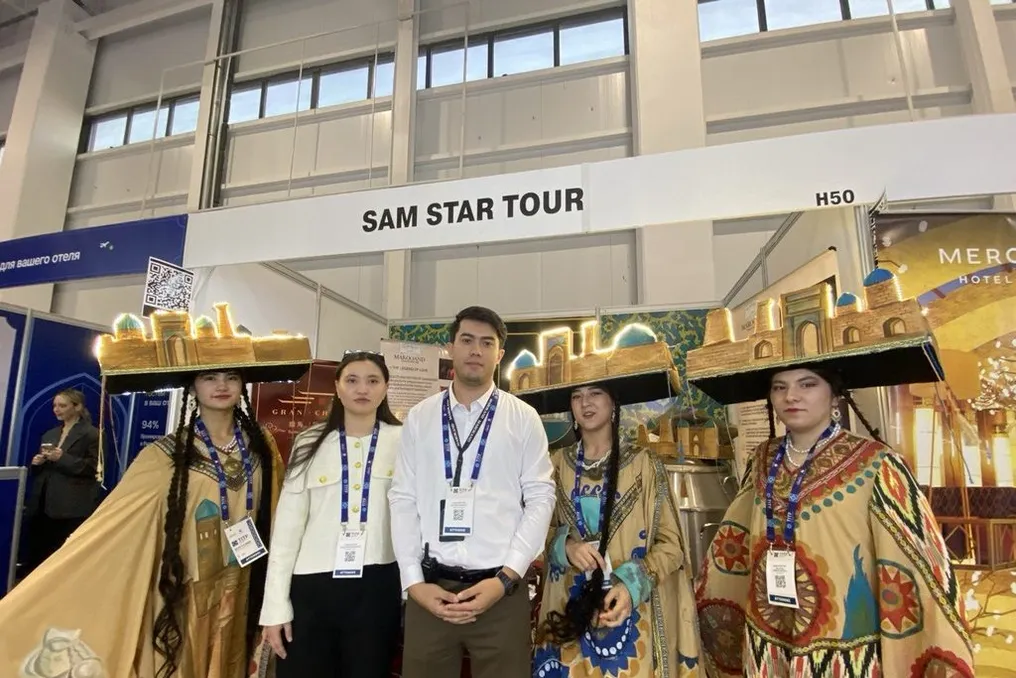
Fair visitors were able to experience the local flavor: national ensembles performed dances in the center of the pavilion, while artisans demonstrated handicrafts in the intricately carved pavilions.
The section dedicated to Tajikistan attracted particular interest from visitors due to exclusive jewelry and antiques. Dilora Kholikzoda, head of the folk crafts organization, noted that the exhibited items, dating back to the 18th–19th centuries, testify to the high skill of ancestors. She also stressed that the fair serves as a platform for knowledge exchange between masters from Uzbekistan and Tajikistan, expressing hope for the preservation and development of this art.
Uzbekistan's cultural heritage was presented through the 'Marakand' show in Samarkand. This theatrical production, designed for 750 spectators, tells a love story against the backdrop of the Great Silk Road, using dance, movement, and plasticity without words. The show aims to reflect the country's cultural diversity.
Participants in the 'Marakand' show stated that the project is successfully demanded by tourists, and further development and popularization of the show require state support and the attraction of additional financial resources.
The First International Tourism Investment Forum focused on discussing several priority issues, including safe tourism, transforming Central Asia into a unified tourist destination, developing medical tourism, the role of craftsmanship, digital transformation, as well as transport systems and the impact of artificial intelligence.
A significant moment was the launch of the '2027: International Year of Sustainable and Resilient Tourism' initiative, proposed by Uzbekistan and supported by the international community. The corresponding resolution was adopted by the UN General Assembly on February 26, 2024, by more than 80 states. This international year aims to highlight the role of tourism in preserving heritage and sustainable economic development.
Overall, the Tashkent International Tourism Fair 'Tourism on the Silk Road' contributed to demonstrating Uzbekistan's tourism potential and strengthening its position in the global market.