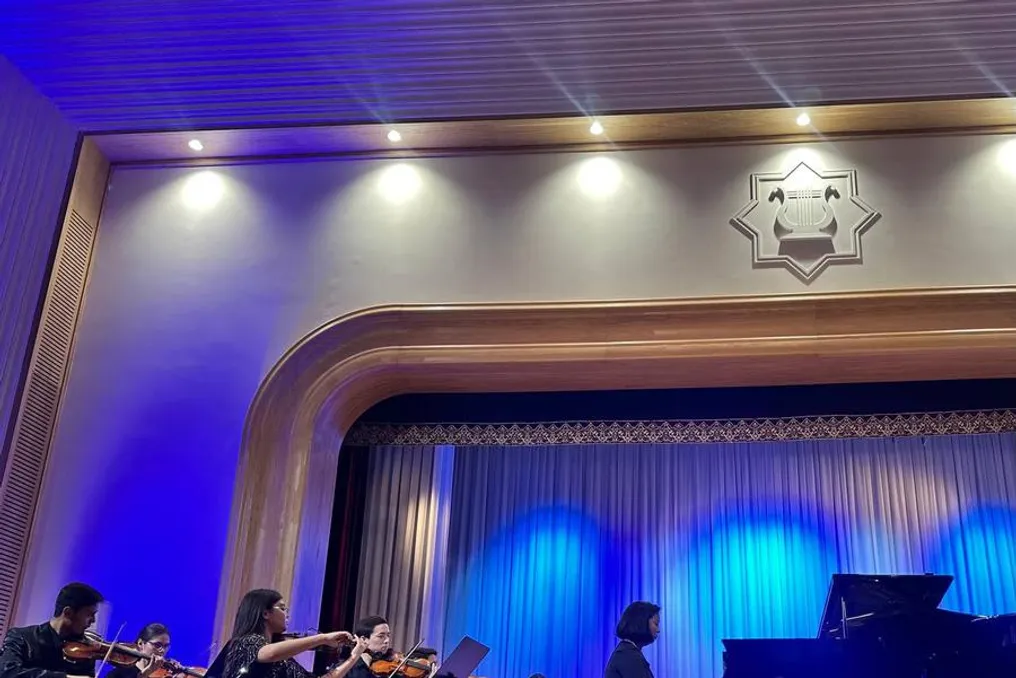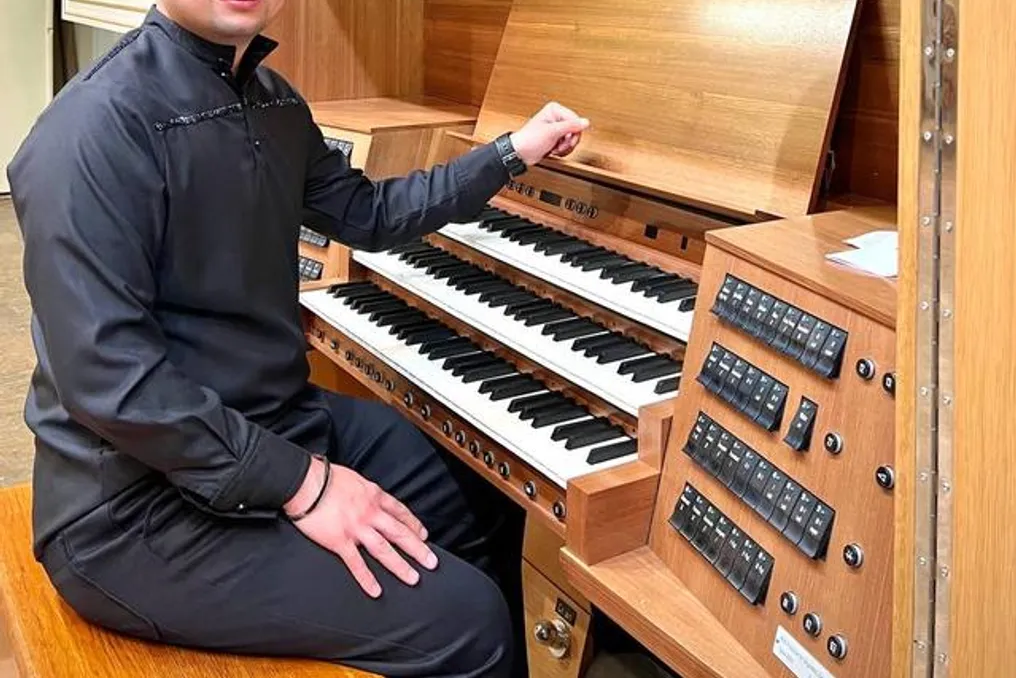
On November 21, 2026, an event titled 'Journey into the World of Organ Music: Eras and Styles' took place in the Organ Hall of the State Conservatory of Uzbekistan. The concert featured works by renowned composers from different centuries. The performance was given by Munira Aminova, a Merited Mentor of Youth of the Republic of Uzbekistan, Associate Professor at the Department of Special Piano and Organ, and the Head of the Department of Interfaculty Piano, as well as Bobir Mirsaidov, a laureate of international competitions and senior lecturer at the conservatory.
The organ is recognized as one of the most significant musical instruments due to its powerful sound, variety of timbres, and ability to convey the slightest emotional nuances. The evening's program allowed listeners to journey from strict polyphonic works of the Baroque era to grandiose Romantic pieces, to familiarize themselves with various national traditions of organ playing, and to feel the uniqueness of each composer's style.
Bobir Mirsaidov's creative path demonstrates how professional interest can influence a musician's destiny. He is from Tashkent and received his initial education at the Republican Specialized Music School named after V. A. Uspensky, where he studied in the special piano class of T. N. Sotnikova. He then continued his studies at the State Conservatory of Uzbekistan under the guidance of M. T. Aminova.
His interest in the organ arose through a teacher who specialized in organ performance. Alongside his piano practice, Mirsaidov began mastering the organ, gradually realizing its enormous artistic potential. Even as a pianist, he won the second prize at the 'Pro Piano Romania' competition in Bucharest in 2013 and the third prize at the International Alexander Rubinstein Piano Competition in Paris in 2014.
After obtaining a bachelor's degree, the musician consciously chose the organ as his specialization for his master's degree, continuing his studies with Munira Tursunkhodzhaeva Aminova. Soon, numerous successes followed: he won first prizes at the international competitions 'OrganArt' in Astana in 2018 and 'Primavera Romana' in Rome in 2019. A significant milestone was completing an assistantship/internship at the Moscow State Conservatory named after P. I. Tchaikovsky in the organ class under the guidance of People's Artist of Russia, Professor Rubin Kabirovich Abdullin. Furthermore, Mirsaidov participated in the VII International Organ Competition named after Gedicke in Moscow.
During his performance, Bobir Mirsaidov presented Fantasia in G major (BWV 572) and two choral preludes by Johann Sebastian Bach—'O Jesus, Descending from Heaven' and 'My Soul Glorifies the Lord,' as well as 'Introduction and Passacaglia' in D minor by Max Reger (Op. 63) and the finale of the First Organ Sonata in D minor (Op. 42) by Alexandre Guilmant.
The diversity of the repertoire allowed for the demonstration of various aspects of organ art. The architectural nature and spiritual depth of Bach's works, the monumentality and polyphonic richness of Reger's music, as well as the virtuosity and dynamism of Guilmant, required the performer not only perfect technique but also a deep understanding of the stylistic approach of each piece. Bobir Mirsaidov convincingly demonstrated his mastery of the instrument, musical erudition, and ability to reveal the rich timbral palette.
Munira Aminova is considered one of the leading figures in the development of organ performance in Uzbekistan. Her creative path is closely linked to this instrument, which she has dedicated many years to in both performing and pedagogical activities.
Aminova received a diploma at the Tashkent State Conservatory in two fields: piano in the class of Associate Professor Yu. A. Kenzer and organ in the class of Merited Artist of Uzbekistan, Associate Professor R. Sh. Karimova. For her achievements, she was awarded the gold medal 'For Success in Studies and Creativity.' The combination of these two specialties expanded her artistic horizons, but the organ became the central theme of her life.
Currently, Munira Aminova combines concert work with extensive pedagogical activity. She not only introduces the public to masterpieces of world organ repertoire but also engages in educating young musicians, imparting professional knowledge and a love for music. Bobir Mirsaidov's story, who began his organ journey in her class, serves as a bright example of the success of this work and the continuity of performance traditions.
The second part of the concert featured Suite IV in Tonality by Guillaume-Gabriel Nivelle, a well-known representative of the 17th-century French organ school. The elegance of the musical language, delicate ornamentation, and the characteristic Baroque timbral refinement allowed listeners to connect with the aesthetics of French organ art.
Particular attention was drawn to Antonio Vivaldi's Concerto in A minor arranged for organ by Johann Sebastian Bach (BWV 593). This three-movement composition, including Allegro, Adagio, and Allegro, demonstrates how Vivaldi's Italian melodic freedom and temperament acquire new dimensions through Bach's polyphonic depth and compositional structure. This work stands as a clear testament to the creative interaction of two great composers.
The main program concluded with 'Prelude and Fugue on the Theme of B–A–C–H' by Franz Liszt—one of the most monumental and virtuosic works of the Romantic organ repertoire. The reference to Bach's musical heritage, dramatic tension, and the monumentality of the sound lent the finale a special expressiveness.
Munira Aminova's performance was characterized by maturity of concept, subtle sense of style, and virtuosity in handling the instrument. In her interpretations, the organ unfolded across the entire spectrum of timbral colors—from exquisite transparency to powerful, rich sound.
The concert was a great success, and the audience warmly welcomed both performers, generously expressing their gratitude with applause. Munira Aminova was especially warmly received, and at numerous requests, she performed two more pieces: a choral prelude by Johann Sebastian Bach and a Toccata by Georgy Mushel.
The conclusion of the evening was a true triumph of organ music. As the last sounds faded under the hall's vaults, the audience stood up, greeting the musicians with a thunderous ovation. This sincere reaction confirmed the high level of performance skill and the strong emotional impact of the music.
The concert 'Journey into the World of Organ Music: Eras and Styles' once again proved that there are worthy successors to organ art in Uzbekistan. Thanks to the talent, dedication, and many years of work of musicians like Munira Aminova and Bobir Mirsaidov, the best traditions of world organ performance are preserved and developed, and interest in this majestic instrument is growing among an increasing number of people.