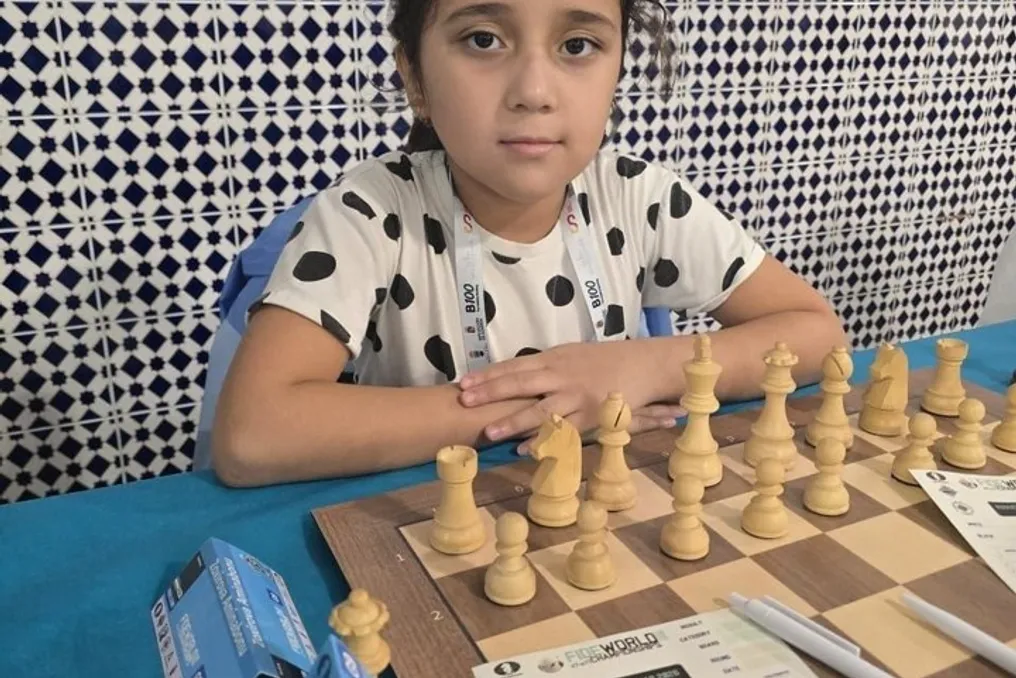
The international success of nine-year-old chess player Aminabonu Zokhirova from Samarkand has drawn attention to how great achievements often begin at a small level. In the world of major sports, the focus is usually on already known winners whose titles are covered by the media, but the article's author finds it unfair that little-known young athletes receive less attention.
The author emphasizes that all champions once started with their first steps at the chessboard in early childhood, and this initial stage lays the foundation for future successes. Therefore, in the author's opinion, the stories of small athletes, even those captured in short news reports, deserve much more coverage.
At the beginning of this week, the II International Chess Tournament 'President's Cup of the Republic of Tajikistan' was held in Dushanbe, the capital of Tajikistan. Among the participants in this event was nine-year-old chess player Aminabonu Zokhirova from Samarkand. At this age, many children are still mastering school discipline, but this girl represented Uzbekistan in international competitions.
Aminabonu participated in rating group B, intended for players with a rating below 2200. The tournament was conducted using the Swiss system over nine rounds, and her opponents were diverse, including more experienced and older players. Following the competition, the Samarkand chess player scored five points out of nine possible, becoming the best among girls under ten years old.
Aminabonu's initial rating in the International Chess Federation (FIDE) was 1584 points, but her tournament performance reached 1782. Performance reflects the level of play shown in a specific tournament, taking into account the strength of the opponents. Thus, in this tournament, Aminabonu demonstrated a level of play corresponding to a significantly higher standard than her initial score.
For her successful performance, she received a special cup, a diploma in the category 'Best result among girls under 10 years old,' and a monetary reward of 200 dollars. The author notes that in this case, the main value lies not in the money, but in the recognition of her worthy performance on the international stage.
This is not Aminabonu's first success. In October of the same year, she participated in the World Chess Championship for Children and Youth, held in Spain, representing the Uzbekistan national team. There, she won fifth place among girls under nine years old.
The author calls for this result to be evaluated more broadly than just a line in a protocol. Participating in a world championship requires not only knowledge of the rules or the ability to build beautiful combinations, but also composure, patience, concentration skills, and the ability to accept and take responsibility for one's own decisions. Furthermore, it is crucial to learn how to cope gracefully with defeats.
Chess, like life, teaches that not every calculated move leads to the desired outcome; sometimes it is necessary to retreat or admit a mistake. This is why chess is called a school of thinking, and the author adds that it is also a school of character. Two recent international performances by Aminabonu deserve attention: she became the best in her age category in Dushanbe, and a month earlier, she took fifth place in Spain.
Although one cannot predict a child's sporting future, it is evident that Aminabonu has proven her ability to compete internationally. This success requires not only congratulations but also attention to the conditions of her further development: who trains her, how the preparation is organized, and what opportunities there are to play against stronger opponents.
The author emphasizes that behind every child's victory is enormous effort—the child, parents, coaches, and all helpers, about whom people remember much less than the winners themselves. It is extremely important not to miss the moment when a child's abilities are just beginning to emerge.
Supporting talent means not just praising and taking photos, but creating conditions for long-term mastery improvement. The author is particularly pleased that Aminabonu is from Samarkand—a city known for its science and culture. He believes that the names of such children should become known to the general public, not just a narrow circle of specialists.
In the author's opinion, sports journalism should more often talk about such children, delving not only into results but also into the process: how the child started playing, who noticed their abilities, how much time they dedicate to the game, and what they enjoy besides chess. This can inspire other children and encourage parents to pay attention to their children's inclinations.
It is important to notice a child's inclination in time, support it, but not turn the hobby into a heavy obligation, allowing the child to enjoy their favorite activity. Aminabonu Zokhirova is only nine years old, and she has a long road ahead. It is hoped that her recognition will not only be linked to another success but also accompanied by the support of people who help preserve her happy childhood, as chess victories should not define the entire value of a child.
In conclusion, the author urges us to recall November 2026, Dushanbe, nine games, and the cup received for the best result among girls under ten years old. After all, great victories often begin not with fanfare, but in silence, with the first independent move on an ordinary chessboard.