Significant changes are being observed in the labor market of CIS countries, characterized by a decrease in the unemployment rate. According to data from the All-Union Confederation of Trade Unions, which unites all states of the Commonwealth, this key indicator fell from 3.4% to 3.1% between 2024 and 2025. The decline occurred in all countries, with each country seeing a reduction of between 0.1 and 0.7 percentage points in the previous year.
Analysis of multi-year data shows a steady trend of decreasing unemployment in most countries of the region over the past five years. The most impressive transformations have been recorded in Uzbekistan and Kyrgyzstan. In Uzbekistan, the unemployment rate dropped more than twofold over the five-year period, falling from 10.5% to 4.8%, which is the largest step compared to other CIS countries. In Kyrgyzstan, the indicator decreased from 5.8% to 3.2%.
Russia and Belarus maintain their leading positions due to minimal unemployment rates. In Russia, unemployment decreased from 5.8% in 2020 to 2.2% by 2025, while in Belarus it fell from 4% to 2.5%.
The situation remains more complex in the South Caucasus region: in Armenia, the indicator reaches a maximum of 12.8%, and in Azerbaijan—5.2%. Kazakhstan demonstrated a more moderate rate of reduction: unemployment fell from 4.9% in 2020 to 4.6% last year, while the situation remained stable for three years, from 2020 to 2022.
The issue of unemployment in post-Soviet states holds great social significance. In the first half of 2026, the total number of unemployed people in CIS countries reached 3.8 million. Summary reports from the All-Union Confederation of Trade Unions allow for a comparison of data on those registered with national employment services in June of the current year; their total number exceeded 1 million people.
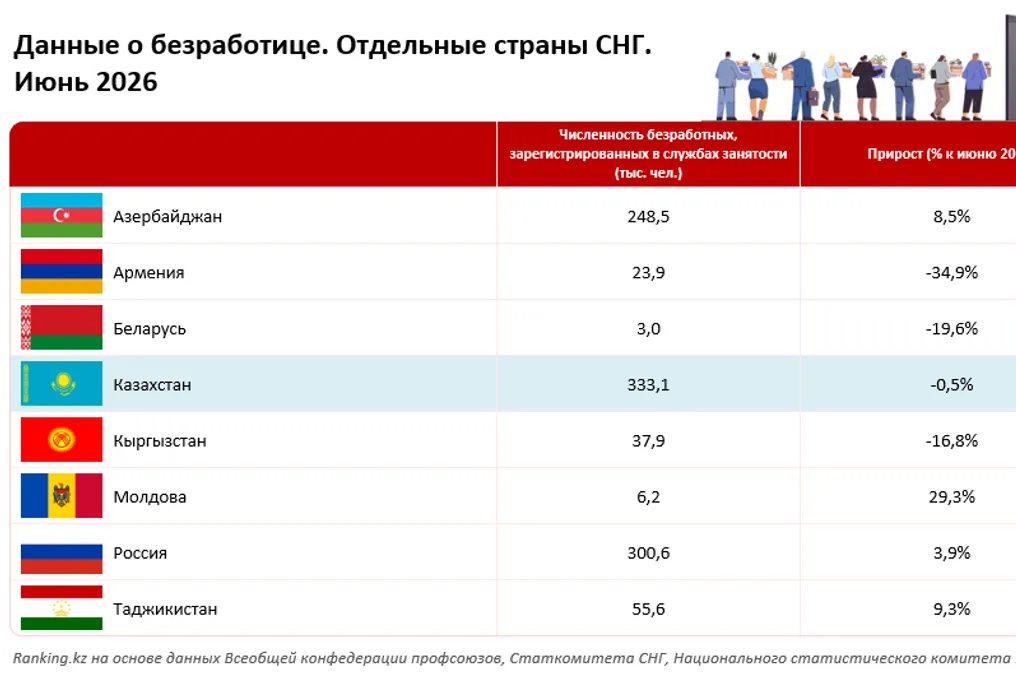
According to the source, the highest number of unemployed was recorded in Kazakhstan—333.1 thousand people, which is 0.5% less than in June 2025. A high number of unemployed was also noted in Russia: in the Russian employment services in June of the current year, 300.6 thousand people held this official status, which is 3.9% more compared to June 2025. Azerbaijan also entered the top three Commonwealth countries with the highest number of registered unemployed—248.5 thousand people, which is 8.5% more than the previous year.
Three CIS countries attracted attention due to a significant reduction in the number of unemployed over the year. Specifically, in Armenia, this number decreased by almost 35%, amounting to 23.9 thousand people. Kyrgyzstan also saw a noticeable reduction—by 16.8%, down to 37.9 thousand people. Belarus turned out to be the country with the fewest registered unemployed in June, only about 3 thousand people.
It is important to understand that the official number of unemployed differs from the total number of people without work, as the unemployed status is assigned only after official registration with the state employment service. This difference is critical because only this status grants the right to receive benefits. Data from the All-Union Confederation of Trade Unions for June 2026 illustrates the differences in the approaches of national systems to dealing with the unemployed.
In most CIS countries, only a few of the officially registered applicants receive benefits. Russia leads in coverage, where in June of the current year, payments were assigned to 77.4% of the unemployed registered. Moldova is second, with a large margin—51.1%. The statistics are different in the other Commonwealth countries: in Azerbaijan, 2.2% of registered unemployed received benefits, in Tajikistan—3.5%, and in Kyrgyzstan—only 0.1%. Data for Kazakhstan is unavailable due to the peculiarities of the national system. In the Republic of Kazakhstan, social payments are available to those who lost their jobs, provided they participate in mandatory social insurance and are registered with the employment service as job seekers. The payment amounts in 2026 ranged from a minimum of 26.8 thousand tenge ($59.1 USD) to a maximum of 348.1 thousand tenge ($768.4 USD).
Financial conditions for supporting the unemployed in Russia depend on seniority, earnings, reason for dismissal, region of residence, and age. As of February 1 of the current year, the minimum benefit amount in the Russian Federation is $25.3 USD, and the maximum is $216.1 USD. For the other countries, data on the average social payment amount is provided. The highest amounts were recorded in Moldova ($281.8 USD) and Azerbaijan ($249.9 USD), while the average payment in Belarus is only $11.6 USD, making this support a formality.