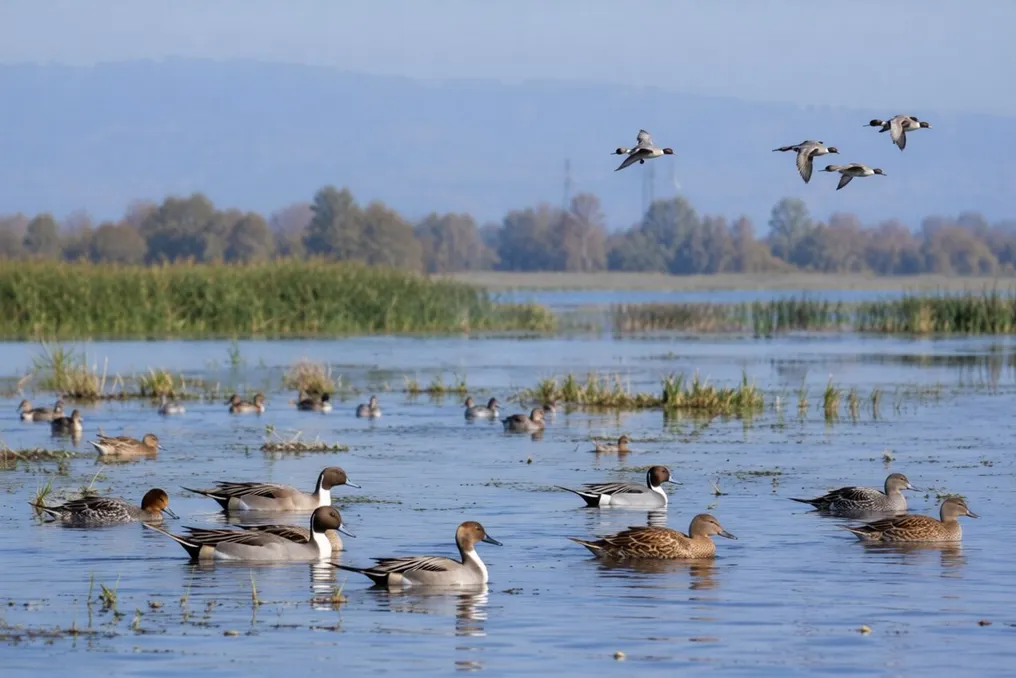
Foreign guests gathered in Priyaganj from seven seas, and Siberian birds brought life to the banks
Read more
Aaj Tak
www.aajtak.in

Foreign guests gathered in Priyaganj from seven seas, and Siberian birds brought life to the banks

In the city of Priyaganj, known as the city of faith, a unique combination of spirituality and nature is currently observed. With the onset of winter, thousands of migratory birds from Siberia and other cold countries have traveled thousands of kilometers to reach the banks of Sangam.

These white birds arrived at the confluence of the Ganges, Yamuna, and the invisible Saraswati in search of a favorable environment and vast water spaces, which has made the banks lively.

Pilgrims and tourists visiting Sangam for bathing and walks kindly feed these foreign guests. The presence of birds is seen everywhere—from the banks to the boats, attracting people's attention. People on the boats photograph and film with these birds circling around them. From children to the elderly, everyone shows enthusiasm to spend peaceful moments with these bird guests.

Every year during the winter season, thousands of migratory birds head to Priyaganj. The favorable climate and the vast water space of Sangam serve as a safe refuge for these birds. This is why the appearance of these foreign guests multiplies the beauty of Sangam. Their melodious singing and chirping grant people coming to the banks a feeling of peace and tranquility.

A crowd of tourists and local residents gathered on the banks of Sangam enjoys this natural festival. A young woman Vaishnavi, tourist Sunita Singh, and young man Vinay Yadav, who came for a walk, among others, witness this picturesque spectacle. These chirping birds have added splendor to the atmosphere of Sangam. Anyone who comes to Sangam does not want to leave without capturing this unforgettable sight on their mobile phone or camera.

Similar stories

11.6 million tourists arrived in Uzbekistan; five leading donor countries identified
Read more
sputniknews.uz

11.6 million tourists arrived in Uzbekistan; five leading donor countries identified

Over ten months, 11.6 million foreign tourists arrived in Uzbekistan. A significant portion of these visitors came from neighboring countries, with the number of tourists from Russia exceeding 1.1 million people.

According to data from the National Statistical Committee, 11,622,103 foreigners arrived in Uzbekistan for tourism purposes between January and October 2026. This figure exceeds the same period last year by almost 1.9 million people, which is an increase of 19.4 percent.

Neighboring countries made the main contribution to the tourist flow. In particular, over 8.4 million people arrived from Kyrgyzstan, Kazakhstan, and Tajikistan.

The number of tourists from Russia also exceeded the mark of 1.1 million people. This figure is higher than that for all 12 months of 2025. Last year, 984.4 thousand tourists arrived from Russia to Uzbekistan.

The combined contribution of these five countries accounts for almost 86 percent of the total number of foreign tourists who visited Uzbekistan.

Iran is a vital wintering ground for millions of migratory birds
Read more
www.tehrantimes.com

Iran is a vital wintering ground for millions of migratory birds

Every year, as temperatures begin to drop in northern Eurasia, millions of migratory birds embark on long journeys in search of warmer regions where they can find food, shelter, and suitable wintering grounds. As part of this remarkable natural route, Iran stands out as one of the most important destinations in West Asia, providing a network of wetlands, lakes, coastal habitats, and lagoons for birds traveling from Siberia and other northern areas.

According to statistics, approximately two million migratory birds arrive in Iran annually to spend the winter in the country's wetlands, making it the most significant wintering site in West Asia. Furthermore, the country serves as a major stopover point on the migration route connecting Siberia with the Nile; about 16 percent of birds following this route choose Iran as their wintering location.

More than 160 species of aquatic and coastal birds have been identified in the country, highlighting Iran's importance for the conservation of regional and international biodiversity. These birds are distributed across approximately 450 wintering sites, particularly along the coasts of the Caspian Sea and the Persian Gulf.

The Country on Major Migration Routes

Iran's geographical position, linking Central Asia, the Caucasus, and the Indian subcontinent, has made it a crucial link in international bird migration routes. The country's diverse climate and geographical features provide various habitats for migratory species throughout the year. From wetlands and lagoons on the Caspian coast in the north to the marshes of Khuzestan and the coastal ecosystems of the Persian Gulf in the south—these natural areas offer necessary feeding and resting spots for birds undertaking long flights.

The Caspian Sea coast holds particular significance in autumn and winter, when large flocks of waterfowl arrive in the northern provinces of Gilan, Mazandaran, and Golestan. Among the most well-known destinations for migratory birds in the country are the wetlands of Anzali, the Miankaleh Peninsula, Ghomishan, as well as the areas around Fereydunkenar and Sorkhroud.

These habitats attract a wide range of species, including flamingos, pelicans, ducks, geese, swans, and storks. Their shallow waters, reed beds, and surrounding vegetation create suitable conditions for feeding, resting, and, in some cases, breeding. Estimates suggest that the population along the southern Caspian coast can exceed one million birds mid-winter, underscoring the ecological importance of this region.

Wetlands: Vital Habitats for Migratory Species

Among Iran's internationally recognized wetlands, Miankaleh holds particular importance. Located in Mazandaran province along the southeastern part of the Caspian Sea, the Miankaleh Peninsula is a major wintering site for numerous species of waterfowl. Its diverse habitats support flamingos, pelicans, geese, ducks, and other migratory birds.

This area was designated a Ramsar Convention site in 1975 and subsequently received UNESCO Biosphere Reserve status in 1976, reflecting its international ecological significance. Further west, the Anzali wetlands in Gilan province serve as another vital refuge for migratory waterfowl. Their extensive reed beds, freshwater bodies, and rich food resources make this location an important destination for birds arriving from northern regions.

In central Iran, the Mikan wetlands near Arak also represent an important seasonal habitat. According to information published in May 2026, this wetland receives approximately 12,000 migratory birds annually, including species arriving from Siberia. Southern wetlands are no less important. The Hur al-Azim wetlands in Khuzestan, and the Shadegan and Hamun wetlands in southeastern Iran provide habitat for numerous migratory species, especially those following routes toward the Persian Gulf and the Indian subcontinent.

Counting Every Bird, Protecting Every Habitat

Monitoring migratory bird populations is an integral part of conservation efforts. Reliable data on species diversity, population size, and migration routes allows conservation authorities to identify ecosystem changes and develop more effective protection strategies.

In January 2026, a survey of winter waterfowl was conducted in Mazandaran province, registering 54,889 birds belonging to 112 species across 36 sites. This study was part of the International Waterbird Census and involved environmental experts, conservation organizations, volunteers, and local communities.

The results also highlighted the importance of habitat security and the impact of anthropogenic influence on determining bird congregation and wintering sites. During Migratory Bird Day, under the slogan 'Every Bird Matters—Your Observations Count!', it was noted how observations by citizens, bird enthusiasts, researchers, and local communities can contribute to monitoring migration routes and population trends. Such participation is particularly valuable in countries like Iran, where migratory birds utilize hundreds of different locations during their seasonal journey.

Protecting these natural visitors requires coordinated actions, including the restoration of degraded wetlands, ensuring ecological water resources, preventing illegal hunting, reducing habitat disturbance, and strengthening scientific monitoring. Local communities can also play a significant role through public awareness initiatives, responsible ecotourism, and participation in conservation programs. Ultimately, the annual arrival of millions of migratory birds is more than just a seasonal natural phenomenon; it is an indicator of the ecological significance of Iran's wetlands and their connection to ecosystems far beyond the country's borders. Ensuring that these birds continue to find safe places to rest, feed, and winter depends on protecting the wetlands that sustain them. Their future is closely linked to the health of these ecosystems and the commitment to their preservation for future generations.

Navoi Region is Becoming a Popular Tourist Destination Thanks to Unique Natural and Historical Sites
Read more
nuz.uz

Navoi Region is Becoming a Popular Tourist Destination Thanks to Unique Natural and Historical Sites

The Navoi Region is gradually revealing a completely different facet of Uzbekistan to travelers—one that is unique, mysterious, and highly diverse. This region offers an introduction to ancient petroglyphs, a turquoise lake in the desert, caravanserais of the Great Silk Road, and hospitable ethnic villages.

Uzbekistan as a whole is a country where every trip enriches knowledge about a new history, combining Eastern hospitality with age-old traditions. Ancient cities preserve the memory of great civilizations, while natural landscapes amaze with their diversity. Millions of foreign guests visit the country annually, interested in educational, health, sports, and gastronomic tourism.

The tourist map of Uzbekistan is not limited only to Samarkand, Bukhara, and Khiva; every region possesses its own treasures awaiting discovery by the general public. One such region is the Navoi Region, located in the center of the country. Although this region is the largest by area and is known primarily for its industry and contribution to the economy, there is another world hidden behind the industrial facade.

This world includes the vast expanses of the Kyzylkum, ancient rock carvings, historical monuments of the Great Silk Road, the picturesque Aidarkul lake, and small settlements where the traditional way of life is still maintained. Here, one can take a walk in the desert, see traces of ancient civilizations, stay in a national yurt, taste local cuisine, and get acquainted with the culture of the local people. The Navoi Region is transforming into a destination that offers not just an excursion, but a deep immersion into the history, nature, and traditions of the region.

There are places where history is not presented in museum exhibits but is literally carved into stone. Such a place is the Sarmyshsai gorge, located in the Navbahor district of the Navoi Region. Sarmyshsai is famous for numerous petroglyphs, i.e., rock drawings left by ancient inhabitants. These images are of high value to historians and archaeologists as they provide insight into the world thousands of years ago: the occupations of people, their food sources, and the region's animal life.

On the rocks, images of various animals are preserved, including bulls, bison, wild horses, mountain goats, argali, camels, as well as predators such as lions, leopards, and cheetahs. Some compositions are dedicated to hunting, daily life, economic activities, and the rituals of ancient inhabitants. According to available information, about ten thousand rock carvings have been discovered in this area, covering dozens of subjects and thematic images. Most of the drawings were created using stone and metal tools, and over time, their surface has acquired a characteristic dark patina.

Of particular interest are the images of animals that no longer exist in the local nature, allowing one to trace the changes in the region's fauna in the past. In addition to petroglyphs, there are inscriptions in Arabic on the rocks, indicating the significance of this territory in later historical periods. Today, Sarmyshsai is recognized as a state museum-reserve and is considered an important archaeological site and a promising tourist zone.

Malik Khamidovich Mamedov, head of the Sarmyshsai State Museum-Reserve, spoke about the development of the area and the measures taken for visitors. He reported that the reserve was established according to Decree No. 440 of the Cabinet of Ministers of the Republic of Uzbekistan from 2019. After its creation, the main focus was on ensuring conditions for local and foreign tourists. Previously, the road to the gorge was in poor condition, which created difficulties for arrivals. With the support of the republic's leadership, the region, and the Agency for Cultural Heritage, more than twenty kilometers of asphalt road have been repaired. Benches have now been installed in the area, and pedestrian paths of about three kilometers have been developed. Work is underway to install binoculars so that visitors can view the rock carvings without climbing difficult mountain sections. Tourists from Italy, Spain, England, Canada, and other countries visit the reserve, and the management strives to ensure comfort for everyone, especially for elderly guests who find it difficult to move in the mountains.

The total area of the reserve is approximately five thousand hectares, with the most densely petroglyph-covered section stretching along the gorge for about two and a half kilometers. Malik Mamedov emphasized that the stones preserve drawings of ancestors depicting animals, hunting and agricultural tools, crafts, flora elements, and people themselves, and each drawing serves as a testament to the lives of ancient generations. Future plans include the development of tourist infrastructure, including the creation of a 32-hectare tourist center, the development of a master plan, and strengthening measures to preserve cultural heritage.

After studying the ancient rock carvings, the route can continue to one of the most unusual natural places in Uzbekistan—the Aidarkul lake. It is often called a turquoise sea located in the middle of the desert. The sight of the vast water surface surrounded by the sandy expanses of the Kyzylkum makes a strong impression, changing the perception of the desert: instead of endless sands, a lake with beaches, birds, and rich underwater life opens up before the traveler.

Aidarkul is one of the largest lakes in Uzbekistan, located on the border of the Navoi and Jizzakh regions, and is part of the Aidar-Arnasay lake system. Its formation history is unique: in its modern form, the lake appeared in 1969 after a powerful flood on the Syr Darya River. Part of the water was diverted into the Arnasay lowlands to prevent the overflow of the Chardarin Reservoir, which led to the formation of a large body of water among arid desert landscapes.

Over time, Aidarkul has become an important part of the local ecosystem. Its shores serve as a stopping and habitat place for many migratory and waterfowl, such as pelicans, herons, swans, and ducks, as well as rare species listed in the Red Book. The lake is also rich in fish: carp, pikeperch, catfish, bream, and lele inhabit its waters, attracting both leisure enthusiasts and fishermen.

The main advantage of this place is its special atmosphere. Tourists can spend time on the sandy shore, swim in the warm season, watch birds, or simply enjoy the silence broken only by the wind. Trips through the desert, acquaintance with nature, and accommodation in traditional yurt camps are organized for visitors, as well as camel rides. Relaxation here is becoming increasingly comfortable: some camps are equipped with air-conditioned yurts and all necessary amenities.

Historical and natural attractions are only part of the region's tourism potential. Currently, the Navoi Region is actively working on developing infrastructure, creating new routes, and attracting investment in the tourism sector. The region aims to increase tourist flow to six million people within the next two years, including attracting up to one million foreign guests.

The scale of development is reflected in statistics: since the beginning of 2026, over three million tourists have visited the region, of which 551 thousand are foreign citizens. Over the last five years, the number of foreign tourists has increased 21 times, and domestic tourists by 2.5 times. Over nine years, 355 hotels and guesthouses have been built in the region, leading to a 20-fold increase in the hotel fund. Currently, 373 accommodation facilities with a total capacity of 9,348 places and 106 tourism organizations are operating.

By the end of 2027, it is planned to open another 120 accommodation facilities, as well as create about 30 new tour operators and travel agencies. One of the key projects will be the 'Ancient Karmana' tourist center with an investment cost of 100 billion soms. This project involves the reconstruction of Karmana Street, spanning 2.4 kilometers, in an ethnic style and the integration of historical monuments, a market, and recreation areas into a single tourist route. The Kosim Shaykh complex will occupy a special place in this route, some structures of which date back to the 16th century.

The Karman district also preserves evidence of the Silk Road era, such as Rabat-i Malik—an architectural monument from the 11th century, built during the reign of Shams al-Mulk Nasir of the Karakhanid dynasty. Initially, this complex served as a fortified residence for rulers and later turned into a caravanserai.

Popular