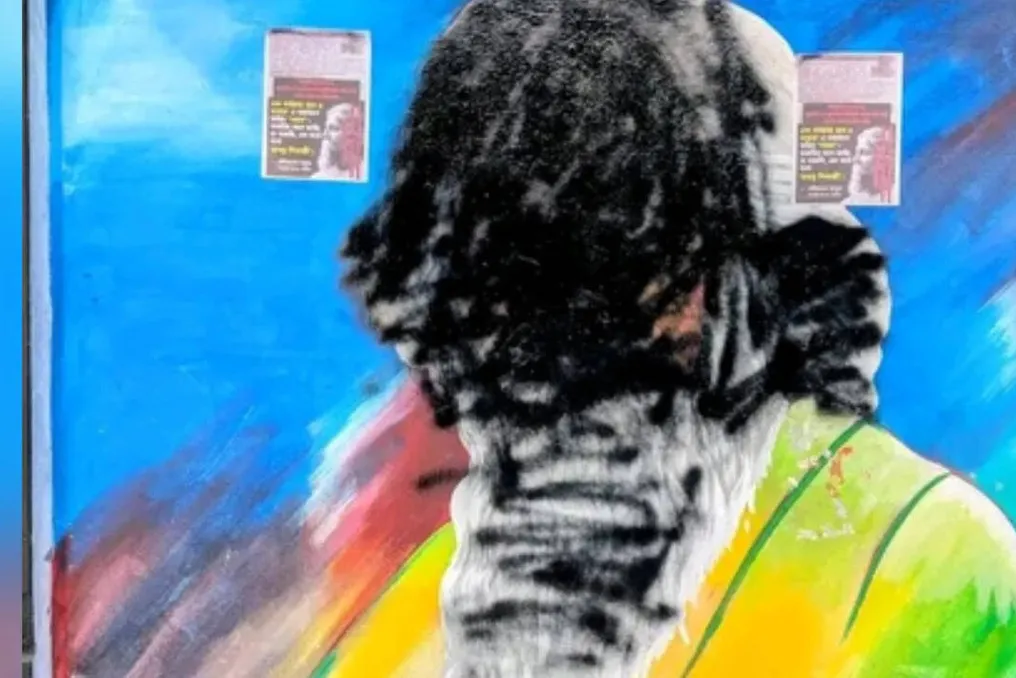
In the city of Khulna, Bangladesh, a portrait of Nobel laureate Rabindranath Tagore was defaced with black paint. Alongside it, posters were placed condemning his place in the country's cultural heritage.
This incident drew criticism from local officials and cultural activists, while the police began an investigation. The mural was painted on the fence of the Khulna railway station and was part of a series of portraits of prominent figures from the fields of art, literature, and regional cultural history. Portraits of other figures on the same wall remained untouched.
Among those depicted were folk singer Fakir Lalon Shah, artist SM Sultan, poet Qazi Nazrul Islam, former Prime Minister Khaled Zia, former President Ziaur Rahman, and writer Michael Madhusudan Dutt. The wall was also decorated with paintings depicting the July uprising, Sundarbans, the Six Dome Mosque, and Bangladesh's textile industry. The artworks were commissioned by the Khulna City Corporation (KCC) before the visit of Prime Minister Tarique Rahman.
Calls to Exclude Tagore from Bangladesh's Cultural Heritage
Residents discovered the damage on Friday morning. Two posters were placed next to the mural, one of which contained a direct message against Tagore and his connection to India. The poster read: 'No place for Tagore who was hostile to Muslims and East Bengal, in Titumir Bengal. No place for glorifying India.' This message expressed disagreement with honoring Tagore in Bangladesh, portraying him as hostile to Muslims and East Bengal, and opposing what was described as the glorification of India.
Police Launch Investigation
The head of the Khulna Sadar Police Station, Lokman Hossain, reported that the police received information about the vandalism on Friday afternoon and started an investigation. According to Hossain, quoted by Dhaka Tribune, 'all businesses across the street were closed on Friday, which made it difficult to determine who and when the mural was damaged.'
KCC Administrator Nazrul Islam Mandju condemned the act, noting that the portraits were intended to encourage independent thinking among children and adolescents. The publication quotes him, stating that 'by damaging the portrait, they exposed their narrow-mindedness and sick mentality.'
Cultural activist Shariful Islam Salim, Secretary General of Nattyalok, suggested that an organized group was behind the incident. He stated that similar actions had occurred in Dhaka and warned that other famous personalities could become targets. Salim added that Tagore's works and philosophy encouraged generations to embrace free thought, secularism, and human dignity.
The vandalism in Khulna occurred several weeks after Tagore's mural was attacked in the capital of Bangladesh, Dhaka, in October. According to The Daily Star, in connection with that incident, the police detained four people, including Al Nur Mohammad Ayasha, a member of the Forum for Public Dialogue Secretariat.