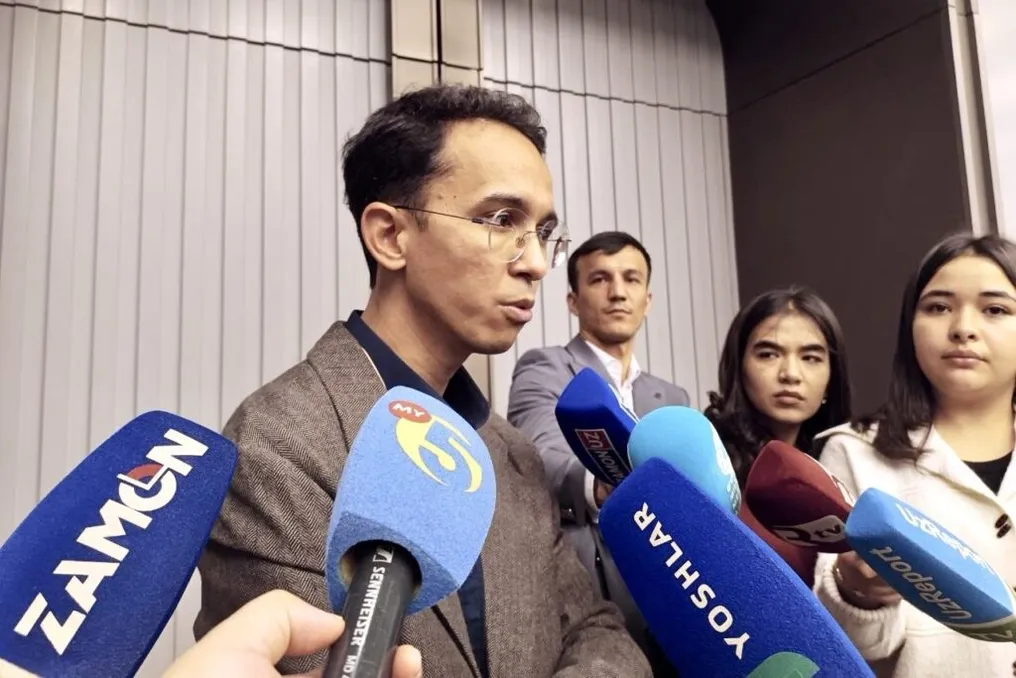
On November 2 in Tashkent, the official presentation of the first stage of the project 'National Study of Media Consumption in Uzbekistan' took place. This project was implemented with the participation of the Public Foundation for Support and Development of National Mass Media, the European Union Delegation to Uzbekistan, the Center for Content Preparation for Mass Media under the Presidential Administration, and the Republican Center for Public Opinion Research 'Ijtimoiy Fikr.'
The survey ran from September 8 to 19 and was conducted in the format of personal interviews at people's places of residence. A total of 1411 people from 14 regions of the country participated, all aged 18 or older.
The Director of the Mass Media Foundation, Zhakhongir Azimov, emphasized that the research results provide a general picture of the republic's media space, covering television, radio, print, and online media. He noted that analyzing indicators by age, gender, place of residence, and media consumption habits requires close attention, and expressed hope that the collected data will be an important step toward understanding public media habits, although he acknowledged the need for more detailed studies in each area.
The main conclusion of the monitoring is that the audience is not a passive group simply receiving information; on the contrary, it actively participates in media processes, independently chooses sources, compares the information received, and determines the topics that interest them.
The study demonstrated that both youth and the older generation show high interest in news and socio-political agendas. 50.4% of the population follows news about events in Uzbekistan, and another 30.4% is interested in them periodically. Furthermore, respondents do not limit themselves to a single source of information.
Telegram has become one of the key channels for receiving news, followed by television and social networks. However, in terms of trust, television leads, trusted by 44.3% of respondents. Telegram is trusted by 11.3%, and news websites by 7.4%. Among television channels, O’zbekiston 24 commands the highest trust.
Radio, printed newspapers, and official government websites showed significantly lower levels of trust.
An important finding was the absence of differences in information preferences between residents of the capital, regional centers, and rural areas. In some regions, interest in news was even higher than in Tashkent. Additionally, rural residents are more likely than urban residents to express doubts about the reliability of materials published by online publications.
People are concerned not only about world and domestic events but also about issues related to their daily lives, such as income levels, employment, social support, prices, health, and child-rearing.
The main threat identified by the respondents is fake news. In their opinion, false information is most often spread through YouTube, Telegram, and social networks. 70.4% of respondents supported the idea of tightening responsibility for spreading inaccurate information.
Renata Vrabel, Acting Chargé d'Affairs of the European Union Delegation to Uzbekistan, noted that the study's findings can help identify information gaps, strengthen society against disinformation, and improve interaction between citizens, media, and institutions. A series of trainings and events aimed at increasing audience understanding and more effective communication using reliable content are planned following this study.
The results of the first stage of the national study of media consumption in Uzbekistan form a comprehensive view of the country's modern media environment, showing how accounting for audience interests and habits affects the media's ability to adapt, counter disinformation, and maintain professional standards.