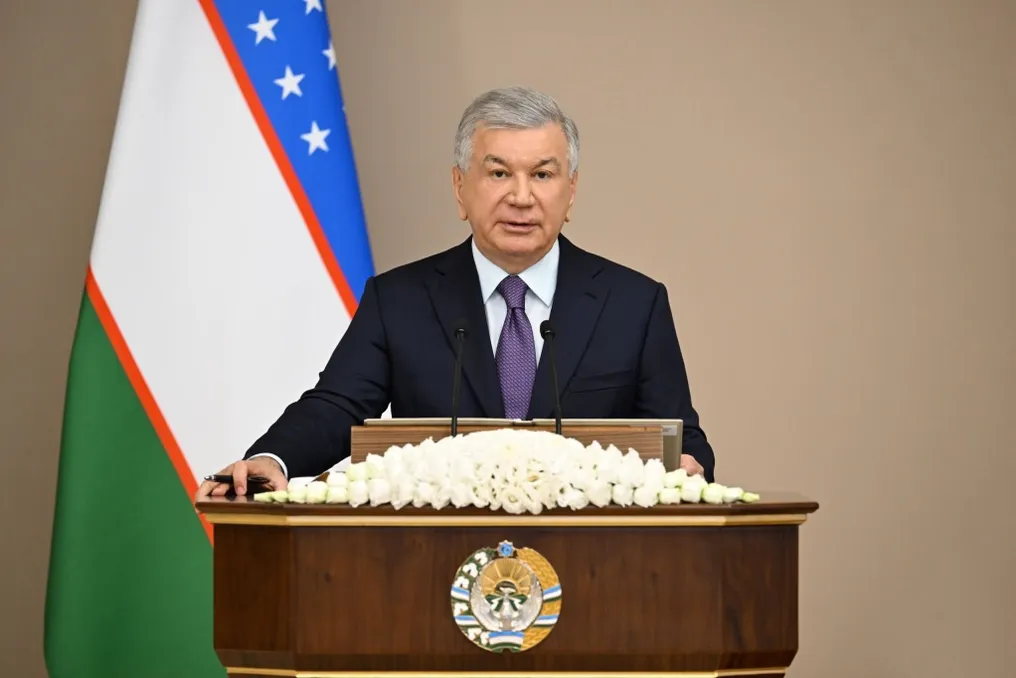
President of Uzbekistan announced the transfer of citizen employment abroad to private agencies by 2027
Read more
Gazeta.uz
gazeta.uz

President of Uzbekistan announced the transfer of citizen employment abroad to private agencies by 2027

President Shavkat Mirziyoyev announced at a meeting on November 2nd plans to fully transfer the functions of directing citizens to work abroad to the most reliable private employment agencies starting in Uzbekistan in 2027.

According to the president, over the past two years, thanks to the simplification of licensing procedures for private employment agencies, their number has tripled, and the number of citizens who found jobs abroad through such structures has increased fivefold.

Nevertheless, Mirziyoyev emphasized that problems have arisen in this area, including cases of fraud and corruption among citizens. Previously, a special law was adopted to eliminate these shortcomings, regulating the activities of private employment agencies.

According to the stated intentions, by 2027, all functions for employing citizens abroad will be fully delegated to the most reliable private agencies. To encourage their work, a payment of 1.5 million soms is provided for each person successfully employed in a high-paying position.

In addition, private agencies are planned to be provided with free rent of part of technical school premises for professional and language training of citizens. It is also proposed to introduce a social tax rate of 1% for teachers and experts invited from abroad, and equipment necessary for training will be exempted from customs duties.

The activities of these agencies must be conducted within a transparent system that includes a rating system. The main parameters for evaluation will be the actual employment of citizens, ensuring their rights, the level of salary received, and the availability of guaranteed social protection.

The President instructed that a draft resolution detailing the further reform of the work of private employment agencies be submitted within a month. The possibility of recognizing this activity as a social service with subsequent simplification of the tax regime is also being considered.

It has not yet been determined how the powers will be divided between private agencies and the state Migration Agency after the proposed transfer of functions.

In Uzbekistan, the activities of private employment agencies are regulated by a law adopted on October 16, 2018. These organizations are obliged to have the corresponding license to provide employment services abroad.

A new law was adopted in November 2025, which tightened requirements for these agencies and expanded their competencies. In particular, they were allowed to conduct language and professional courses, as well as cooperate with foreign employers.

To increase client protection, additional financial guarantees were introduced: private agencies are now required to place a deposit of 4000 basic calculation units in a special bank account, the funds of which can be used to compensate citizens for damages.

In October 2026, the Migration Agency published the results of the assessment of private employment agencies for the third quarter. Out of 47 inspected organizations, 40 received an unsatisfactory rating, four received a satisfactory rating, and three received a good rating; none reached the 'exemplary' category.

The assessment was carried out based on 11 different indicators, including employment results, contract registration, preparation of citizens for travel, compliance with legal norms, and the number of complaints received.

The rating system has been operating since 2025, but the Migration Agency emphasized that the rating only reflects the results for a specific period and does not serve as confirmation of a license or a guarantee of service quality.

Previously, on October 12, the leadership of the Migration Agency met with representatives of private agencies to discuss citizen complaints regarding delays in service provision, non-fulfillment of contract terms, and difficulties with fund refunds in case of unsuccessful employment. The agency demanded that all contracts and employment data be registered in the Xorijda ish system, that deposit guarantees be provided, and that citizens be adequately prepared for departure.

Similar stories

Mirziyoyev demanded strengthening the work of ambassadors on employment for Uzbek citizens abroad
Read more
podrobno.uz

Mirziyoyev demanded strengthening the work of ambassadors on employment for Uzbek citizens abroad

President Shavkat Mirziyoyev instructed to review approaches to organized labor migration and intensify the preparation of citizens of Uzbekistan for high-paid foreign positions. He noted that despite expanding partnerships with foreign employers, ambassadors, hokims, and technical school directors are not effectively utilizing the potential of global labor markets.

On November 2, the head of state visited the international center for language and profession training 'Intil' in the Uchtepinsky district of Tashkent, after which a meeting was held dedicated to priority tasks in the field of labor migration. During this meeting, Mirziyoyev emphasized current trends in the global labor market.

According to him, currently, 168 million people are employed abroad, and given the presence of citizens in Uzbekistan who wish to work abroad, as well as high demand for labor in other countries, the main goal is to combine these resources.

The geography of organized labor migration of Uzbekistan has significantly increased in recent years—from three to twenty-seven countries, and the number of major foreign employers cooperating with the republic has approached four hundred. Nevertheless, over the last decade, the number of Uzbek citizens working abroad has halved, although the volume of remittances to their families has increased fourfold. The President interprets this as a sign that citizens are increasingly going to earn money not as low-skilled workers, but as trained specialists.

Differences in migrant incomes by region

The unevenness of remittances per working individual abroad was also discussed at the meeting. The highest income was recorded in the Fergana region—$1,850 monthly. In Karakalpakstan and Tashkent region, this figure is about $400, in Syrdarya region—$500, and in Jizzakh and Navoi regions—$600. In Surkhandarya and Khorezm regions, the amount does not exceed $700.

In light of this, Mirziyoyev pointed to the need to revise the activities of hokims, ambassadors, and technical school directors to prepare citizens for obtaining higher-paid vacancies abroad. The head of state stressed that workers must be aware in advance of the working conditions, salary size, and guarantees for the protection of their rights.

Need for active utilization of external market demand

Mirziyoyev also stressed the importance of closer interaction between ambassadors, regional hokimiyats, and technical schools in finding foreign partners and employing citizens. Germany, Turkey, Slovakia, and Qatar were named as successful examples of cooperation where contacts with professional educational institutions were established. At the same time, the president noted the insufficient activity of some ambassadors in this area.

The prospects for the employment of Uzbek citizens in European Union countries were discussed. The EU has included the issue of attracting specialists from Central Asia into its migration policy for the first time. However, in the president's opinion, the potential this opens up is not being fully utilized. For example, there is a need for 33 thousand workers in Great Britain, but Uzbeks are mainly sent for temporary agricultural work. Agreements with employers in the medical, logistics, and industrial sectors, as well as participation in the 'Youth Mobility' program, remain incomplete.

The situation is similar with Italy: despite agreements reached to expand cooperation in labor migration, existing opportunities are not fully realized.

Importance of foreign language skills for high wages

Another aspect of the meeting was the language training of the population. Mirziyoyev emphasized that knowledge of foreign languages is a key requirement for obtaining well-paid work abroad. About 200 thousand young people in Uzbekistan have undergone quality English language study and received the necessary certificates. However, the opportunities for their employment in countries such as the USA, Canada, Australia, New Zealand, Sweden, and Denmark are not being fully utilized. The president called for the more active creation of conditions for these citizens to work in the mentioned countries and for strengthening ties with foreign employers.

Popular