A ceremony was held in the Piskent district of Tashkent region to launch new intelligent nurseries. This complex was created as part of a project called 'Greening of forest and urban territories of Tashkent region based on intelligent technologies.'
The implementation of this project is carried out by the Forestry Agency under the Committee for Ecology with the support of the Korean Agency for International Cooperation (KOICA) representative office in Uzbekistan.
Attendees at the event included Golibjon Kurbonov, Deputy Director of the Forestry Agency; Won Do Young, Extraordinary and Plenipotentiary Ambassador of the Republic of Korea to Uzbekistan; Abdushukur Khamzaev, head of the Environmental Party of Uzbekistan faction in the Legislative Chamber of the Oliy Majlis; as well as representatives from the Committee for Ecology and the Forestry Agency, KOICA experts, officials of the Piskent district hokimiyat, heads of local state forestry enterprises, and media representatives.
Golibjon Kurbonov, speaking at the opening, emphasized that in recent years, the head of state has initiated significant work to increase green zones and create new forest areas in the country.
He noted that a modern seedling production center capable of releasing millions of high-quality seedlings annually was previously launched in the Guzar district of Kashkadarya region. Furthermore, this year, a complex of intelligent nurseries covering an area of 5.5 hectares was established in Andijan region. These facilities are designed to advance the national program 'Yashil maqon' ('Green Space') to a new level.
The nurseries being commissioned in the Piskent district are seen as a natural development of these positive initiatives. Golibjon Kurbonov expressed gratitude to the government of the Republic of Korea, KOICA, and all partners for their contribution and support in creating this modern complex.
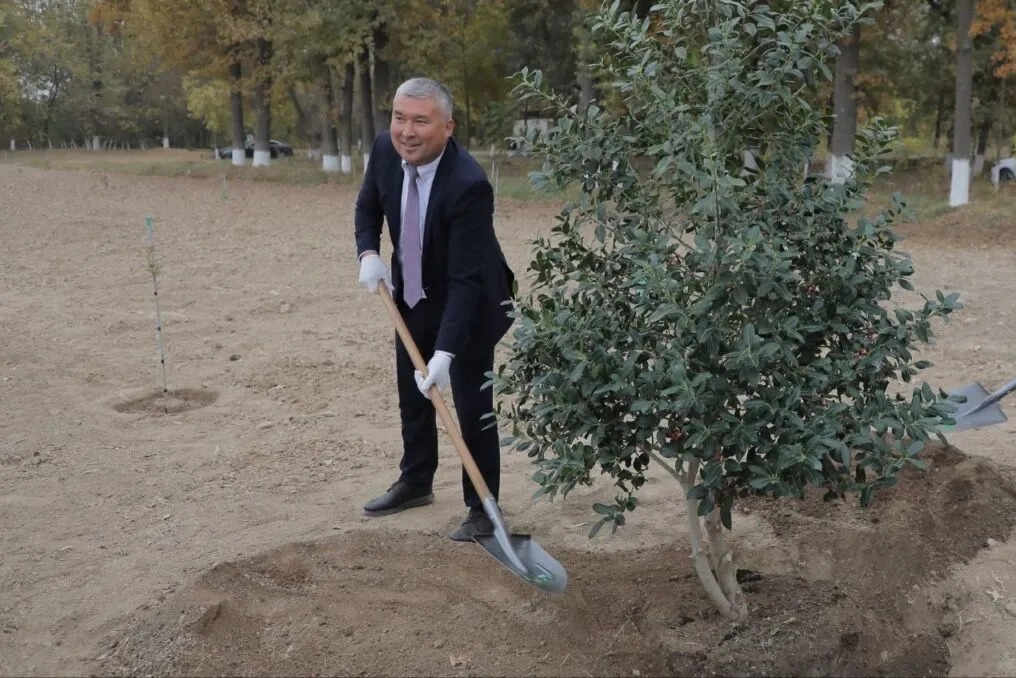
During the official part of the event, a memorial stone dedicated to the creation of the nurseries was unveiled, after which guests planted trees in memory of the event. Participants also inspected the infrastructure and operations of the nurseries.
The project, jointly with KOICA, is planned for the period from 2024 to 2028 and is valued at 7.7 million US dollars. The complex is located on the territory of the Dungkurgon site of the Tashkent State Forestry, which is engaged in growing planting material. It includes 14 intelligent greenhouses covering a total area of 7 hectares.
The greenhouses are equipped with automated systems for continuous monitoring of the internal environment, ensuring ideal conditions for cultivating high-quality planting material that meets the local climate. Growing seedlings using intelligent technologies is critical for improving forestry, increasing production efficiency, and fulfilling tasks related to climate change adaptation.
Within the framework of the project, training seminars are conducted on grafting and the introduction of modern agro-technologies for seedlings adapted to local conditions. The project's implementation will also help increase the use of existing forest infrastructure, create new jobs, and expand opportunities for propagating various species of trees and shrubs.
The modern complex will allow for the production of large volumes of planting material, supply forestry enterprises with quality seedlings, form new green zones in the republic, engage in reforestation, and prevent desertification of arid lands.
According to Korean experts, the greenhouses using modern technology have several advantages. One of the key ones is significant water saving due to the use of advanced equipment. Seedlings are grown in special containers rather than directly in the soil, allowing for the production of transplant-ready material in an average of one year. Automation reduces the need for manual labor, as all operations are managed by specialized software, guaranteeing the quality development of the seedlings.
Furthermore, seedlings grown in containers under these conditions are significantly easier to transport and plant in mountainous areas, which also leads to reduced costs.
For reference: in the first nine months of the current year, forestry enterprises under the Forestry Agency system collected 1,100 tons of seeds of trees and shrubs. 101.6 million seedlings and saplings adapted to local soil and climatic conditions are under care across an area of 1,035 hectares. The technologies implemented in the Piskent nursery allow for rational use of water resources, control of growing conditions, and improvement of planting material quality. It is planned to disseminate this advanced experience to other forestry enterprises in the republic.