
ANPD publishes guide explaining obligations of technology companies under the Digital ECA for online child protection
Read more
Olhar Digital
olhardigital.com.br

ANPD publishes guide explaining obligations of technology companies under the Digital ECA for online child protection

The National Data Protection Authority (ANPD) released a guide on Wednesday (28th) aimed at clarifying the responsibilities of technology companies regarding the safeguarding of children and adolescents on the internet. This material specifies which services must adhere to the Digital Child and Adolescent Statute (ECA Digital) and what measures must be implemented to mitigate dangers in the virtual space.

The guidelines cover a wide range of services, including social networks, messaging applications, electronic games, video platforms, app stores, operating systems, and e-commerce platforms. It is important to note that the application of these rules is not limited only to products developed for minors; general public services may also be covered if there is a possibility of access by children and adolescents.

The guide aims to elucidate the application of Law No. 15.211/2025, which established the Digital ECA, providing criteria for companies to recognize their obligations. This legislation came into effect in March 2026.

According to the ANPD, the protection of this demographic group must be integrated into both the development process and the operation of digital services. This implies that companies have a duty to proactively identify and reduce risks, rather than only reacting after an incident occurs.

A fundamental concept presented in the guide is that of 'probable access.' This definition allows for the inclusion of services that were not specifically designed for children and adolescents but possess attributes capable of attracting this audience and exposing them to significant risks.

The analysis takes into account three primary aspects. For example, an application may declare itself exclusive to adults, but if it offers videos, games, rewards, or forms of interaction that attract teenagers, the company's claim will not be sufficient to exempt it from the law's application.

The agency has the prerogative to analyze the actual characteristics of the service to define the applicability of the obligations. Furthermore, the ANPD clarifies that implementing age verification methods does not automatically nullify the other responsibilities stipulated in the law.

The guide emphasizes the need for efficient age verification mechanisms. A mere declaration of the user about their age or a notice in the terms of use is not sufficient to prove that the company fully complies with its obligations.

App stores and operating systems also have specific duties. One of these duties is to provide developers with information about the age range of users, assisting them in applying appropriate protective measures.

However, these mechanisms must always respect privacy. Age verification cannot be used as justification for collecting documents or personal data that exceeds what is strictly necessary.

Another crucial requirement is the adoption of more protective privacy settings by default. For children's and adolescents' accounts, companies must prioritize measures that minimize data exposure and inherent risks associated with platform use.

The guide also addresses restrictions on using minors' personal data for behavioral advertising purposes, in addition to requiring that data collection be limited to what is essential for the service's operation.

The duty of prevention is a central point highlighted by the ANPD. Companies must identify potential threats, measure the chance of harm, and implement actions to prevent or reduce such risks. Responsibility does not cease with the installation of a security tool; providers must also monitor the effectiveness of these measures and make adjustments when necessary.

Among the required actions are presenting terms of use and privacy notices in language that is simple, clear, and understandable to the youth audience. Platforms must also provide reporting channels and resources so that guardians can report risk situations.

The intention is to change the companies' approach: instead of relying solely on reports and subsequent corrective actions, protection must be considered from the product conception phase throughout its operational cycle.

The guide establishes that responsibilities will be assessed according to the specifics of each service, its size, the volume of users, and the company's capacity to influence the content and interactions offered. This allows for a proportional application of the law, without deviating from the main objective of protecting children and adolescents.

The ANPD also highlights the importance of the active participation of the companies themselves in complying with the regulations. Providers must be able to demonstrate that the adopted measures are effective and consistent with the risks of their products.

The publication serves to guide how the authority intends to conduct the application of the Digital ECA obligations. The document was improved based on contributions obtained during a public consultation held between April and June 2026, and includes practical examples, tables, and a flowchart to assist companies in identifying legal classification.

In summary, the guidance reinforces that the safety of minors on the internet cannot depend exclusively on family surveillance or voluntary initiatives by platforms; companies must also assume responsibility for the safety of the environments they build and manage.
Similar stories

Network Readiness Index: Kazakhstan Leads Central Asian Countries in Digital Development
Read more
nuz.uz

Network Readiness Index: Kazakhstan Leads Central Asian Countries in Digital Development

Digital technologies are integrating into all spheres of the economy and daily life, including the internet, e-government services, digital payments, and modern means of communication. The level of a state's digital progress depends not only on the availability of technologies but also on the capabilities of the population and businesses, as well as the quality of regulation and the effectiveness of technology use.

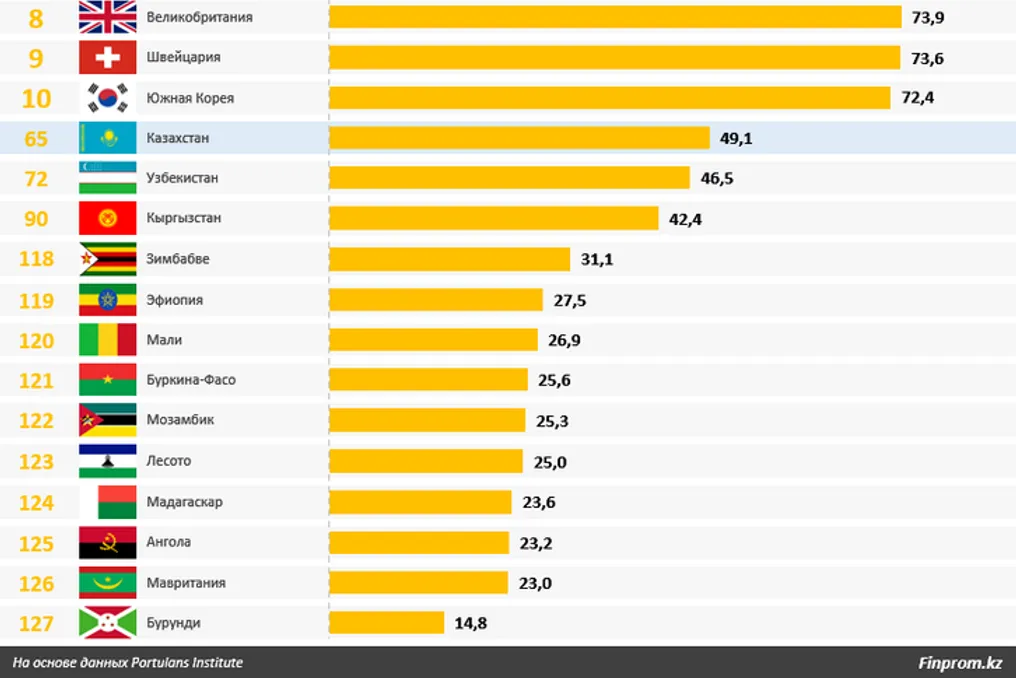
The Network Readiness Index (NRI), compiled annually by the Portulans Institute, is used to assess these aspects. The 2025 rating includes 127 countries and is based on 53 indicators grouped into four blocks: technology, people, governance, and the impact of digitalization on society and the economy.

The USA is recognized as the world leader with 79.1 points out of 100. Following them are Finland (75.8 points) and Singapore (75.5 points). Denmark, Sweden, the Netherlands, Germany, the United Kingdom, Switzerland, and South Korea are also among the top ten leaders. Burundi ranks at the bottom of the list with a score of 14.8 points; Mauritania, Angola, Madagascar, and Lesotho are also noted among the lowest performers.

Among the Central Asian countries, Kazakhstan took the highest position, securing 65th place with a score of 49.1 points. Uzbekistan ranked 72nd (46.5 points), and Kyrgyzstan was 90th (42.4 points). Because of this, Kazakhstan surpassed Uzbekistan by seven positions, and Kyrgyzstan by 25.

It is important to note that Tajikistan and Turkmenistan did not participate in this rating. Although Kazakhstan has an advantage in the overall score, this does not imply superiority across all index components, as neighboring countries showed better results in some individual areas.

In the 'Technology' category, which assesses access to digital infrastructure, content creation, and advanced technology development, Uzbekistan ranked highest among the three CA countries—75th place with 40.7 points. Kazakhstan is 81st (38.9 points), and Kyrgyzstan is 98th (31.4 points). Kazakhstan's result in providing schools with internet access is particularly noteworthy, where the country ranked first globally among the states included in the rating. In terms of mobile tariff accessibility, Kazakhstan is 20th, and for international internet channel throughput, it is 34th.

Uzbekistan demonstrated 7th place in the prevalence of fiber optic connections and 18th place in international internet channel throughput.

In the 'People' category, Kazakhstan ranked 66th with a score of 41.1 points, surpassing Uzbekistan (77th place, 37.8 points) and Kyrgyzstan (94th place, 32.2 points). Kazakhstan's strongest points are seen in the digitalization of public services: the country ranked 10th globally for online service development and 25th for the capacity of government structures to handle data. In terms of domestic mobile broadband traffic volume, Kazakhstan was ranked 29th. However, in the area of ICT skills in education, Kazakhstan ranked 107th, trailing Uzbekistan (76th place) and Kyrgyzstan (83rd place). Meanwhile, Uzbekistan ranked 21st in mobile traffic volume, and Kyrgyzstan ranked 12th in adult literacy rate.

In the 'Governance' section, which examines trust in the digital environment, regulation, and technology accessibility for all segments of the population, Kazakhstan also achieved the best result among the three CA countries—61st globally with 61.4 points. Uzbekistan was 71st (57.3 points), and Kyrgyzstan was 90th (51.0 points). Kazakhstan ranked 32nd in digital inclusion and 27th in electronic citizen participation. Uzbekistan excelled in e-commerce legislation and ranked 7th in the small socio-economic disparity in the use of digital payments. Kyrgyzstan ranked 20th in the indicator of differences in digital payment usage between urban and rural areas.

In the 'Impact' category, which combines economic and social indicators, including quality of life and achievement of sustainable development goals, Kazakhstan and Kyrgyzstan showed the most similar results. Kyrgyzstan ranked 54th with 55.2 points, slightly ahead of Kazakhstan (56th place, 54.8 points). Uzbekistan is 82nd with a score of 50.0 points. Regarding quality of life, Kyrgyzstan ranked 26th, Uzbekistan 28th, and Kazakhstan 35th. In the economic aspect, Kazakhstan was 78th, Kyrgyzstan 106th, and Uzbekistan 107th. Concerning contribution to sustainable development goals, Kyrgyzstan ranked 60th, Kazakhstan 82nd, and Uzbekistan 100th.

Notably, Kazakhstan became the only country among the three Central Asian nations to enter the first half of the global ranking simultaneously in two areas—'Governance' and 'Impact'. Although Uzbekistan and Kyrgyzstan achieved better results in some individual parameters, they lag behind Kazakhstan in the overall standings. This highlights that Kazakhstan's regional advantage stems not from leading every single indicator, but from a combination of sufficiently high results across several areas of digital development.

Popular