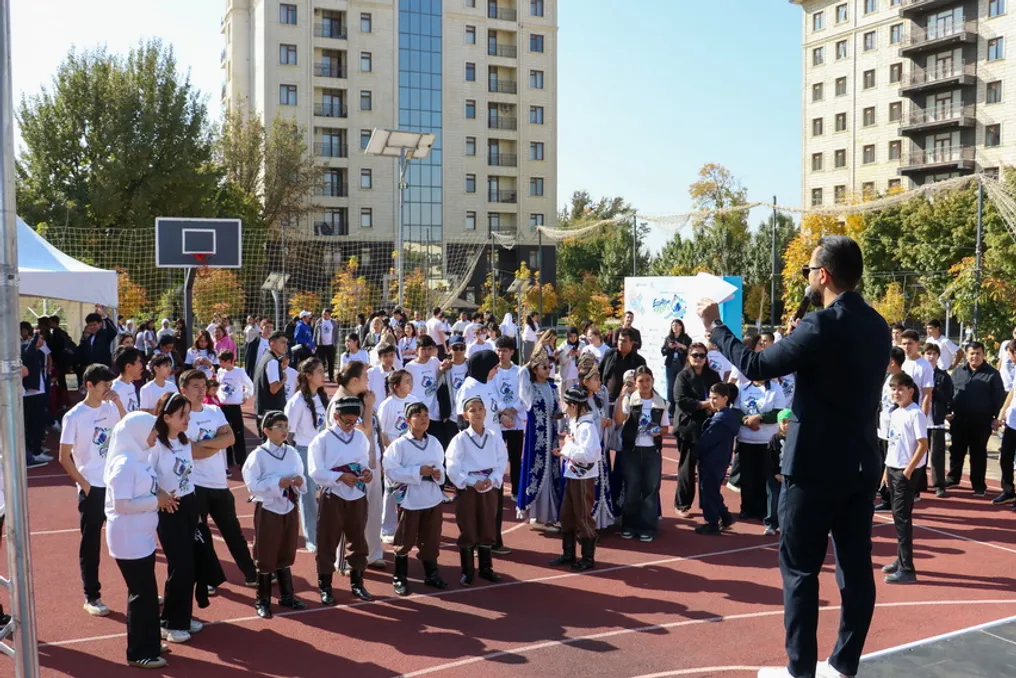
The first environmental atomic festival, EcoAtomFest, took place in Tashkent on October 24, 2026, at the Tashkent Branch of NIYAU MIFI. The event was organized by the state corporation Rosatom with the support of the Uzatom agency and served as the concluding stage of the Autumn School and Impact Team environmental camp.
The festival's program aimed to connect the study of sustainable development principles with direct environmental protection activities. Students from Uzbekistan, Russia, Kazakhstan, Kyrgyzstan, and Tajikistan participated. Participants engaged in tree planting, attended environmental lectures, and took part in master classes, allowing them to meet like-minded individuals and learn about opportunities to implement their own initiatives.
The main event of EcoAtomFest was the collective planting of fifty ash trees. Before starting the work, all participants underwent necessary briefings, then divided into small groups and began working in specially prepared areas under the guidance of volunteers.
Greening territories aligns with Uzbekistan's national goals in environmental protection and increasing the number of green spaces. The state project 'Yashil Maqon,' launched by the President of the Republic of Uzbekistan Sh.M. Mirziyoyev in 2021, aims to raise the level of greening in the country from 14.2% to 30% by 2030. Such actions contribute to involving youth in achieving these goals and fostering a sense of responsibility towards the urban environment.
After finishing the tree planting, guests participated in the interactive part of the program. Experts and volunteers organized sessions dedicated to daily environmental practices, features of urban nature, and finding solutions to environmental problems. Volunteers from the organization 'Oltin Qanot Volontyorlari' conducted a master class on growing microgreens.
Pavel Volkov, head of NGO 'Indigo,' shared advice on proper care for young and mature trees. Margarita Davydova, an activist and community specialist from birds.uz, introduced visitors to local bird species and observation practices. Mohinurkhon Ergash, an eco-activist and expert from the Volunteer Association of Uzbekistan, invited participants to discuss the ecological challenges of the republic's regions and develop their own proposals for their resolution. Jamshid Khakimov, chairman of NGO 'ECOLAND,' conducted an introductory lesson on ecology, after which visitors could engage in eco-crafts and visualize their concept of an eco-friendly home through drawings.
At the festival, participants were introduced to an international grant competition for environmental and socially significant projects, organized by Rosatom. Uzbekistan is one of the countries whose organizations are eligible to apply for this competition. The competition supports various areas, including nature conservation, environmental culture, education, volunteering, assistance to vulnerable populations, and urban infrastructure development. Projects can be presented as new initiatives or as individual stages of already implemented programs; the best projects will receive financial support, and winners will receive consulting and organizational assistance from invited experts.
The cultural program was opened by representatives of specialized boarding school No. 11 'Nurliman' from the Syrdarya region, who performed with the dombra and a dance number. Aziz and Akmal Anvarov from the Tashkent region presented the 'Andijan Polka,' and the Divas Dance Studio demonstrated the Korean folk dance 'SARANG-MU.'
EcoAtomFest concluded with an awards ceremony for activists recognized for their contribution to the environmental condition of the Republic of Uzbekistan. The organizers expressed gratitude to all representatives of environmental and volunteer structures for their educational activities and participation in environmental protection events. The festival became an important platform for interaction between youth, the expert community, and public organizations, successfully combining the educational process with practical work on greening and strengthening environmental culture.
Alexandra Khidirnazarova, Head of the Industrial Safety, Labor Protection, and Environmental Department of the 'Nuclear Power Plant Construction Directorate,' noted that 'environmental protection and safety culture begin with a responsible attitude towards one's actions.' She emphasized the importance of involving youth not only in discussions but also in practical activities, as such initiatives align with Uzbekistan's priorities for increasing green areas and forming the environmental culture of future specialists.
Diana Gamazova, member and mentor of the Impact Team 2050 international youth advisory council and head of the 'Atomic Energy for Central Asia' project, stressed that the camp allowed participants to see the close connection between technology, ecology, and quality of life. She added that knowledge of sustainable development gains special value when it is embodied in practical actions within international teams.
Alexey Dremuchev, CEO of 'Rosatom Central Asia,' stated that 'environmental responsibility is demonstrated through concrete actions,' and noted that EcoAtomFest brought together youth, volunteers, and experts around a common goal. He expressed hope that this meeting would be the beginning of long-term partnerships and new environmental initiatives.