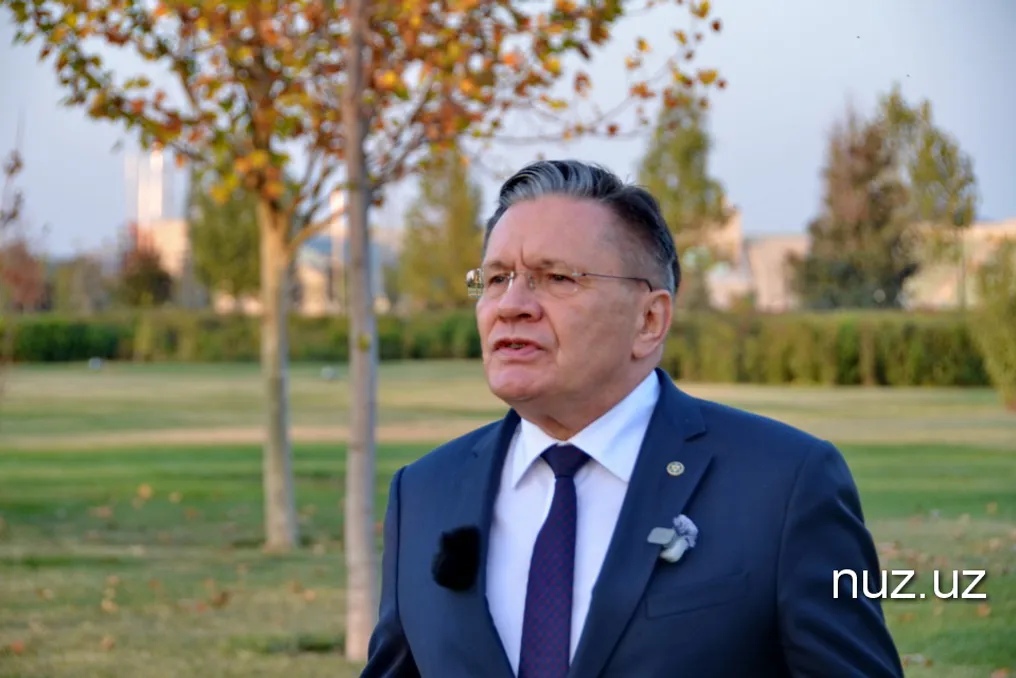
During his visit to Uzbekistan, Rosatom head Alexey Likhachyov held a meeting with President Shavkat Mirziyoyev. He also inspected the construction site of the NPP in Jizzakh region and the Central Asian regional youth nuclear platform located at the Tashkent branch of NUPI MEPhI. Before returning home, Alexey Likhachyov gave an interview to foreign and Tashkent journalists.
Responding to questions about Uzbekistan's plans for building the second and third NPPs, Likhachyov noted that the meeting took place against the backdrop of active construction of all four units. He emphasized that the project in Uzbekistan is outstanding because two gigawatt facilities and two small-power reactors are being built simultaneously. He paid special attention to the financial scheme, which includes an international financial institution, as well as the fact that Atomgrad is developing in parallel with modern infrastructure, education, and medicine.
Likhachyov stated that Uzbekistan will not be limited to four reactors but will move forward, and Rosatom is ready to participate in this. He added that the choice of partners remains with the customer, and Russia is not afraid of competition, as serial production helps reduce costs and increase competitiveness.
Significant work is underway to train qualified personnel, confirmed by the establishment of the Central Asian regional youth nuclear platform at the Tashkent branch of MEPhI. The first specialists for small NPPs in Uzbekistan should be hired next year, marking the beginning of a long-term mutually beneficial partnership between Russia and Uzbekistan.
Regarding the progress at the NPP in Jizzakh region, Likhachyov reported that the process is active. He noted the significant role of the local subcontractor, which allows the level of competence localization to reach 40%, which is beneficial both economically and in terms of personnel stability. Specialists from Belarus, and later from Uzbekistan, will be able to participate in other Rosatom projects in third countries. This year, the completion of the concrete pouring of the foundation slab for the reactor department of the small blocks is planned, after which the construction of control, reactor, and machine halls will begin. The reactor body for the small station weighing over 200 tons is already being manufactured, while the customer's controllers are present at all stages of production abroad.
Next year, the completion of surveys and design for the large station, as well as the transition to full-scale construction, is planned. The number of personnel at the site will double, reaching a peak of 12–13 thousand people. About 350 people are studying at the Tashkent branch of MEPhI, and approximately 900 at universities in Russia, with all construction participants working in coordination.
Likhachyov considers personnel training a critically important element in the nuclear industry, given the work with high technologies and huge volumes of energy. Specialists must possess not only basic knowledge and practical skills (acquired through internships at operating Russian reactors, training halls, and the technical academy) but also undergo individual licensing. In addition to professional skills, general values such as prioritizing safety, striving for continuous self-improvement, and a sense of service are extremely important, as the nuclear facility is equated to a state facility and civil service. Work with young people should begin as early as possible. Furthermore, communication with young specialists helps form strategic development plans for the period 2050–2060s, taking into account their vision and aspirations.
Commenting on Kai Callas' statement about the European Union's intention to achieve free passage along the Northern Sea Route, despite perceiving Russia and China as a threat, Likhachyov noted an obvious contradiction in the statements of European leaders. He emphasized that the Arctic Ocean is an open territory, but only Russia possesses the necessary icebreaker fleet to ensure safe navigation. Within its economic zone, Russia provides a comfortable transport corridor, offering icebreaker escort, navigational support, rescue services, and communication. Moreover, there is no fee for passage along the NSR; only ancillary services are charged at reasonable prices.
Rosatom is ready to cooperate with European companies on the principles of development. Representatives from South Korea (which conducted a test voyage and is preparing for systemic cooperation), India, Vietnam, and China are showing interest in working together. Likhachyov added that there are no unfriendly peoples in Russia, and unfriendly rulers will eventually go down in history.
Regarding Reuters' report on the possible change of contractor by Hungarian authorities during the expansion of the 'Paks' NPP, Likhachyov stated that 'there is no news.' He specified that the situation remains in a state of 'neither peace nor war': the audit of the Hungarian contractor 'Paks-2' is ongoing, deadlines are shifting, and information on the audit results is unavailable. Nevertheless, work on the production program for 'Paks-2', approved by the Hungarian government for the current year, has not been suspended. He expressed a desire for clarity, as 'Paks-2' is a sought-after product in the global nuclear market, and Hungarian companies are counting on its success. The Russian side is ready to demonstrate the effectiveness of its technologies, which surpass similar European and American projects in terms of timing and cost, while respecting the sovereignty and decisions of the Hungarian government.
Concerning the dispute with the Finnish company Fennovoima in the International Arbitration Court, Likhachyov explained that the final winner has not yet been determined, as arbitration instances lie ahead. The legal dispute is divided into three parts: the legality of contract termination (where previous instances, including the court in Sweden, recognized the termination by the Finnish side as unlawful); the reasons for delays (the court confirmed that the almost five-year delay was due to the client, as the contractor moves at the speed set by the client); and the financial issue. Rosatom's claim amounts to over 2 billion dollars, covering investments in Fennovoima's charter capital and the issued loan. Taking into account mutual offsets, the court's decision is generally in Russia's favor, both regarding the termination and the reasons for delays, which gives the right to demand the full amount to be paid.
On the situation at the Zaporizhzhia NPP, Likhachyov reported that new strikes hit the station's infrastructure in Enerhodar, damaging the printing house, garage cooperative, and transport department. Fortunately, unlike the previous day, there were no casualties among the staff, but the city continues to live under heavy frontline conditions. Work continues in stealth mode on the energy infrastructure, which must be completed at night to strengthen the external energy security of the station. He assured that the situation is under control, the station is in a safe condition, and the staff continues to heroically perform their duties to preserve it.