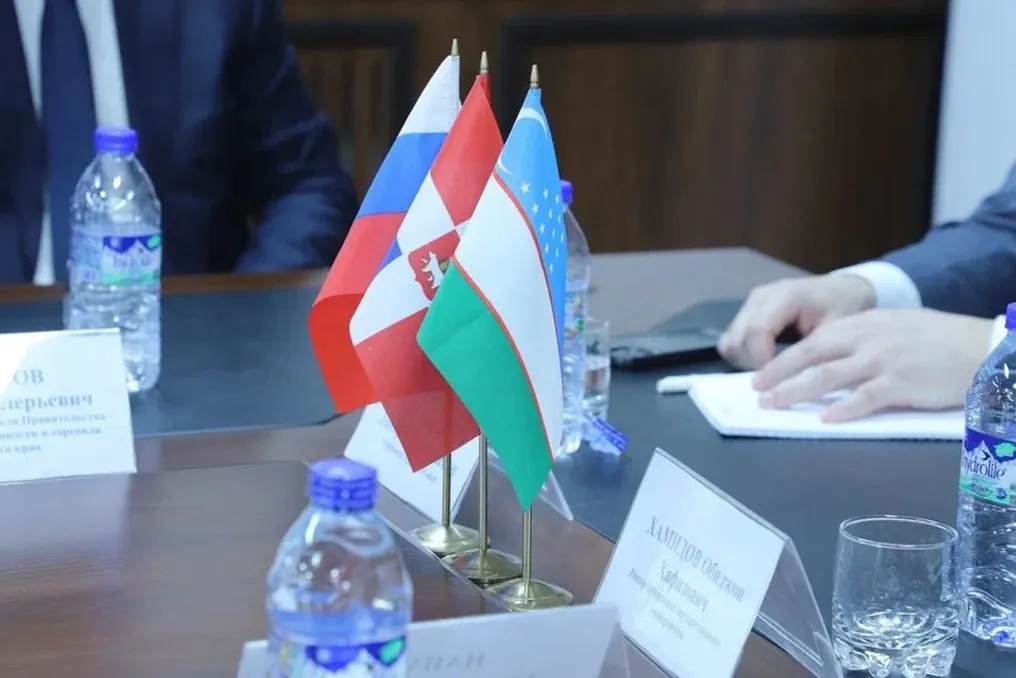
Cooperation between Uzbekistan and Perm Krai is reaching a new qualitative level, covering areas of trade, industrial cooperation, specialist training, and establishing new business contacts. This development is occurring not only at the state level but also at the regional level. The next major platform for establishing direct ties between entrepreneurs and producers is the AgroExpo Uzbekistan 2026 exhibition, which will take place in Tashkent from November 25 to 27.
The total trade turnover between the two countries has reached significant figures. According to data from the Ministry of Investment, Industry and Trade of Uzbekistan, in 2025, the volume of trade with Russia amounted to 13 billion dollars, an increase of 8.4%. Meanwhile, the export of Uzbek products increased by 12.2%, reaching 4.4 billion dollars. More recent data from the National Committee on Statistics of the republic shows that from January to August 2026, Uzbekistan's foreign trade turnover with Russia was 9.2 billion dollars.
Russia's First Deputy Prime Minister Denis Manturov reported that trade showed a growth of 20% for January-July 2026, reaching approximately 7.5 billion dollars, with increases observed in both directions.
On October 6, 2026, the 27th meeting of the Intergovernmental Commission took place in Fergana. During the meeting, plans were announced to launch 17 joint projects worth 350 million dollars in 2026, which will be implemented in the chemical, agro-processing, and metalworking sectors. Additionally, the parties approved the Scientific and Technological Development Strategy for the period from 2026 to 2040.
On the same days, the III Council of Regions of Russia and Uzbekistan was held in Fergana. Russian President Vladimir Putin emphasized that nearly 80 subjects of the Russian Federation are involved in trade, economic, scientific, technical, and humanitarian relations with Uzbekistan. At the St. Petersburg International Economic Forum on June 5, 2026, President Shavkat Mirziyoyev presented the scale of interaction, noting that mutual trade turnover has grown more than threefold over the last decade—from 4 to 13 billion dollars. He also pointed out that the portfolio of joint projects of the countries exceeds 50 billion dollars.
The Head of State particularly highlighted the role of regions in developing these economic relations, naming Perm Krai as one of Uzbekistan's Russian partners and emphasizing the importance of interregional initiatives in the fields of mechanical engineering, energy, agriculture, logistics, and other industries.
Joint work between Uzbekistan and Russian regions allows enterprises to directly discuss supply issues, find technological partners, and develop joint production plans. One area of interaction with Perm Krai is industrial cooperation. An agreement was previously reached on developing a roadmap for cooperation jointly with the Ministry of Energy of Uzbekistan. Prospective areas include the oil and gas and chemical industry, mechanical engineering, as well as the supply of high-tech equipment.
Uzbek companies are interested not only in purchasing finished products; they also see potential in joint production and technology localization, which contributes to the growth of local industry, job creation, and improvement of engineering qualifications. Regional interaction also includes business missions, participation in industry exhibitions, and direct negotiations between companies, helping to move from general agreements to discussing specific commercial terms.
The Perm Regional Branch of 'Delovaya Rossiya' organized a business mission to Uzbekistan, which took place from October 19 to 23, 2026. The trip route included Perm, Tashkent, and Samarkand. Initial results have already appeared: a business dialogue 'Perm – Uzbekistan' took place in Tashkent over two days, during which a memorandum of cooperation was signed, and Uzbek representatives were invited on a reciprocal visit to Perm. This is reported by the Telegram channel of the Perm branch of 'Delovaya Rossiya.'
According to the organizers, after the official part, participants exchanged contact details, and some have already agreed on further negotiations. Requests from companies were considered at the Chamber of Commerce and Industry of Uzbekistan, and a decision was made to exchange commercial proposals. On the second day, the delegation visited a large Central Asia Technopark where various products are manufactured—from household appliances to elevators, escalators, and industrial equipment. Such trips open opportunities to familiarize oneself with the Uzbek market, negotiate with potential partners, and study prospects for business interaction.
The next opportunity for direct communication between producers and potential buyers will be presented at the international agro-industrial exhibition AgroExpo Uzbekistan 2026. The event is scheduled for November 25–27 at the Uzexpo Center National Exhibition Complex in Tashkent and is dedicated to animal husbandry, horticulture, crop cultivation, and agricultural machinery. Organizers have ensured visitor registration, the possibility of renting exhibition stands, and a business program.
The exhibition can be useful for Uzbek agricultural holdings, farmers, and processing enterprises, as they can study producer offers, compare equipment technical specifications, discuss supply and service conditions. According to the press service of the Russian Trade Representation in Uzbekistan, companies such as Rostselmash, Tenzo-M Weighing Company, and Yaroslavich PC, as well as a collective exhibition of Perm Krai, will be represented at the exhibition. The Perm stand will showcase agricultural machinery, loaders, attachments, and veterinary drugs. The program also includes the IX International Poultry Forum, the III National Farmers Forum, and a livestock auction.
Participation in such industry events helps companies find partners for long-term cooperation, whether it is the supply of finished products, equipment localization, or the creation of joint production facilities.
Cooperation between Uzbekistan and Russia goes beyond simple trade exchange, including industrial projects, technology exchange, personnel training, and the development of educational ties. Shavkat Mirziyoyev specifically emphasized the importance of forming industrial chains, localizing production, and expanding interregional ties at the PMI Forum, naming energy, chemistry, mechanical engineering, logistics, textile industry, and agriculture as priority areas.
For the Uzbek economy, this interaction opens up prospects for enterprise modernization, expansion of domestic production, and increase in export supplies. In turn, for Russian regions, Uzbekistan serves as a market with growing demand for engineering solutions, agrotechnologies, and industrial equipment. Nevertheless, developing ties with Russia remains part of Uzbekistan's multi-vector foreign economic policy, allowing businesses to choose partners based on needs, commercial terms, and technological capabilities.
The example of Perm Krai demonstrates how important regional ties are in this process. Exhibitions, business missions, and direct negotiations form the basis for future cooperation, and its actual results will depend on the successful implementation of specific agreements between enterprises of both countries.