Industrial 3D printing, known as additive technologies, offers a solution to the problem of long waiting times for rare imported parts that may take months to replace. This technology allows necessary components to be created from a digital model, bypassing long logistics and high costs. There is potential to open such a center in Uzbekistan that could provide local factories with these parts.
The possibility of creating an Additive Technology Center in Uzbekistan became an important topic at a specialized seminar on 3D printing for industrial enterprises. The event took place at the 'Uzatom' Agency with the participation of experts from the 'Rosatom' Fuel Division. About thirty companies from the automotive, chemical, and mining sectors attended the seminar, including NKMK, 'Navoiatom', and UzAuto Motors. The project involves creating working groups, auditing the production capacities of enterprises, defining the list of services and products, and developing support measures for the center.
Additive technologies are used to create prototypes, spare parts, tooling, and samples. This allows for the prompt manufacturing of rare parts, restoration of worn elements, or obtaining complex-shaped items that are difficult to produce using traditional casting or milling methods. Furthermore, the technology contributes to material saving, as unused powder can be reused.
Historically, 3D printing has most often been used for creating prototypes. The first example of its serial implementation was in the aviation industry. In 2015, GE Aviation plant in Oberne (USA) began producing printed fuel injector tips for the LEAP engine. A part that previously consisted of twenty pieces was transformed into a single unit, became one-quarter lighter, and, according to the company, proved five times more durable.
The German company Deutsche Bahn has been using 3D printing to maintain its rolling stock since 2015, having manufactured over one hundred thousand parts. In 2023, they created a reducer housing for a shunting locomotive weighing 570 kg and with a volume of almost one cubic meter, which was the largest part they had produced using 3D printing. However, it was not the housing itself that was printed, but the casting mold for its subsequent casting. If such a part were purchased through standard methods, the waiting time could have averaged nine months, whereas with the new technology, the period was reduced to two months. The company keeps digital models in a 'digital warehouse,' allowing rare spare parts to be printed as needed instead of being stored in a warehouse.
In Russia, a significant step was the application of additive technologies in nuclear engineering, where extremely high requirements are placed on components. In February 2026, specialists from 'OKBM Afrikantov' (part of 'Rosatom'), together with materials scientists, completed research, testing, and developed regulatory documentation for a pump part of the RITM-200 reactor unit, known as the 'wheel'. According to the estimates of state corporation specialists, the production cycle of this item was reduced by approximately 20%. Developers also noted the advantages of the technology, such as lower material consumption, high reproducibility, and the ability to create parts with complex geometry.
Nevertheless, for mass production of simple parts, casting, stamping, or machining remain more cost-effective methods. Therefore, the decision to use 3D printing is made individually for each item. It is important to understand that for industrial use, simply printing a part of the required shape is not enough; confirmation of material properties, absence of critical defects, and stability of results from batch to batch are required, which is achieved through mandatory testing.
The example of the 'wheel' for RITM-200 demonstrates how, in the nuclear industry, where material requirements are very strict, the development process includes a comprehensive set of tests and the creation of a regulatory framework. In other sectors, the requirements may be less stringent, but the overall scope of work includes materials science, testing, tuning printing modes, subsequent processing, and quality control. Therefore, for an additive technology center to function, it requires not only printers but also laboratories, qualified engineers, and an approved regulatory framework.
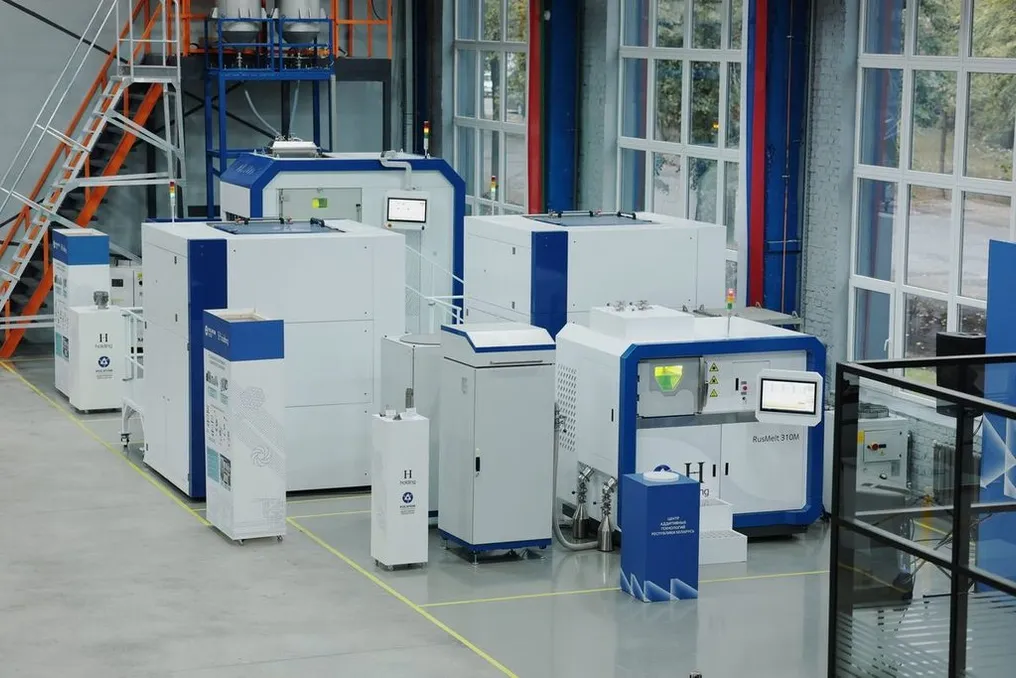
The first international additive technology center created by 'Rosatom' was launched in September 2025 in Minsk in partnership with the Belarusian company 'Gorizont'. Before the launch, an audit of several interested enterprises was conducted. The center operates two 'Rosatom' metal 3D printers of the RusMelt series, an industrial printer for engineering plastics, a 3D scanner, and equipment for printing sand-polymer molds. The annual production capacity of the center reaches 1.5 tons of products from various metals, 3 tons of sand-polymer molds, and 100 kg of engineering plastic products.
The Minsk project by 'Rosatom' is considered a model for other countries. According to the state corporation's press service, the next stage is the gradual localization of 'Rosatom' 3D printer production by 2027. Preliminary achievements already exist: in October, the company presented the first small-sized RusMelt 150M 3D printer assembled using Russian and Belarusian components.
'Rosatom' is also developing projects to create full-fledged additive technology centers in other countries. Work is currently underway on projects for Egypt. In 2026, an agreement and memorandum on developing the construction project of a similar center were signed in Vietnam. Cooperation with foreign partners goes beyond just supplying equipment; one of the key aspects is production localization. For example, this year, the production of 3D scanners of Russian design began in India. Localization is expected to help reduce the price of equipment for end-users and provide the opportunity to obtain 'Made in India' status, simplifying sales in the domestic market. In April, 'Rosatom' made its first shipment of a state corporation's 3D printer abroad—the RusBeam 2800 installation for the aerospace industry in India, following a tender.
Simultaneously, there is a growth in domestic equipment production in Russia. In 2023, the Moscow Additive Technology Center of the state corporation produced three metal 3D printers, and in 2025—already 13. At the beginning of September 2026, the thirtieth machine was assembled there. In addition to the equipment itself, 'Rosatom' is involved in the production of metal powders and software for 3D printing, as well as staff training.
Interest in additive technologies in the country aligns with the general course toward industrial modernization. At the August seminar, industries for which expensive equipment is critical were presented. For mechanical engineering, chemical, and mining and metallurgical enterprises, additive manufacturing should be viewed not as a complete replacement for existing methods, but as a tool for solving specific production tasks where it proves more effective than traditional approaches. These tasks may relate to rare parts, small batches, complex geometry items, component restoration, or receiving supplies from abroad that take months.
The audit planned within the project should determine exactly which parts and operations in Uzbekistan's enterprises correspond to these scenarios. The results of this audit will determine the choice of equipment, the scale of the future center, and its economic model. Such a stage has already been passed in Minsk. Experience from other countries indicates a number of issues that this project must resolve: who will act as the center's customer, who will be responsible for training engineers and certifying printed parts, and whether local production will be implemented. The answers to these questions will determine whether 3D printing becomes an effective tool for the country's industry and what practical effect it can achieve.