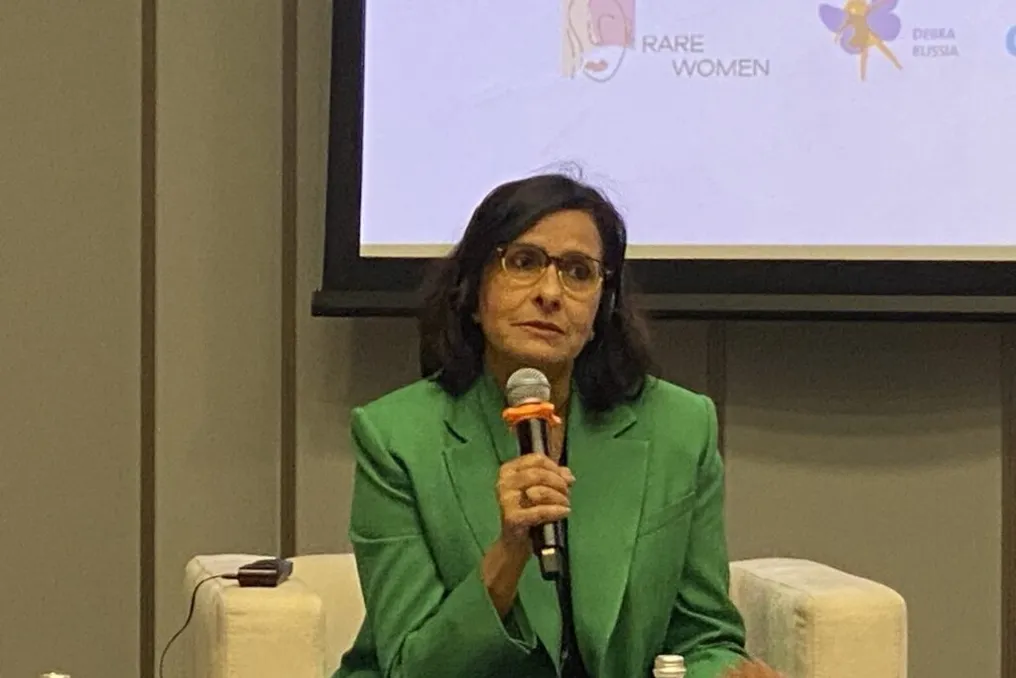
An International Women's Public Talk titled 'Changing the System, Changing Lives: Women in the World of Rare Diseases' was held in Tashkent. The issue of providing assistance to patients with rare genetic skin diseases in the country was first raised in 2018.
In 2020, the organization 'Kapalak Bolalari' was established at the initiative of Alena Yartseva's (Kuratova) foundation, 'Butterfly Children'. A significant step was the opening of the first specialized Center for Genetic Dermatoses in Central Asia in 2021, based at the Republican Scientific and Practical Medical Center of Dermatology, Venereology, and Cosmetology under the Ministry of Health of the Republic of Uzbekistan. The public talk was dedicated to the fifth anniversary of this Center.
Female experts from Uzbekistan, Russia, Singapore, India, and Croatia discussed how mothers can contribute to long-term social changes, and how the development of the support system for people with rare diseases affects women and their families.
All speakers had personally faced this problem but managed to find a solution. They united to support mothers whose children suffer from similar ailments, becoming a driving force for significant change, especially in Uzbekistan currently.
Rita Jain, Vice President of DEBRA International and President of DEBRA Singapore, noted the huge, yet often unnoticed, contribution of women to the healthcare system, focusing on mothers of children with rare diseases. She called them 'warrior mothers,' emphasizing that these women demonstrate exceptional resilience despite pain, guilt, and anxiety for their children's future. Instead, they channel their experiences into creation, helping other families and improving the lives of children with rare illnesses.
The example of Uzbekistan shows how the joint work of local patient organizations, founded by women, and large international structures like DEBRA yields results. Local groups solve community problems, while collaboration with foreign colleagues facilitates experience exchange and the search for common solutions.
This approach has allowed the country to achieve substantial progress in addressing the issues of patients with rare skin diseases, but the foundation of these rapid transformations is state support.
In 2018, dermatologists began systematically searching for patients with hereditary skin diseases, including ichthyosis and congenital bullous epidermolysis. One priority area was the formation of a National Register of children suffering from rare (orphan) and other hereditary-genetic diseases. Currently, 434 patients with congenital bullous epidermolysis are included in this Register.
In 2019, Presidential Decree No. PP-4440 was approved, which stipulated the annual allocation of 10.5 billion soms for the purchase of medications and dressing materials for these patients. In November 2025, measures for the period 2025–2029 were defined, covering ten rare diseases instead of the previous five.
The expansion of the program led to an increase in the number of monitored patients and a significant rise in funding. In addition to medicines and dressings, costs for molecular-genetic testing are now covered. Special therapeutic nutrition is planned for some groups of patients with bullous epidermolysis.
Parallel to improving treatment, the early diagnosis system is being improved. The last two years have been dedicated to training medical personnel to recognize the signs of bullous epidermolysis and correctly refer patients. A family doctor who discovers suspicious symptoms must know where to refer the patient for further examination. District dermatologists provide follow-up care and can use telemedicine for consultations and diagnosis clarification. Furthermore, public education is being strengthened; interaction with mahallas and educational institutions helps raise awareness about hereditary diseases and the importance of genetic counseling, according to Akram Rakhmatov, head of the scientific laboratory for studying mycosis problems at the Republican Scientific and Practical Medical Center of Dermatology, Venereology, and Cosmetology under the Ministry of Health of the Republic of Uzbekistan.
The Center for Genetic Dermatoses plays a key role in achieving these results. It is designed to serve 12 patients and operates considering the constant change of hospitalized patients. Here, patients undergo detailed examinations, after which an individual treatment and monitoring strategy is determined. A comprehensive assessment of the patients' condition is achieved through laboratory diagnostics and interaction with specialists. The Center functions as part of a republican specialized center, which guarantees the continuity of the process from diagnosis to inpatient treatment and subsequent control.
One of the Center's patients, Kamola Khaydarliyeva, shared that she has been connected with the Center for Genetic Dermatoses and the foundation for many years. Thanks to their support, she was able to gain confidence and change her outlook on life. She has four children and a mother in her family; her younger brother also suffers from bullous epidermolysis. She noted that previously obtaining necessary help was extremely difficult, and until 2008, treatment took place in ordinary dermatological and venereological dispensaries and hospitals. Later, she was invited to the Tashkent Medical Institute, where doctors from Russia provided dressing materials and taught proper care. After the establishment of the 'Kapalak Bolalari' foundation, assistance became regular, including free dressing materials and support in other areas of life.
Until eighteen, she felt lonely, believing she suffered from a unique disease, and did not envision her future. Now she knows she is not alone, has gained confidence, and is happier. Treatment gave her a 'second wind'; she started reading, developed new interests and aspirations, and a desire to travel and develop. Despite the difficulties, she obtained higher education at the Irrigation University, graduating from the Cadastre faculty, and has been studying Arabic for two years. In the future, she hopes to contribute to science, as well as start a family and raise worthy children.
Observing such stories and meeting people dedicated to their cause makes it clear that by uniting organizations and specialists for a common goal, changes can be achieved at the state level, especially when women, striving to help their children, initiate changes themselves and inspire others to real transformation.