As part of the STADA Health Report 2026 study, conducted in 20 countries worldwide, 52% of respondents from Uzbekistan gave a high rating to the digital capabilities of the healthcare system. The presentation of the results of this international study took place on October 7th in Tashkent and Almaty via a video bridge, followed by a forum dedicated to discussing the digitalization of medicine in Uzbekistan.
The main goal of the forum was to examine how modern information technologies and artificial intelligence are being implemented in the participating countries. Uzbekistan is actively participating in global progress in IT and AI, possessing a state strategy until 2030. This strategy, approved by a decree of the President of the Republic of Uzbekistan, aims to form the necessary infrastructure, train qualified personnel, and create clusters for information and artificial intelligence.
Comprehensive research carried out by the organization 'Ijtimoiy Fikr' in Uzbekistan revealed a high assessment of the digital potential of the national healthcare system. Bakhtiyor Hajimukhamedov, head of Stada in the Republic of Uzbekistan, noted that this provides a significant advantage in early diagnosis, choice of treatment methods, and prognosis prediction, as well as contributing to a substantial reduction in the financial burden on the system.
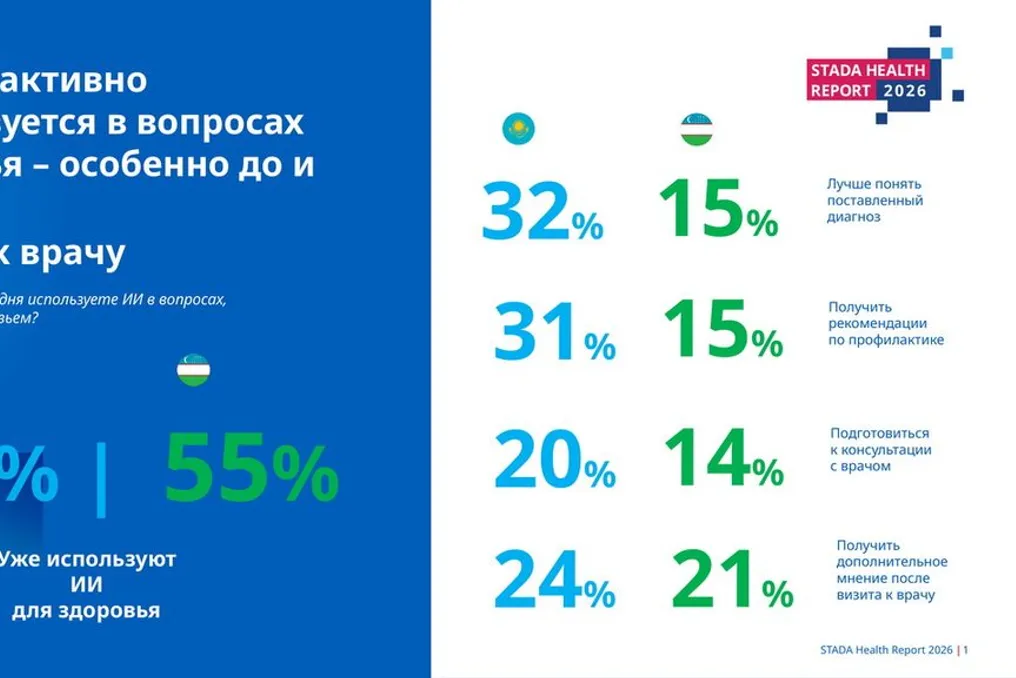
According to the results, 52% of citizens believe that the system provides them with quality digital medical services, which is significantly higher than the average in the 20 participating countries (28%). Furthermore, almost half of the respondents (49%) are willing to entrust a 'digital pharmacy' with managing prescriptions or receiving consultations. Artificial intelligence is already used by 55% of Uzbeks in their daily approach to health.
In 2026, 82% of the population of Uzbekistan are satisfied with the work of the state healthcare system, which is one of the highest indicators among the countries participating in the STADA Health Report 2026. Over the past year, the share of satisfied individuals increased by 13 percentage points, with the share of those completely satisfied with the system rising from 7% in 2025 to 22% in 2026.
Citizens highly value the system's ability to meet various health needs: 65% positively assess access to medicines, 64% assess support in crisis situations, 62% assess elderly care, and 57% assess preventive care. Digital capabilities were rated by 52% of respondents, exceeding the study average of 28%.
One of the key aspects of the STADA Health Report 2026 is the impact of AI on healthcare and patient-doctor interaction. In Uzbekistan, 55% of residents already use AI for health issues, with young people (under 35 years old) showing the highest activity at 69%. Twenty-one percent of citizens consult AI for a second opinion after a doctor's visit, which is higher than the study average (16%).
Nevertheless, the attitude towards the complete autonomy of technologies remains reserved: half of the population is not yet ready to replace an AI consultation with a doctor's visit, and 47% do not trust an AI diagnosis as much as a specialist's diagnosis. However, 15% of respondents use AI to better understand an already received diagnosis. Moreover, 38% of Uzbeks believe that with the development of AI, doctors will become even more important, trustworthy figures, which is higher than the average of 30%.
In addition, a high level of readiness for online drug purchases was noted (49%). At the same time, 29% of respondents predict the transition of doctor consultations to an online format. Among desired future innovations in pharmacies, Uzbeks named home delivery of medications (37%), round-the-clock consultations (33%), and individual health checks (23%).
Despite technological development, health decisions in Uzbekistan still rely largely on personal trust. 55% of residents rely on doctors' opinions, 53% on spouses or partners, and 49% on family members. Pharmacists and pharmacy staff play an important role, with 43% of respondents relying on their opinions. The influence of cultural and religious attitudes is also noticeable (39% versus 19% in the study average), while 31% of citizens rely on state institutions compared to 14% on average.
Bakhtiyor Hajimukhamedov emphasized that Uzbekistan's healthcare is undergoing rapid changes, and people notice it. He added that the growth in the use of new technologies, including AI, demonstrates that technological development does not mean abandoning the traditional model, but rather expanding its capabilities for more conscious healthcare.
The high dependence on the opinion of loved ones is combined with a strong sense of personal responsibility: 85% of Uzbekistan's residents claim they can fully or significantly control their health, which is higher than the average of 78%. Of particular note is the share of those who feel full control—45% versus 13% on average across the 20 countries.
Almost half of the respondents (48%) believe that the responsibility for health awareness lies primarily with the individual, while 41% place this duty on medical professionals and the state. When allocating hypothetical financial resources for health, 29% would prefer to buy dietary supplements or vitamins, and only 9% would purchase health maintenance technologies (such as fitness trackers).
Citizens of the country are also more confident about medical information: 40% believe they are capable of finding and understanding necessary health information, which is significantly higher than the average of 22%.
Despite high satisfaction with the system, there are requests for improvements. If residents could determine development priorities, 59% would demand increased accessibility of medical care in rural and low-income areas. Other requests include improving primary care accessibility (36%), reducing queues and increasing the number of doctors (35%), and improving elderly care (33%). Only 13% of respondents named investment in telemedicine and digital tools as a top priority.
A gap was also identified between high self-assessment of health and actual preventive behavior: 48% of residents do not undergo any available preventive examinations, whereas the study average is 33%. The situation is worsening: the share of those who do not undergo examinations has increased from 25% in 2023 to 48% in 2026. Nevertheless, 32% would say that if additional health budget were available, they would allocate it to screenings and prevention.
In conclusion, the results of the STADA Health Report 2026 demonstrate that Uzbeks highly value their healthcare system and are actively adopting new technologies; however, they maintain an orientation towards the opinions of doctors and loved ones, and the main needs remain physical accessibility of medical care and the development of preventive medicine.