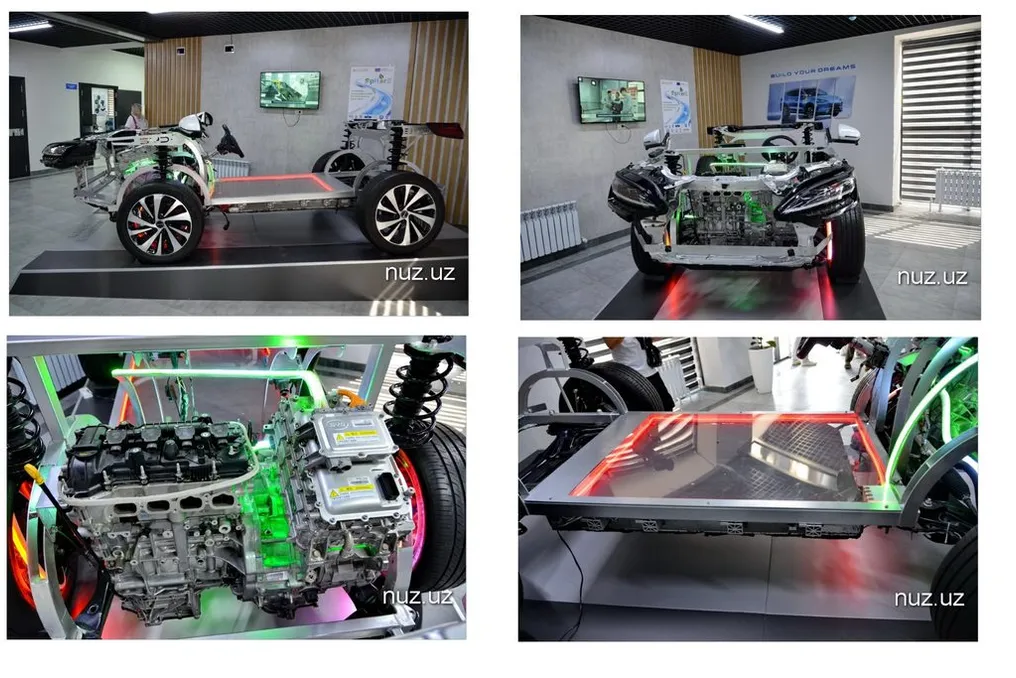
As part of the 'BYD. Made in Uzbekistan' initiative, BYD Uzbekistan Factory, together with BYD Astana Motors Uzbekistan and supported by the BYD Central Asia distributor, organized a tour for media representatives and clients to its plant in Jizzakh. During the event, the engineering school, vehicle production processes, and the functioning of dealership centers were demonstrated.
The BYD Uzbekistan Factory site in the Jizzakh region produces both electric vehicles and hybrid vehicles. The production utilizes robotic equipment and a multi-stage quality control system. The total area of the enterprise is 27 hectares, and the annual production capacity reaches 50 thousand units. The total investment in the plant has reached 160 million dollars.
BYD Uzbekistan Factory is a joint venture established between 'Uzavtosanoat' and the Chinese company BYD. The ownership structure is distributed as follows: the Uzbek side holds a 51% stake, and the Chinese side holds 49%.
Currently, three models are produced at the plant: Song Plus, Chazor, and Yuan Up. In 2024, the plant produced 4,004 vehicles, and over 20 thousand units are planned for 2025. Furthermore, production is planned to increase to 40 thousand vehicles by 2026.
The visit to the plant began with a tour of the training center, which is based at Tashkent Polytechnic University. Training is available to all interested parties, including students aspiring to work at the factory in the future. Specialized professionals are also trained here and subsequently sent to work at foreign enterprises.
Theoretical training covers disciplines such as vehicle and electric vehicle design, post-engineering, reverse engineering, industrial engineering, IT programming of production processes, and quality management. Specialists in robotics, CATIA engineers, plumbers, and other in-demand professions are also trained. The duration of training ranges from two to three months depending on the chosen specialty, and the training center is equipped with modern robot simulators.
The production cycle is divided into four key stages: body welding, painting, assembly, and final quality control. The welding shop has the potential to manufacture up to 50 thousand bodies annually. Here, 4,528 weld points are executed using 61 KUKA robots, 200 welding jigs, and 297 modern welding machines. Of this, 69% of the welding work is done manually, and 31% is automated. The sides and roof of the Song Plus body are connected using high-precision laser welding, and the quality of these seams is controlled by ultrasonic methods; all BYD models have galvanization.
A dedicated section for side welding covers 4 thousand square meters and is capable of producing 50 thousand sets of panels per year, for which $8 million was allocated for equipment. After welding, the body undergoes geometry checks in a measurement laboratory, where a Hexagon coordinate measuring machine checks over 2 thousand control points with an accuracy of 20 microns. Additionally, a Hexagon laser 3D scanner, in conjunction with a FANUC robot, allows scanning 90 types of body parts in one hour and comparing them with the 3D model.
The paint shop, covering 7,800 square meters, is designed for 50 thousand bodies per year, with a project cost of $29 million. In this facility, the body undergoes several treatments: anti-corrosion protection, sealing, primer application, base coat, and two-component lacquer coating. Ten ABB robots are installed in the shop.
After painting, the bodies move to the assembly line, which spans 16 thousand square meters and also has a capacity of 50 thousand vehicles per year. Assembly is structured in three stages: Trim, Chassis, and Final. The production pace is set at one vehicle every five minutes. 21 automated AGV systems, robots, and manipulators are used for transport. Painted bodies are stored in an automated two-level warehouse with a capacity of up to 70 bodies, providing a reserve for the assembly line operation of about six hours in case of a temporary shutdown of the paint shop.
The final inspection of the vehicle after assembly includes checking wheel geometry, braking system, headlight alignment, and ADAS system functionality. The vehicle is then directed to a rain chamber, where it is subjected to high-pressure water exposure for five minutes to check for airtightness. The process concludes with tests on a special test track under various road conditions.
One of the priority areas for the plant's development is increasing the share of locally sourced components. In 2025, 72 types of components were localized for the Song Plus model, including seats, plastic fuel tanks, chassis parts, glass, bumpers, interior and exterior elements, as well as sound and vibration insulation and floor and roof coatings.
Seven local enterprises are involved in the localization program: Uz Tong Heong, YAPP, Uz Auto Austem, Avtooyna, Uz Koram, Uz Dong Yang, and Uz Hanwoo. In 2025, local components worth over 50 billion soms were supplied to the conveyor belt. This allowed for a reduction in import content by approximately $3,044 per vehicle and a decrease in cost by $1,040.
With the production of 20 thousand vehicles per year, the import substitution potential is estimated at approximately $60 million. The JinTing Automobile Electric plant from China has also started operations in Jizzakh, producing 24 types of wiring harnesses for the Song Plus. This enterprise has created over 100 jobs, and the projected annual import reduction is estimated at $7 million.
In 2026, BYD Uzbekistan Factory plans to localize another 100 types of components: 40 for Song Plus, 22 for Chazor, and 38 for Yuan Up. The second phase of the project plans for an additional localization of 70 components for Yuan Up.
Approximately 1,600 employees work at the plant. There is a gradual reduction in the number of Chinese specialists: if there were over 150 at the start, the current number is around 50. Local employees undergo training in China: 40 people received such training in 2024, 51 in 2025, and 60 more are planned for 2026.
Additionally, BYD Uzbekistan Factory has invested 10 billion soms in creating the infrastructure for the Higher School of Engineering 'Industrial Engineering' at the Jizzakh Polytechnic Institute. This project aims to train specialists capable of working with modern industrial technologies.
Production is carried out using CKD and SKD technologies. The Song Plus Champion DM-i and Chazor DM-i models are produced using the full-cycle CKD technology, while the Yuan Up in hybrid and fully electric configurations is assembled using the SKD knock-down method. International quality management standards have been implemented at the enterprise: BYD Uzbekistan Factory has received ISO 9001:2015 certification and became the first BYD plant outside of China to be awarded the Three-Star Factory certificate.
Thus, the plant in Jizzakh is actively developing not only vehicle production but also forming a local component supply chain, a personnel training system, and integrating advanced industrial technologies.