The 17th Central Asian International Exhibition 'Textile Machinery and Technologies – CAITME 2026' has concluded in Tashkent. The event was held under the slogan 'Technologies that Define the Future of the Region's Textile Industry' and showcased fresh directions for the development of Uzbekistan's textile sector.
CAITME has established itself as one of the largest exhibition events in Central Asia and the CIS countries, becoming a national brand of Uzbekistan in the textile industry. The exhibition provides local producers with the opportunity to familiarize themselves with the latest developments, receive technical support for operating machinery and equipment, and learn about offers directly from suppliers.
This is particularly important in the current situation when the global textile industry is undergoing a complex phase of transformation. Increased competition in external markets, changes in logistics chains, revision of international tariff policies and transport routes, as well as new requirements from international buyers regarding transparency, sustainability, and overall production efficiency are being observed.
Against the backdrop of these global changes, Uzbekistan continues to support and promote the development of the textile and sewing/knitting industry. This support is implemented through tax reductions, providing benefits for entering new export markets and marketing assistance, preferential lending, attracting investments, and supporting innovative projects. In 2025 alone, $2.1 billion in foreign investment was attracted to this industry. Simultaneously, active modernization of production capacities and the implementation of international standards and certifications are underway.
Although the domestic textile industry has long been a consumer of modern equipment, the exhibition demonstrated the emergence of a new trend: Uzbek specialists are now capable of exporting their own 'smart' solutions.
An example of this development is the company KESIM, founded by local entrepreneur Mansurbek Moydinov. Since 2011, this company has been a leading distributor of high-tech equipment for automating textile production in Central Asia and the CIS, representing the HANBOND brand, which is a major Chinese manufacturer of plotters. The company is not limited to the domestic market, successfully promoting its developments internationally under the name PROFCUT.
Humoyun Ergashov, director of the Tashkent branch of PROFCUT (Professional Cutting Equipment), shared information about modern cutting methods in textile production. He noted that over more than ten years of experience, the company has become a reliable partner for clients, as many large textile enterprises prefer its services even after interacting with well-known European brands. The company's service is recognized as the best in Central Asia, and they offer 'smart' solutions, serving clients across Uzbekistan and Kazakhstan through branches in Andijan, Tashkent, and Shymkent.
The plotters used feature high quality and durability, while every stage of production undergoes thorough control, distinguishing them from cheaper analogues that may fail and require additional repair costs. Ergashov also explained the basis of advanced solutions: the equipment is equipped with the Gemini CAD Systems software module, which covers the entire production cycle and is suitable for digitizing cardboard patterns in any industry. The Gemini Spread & Cut Planner (PE) software is designed for planning the fabric laying and cutting process, helping to manage time, materials, and financial resources in a unified system.
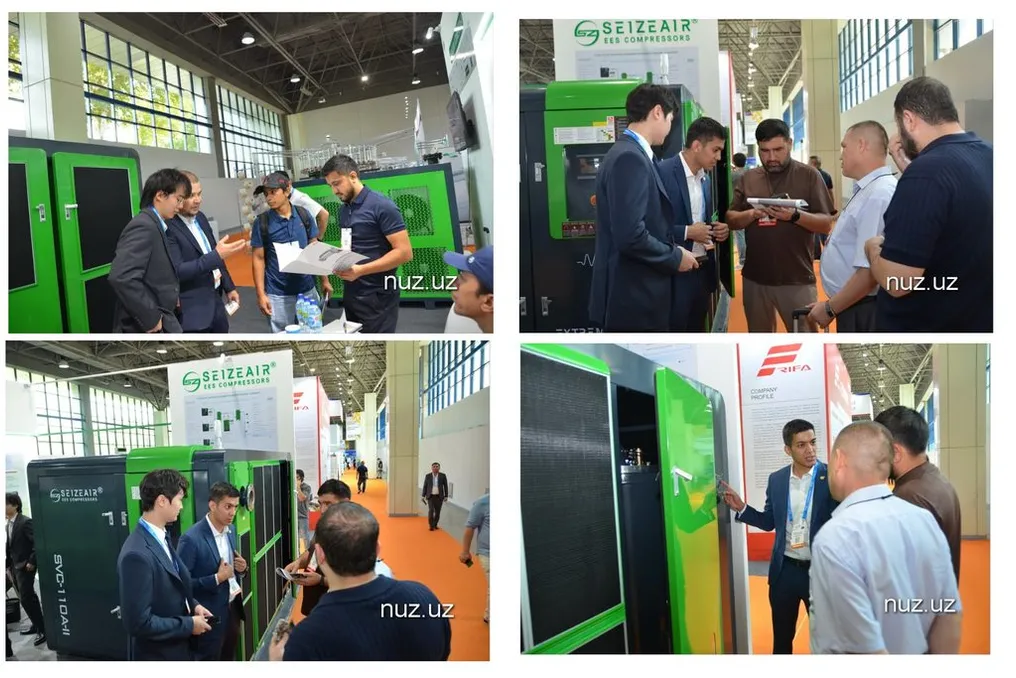
In conditions of continuously rising electricity costs, manufacturers are forced to pay close attention to increasing energy efficiency and reducing energy consumption. The company SEIZEAIR Air Compressor contributes in this direction by supplying compressor equipment for the textile industry.
Ilmurat Kasimov, Deputy Director of the International Department of SEIZEAIR Air Compressor, spoke about assisting textile workers in improving energy efficiency. He reported that the company's equipment features high energy efficiency, allowing consumers to save money on electricity. The company has already implemented numerous projects in Uzbekistan, particularly in the regions of Kashkadarya, Namangan, Andijan, and Tashkent region. Among their clients are Oltin ko‘l tekstil, Sho‘rlik tekstil, Muazzam tekstil, and other enterprises.
Given the significant rise in electricity prices in Uzbekistan over the last three years, especially for industrial facilities, timely replacement of outdated equipment with more energy-efficient models is becoming extremely relevant. Kasimov specified that instead of common single-stage compressors, they offer two-stage models, which possess maximum energy efficiency and greater productivity thanks to permanent magnet motors, ensuring substantial electricity savings. In addition to compressor equipment, the company also supplies dryers, filters, and consumables for air preparation. The company's service network covers the entire territory of the Republic of Uzbekistan, providing clients with favorable conditions.
It is important to note that the compressor is a critically important element in textile production and one of the main consumers of electricity. When calculating the cost of goods in weaving mills, choosing energy-efficient equipment is of paramount importance. Kasimov emphasized the company's philosophy: the goal is to maximally reduce the client's electricity costs. He added that despite potentially higher initial costs, the payback is achieved through energy efficiency, and based on factory visit experience, switching to their equipment allows clients to save 20 to 30% of electricity annually.
Another trend noted at recent textile equipment exhibitions is the concept of 'smart' recycling of textile waste at all stages of production—from the spinning department to turning used clothing back into yarn, fabrics, and garments, which contributes to achieving circularity in the textile industry.