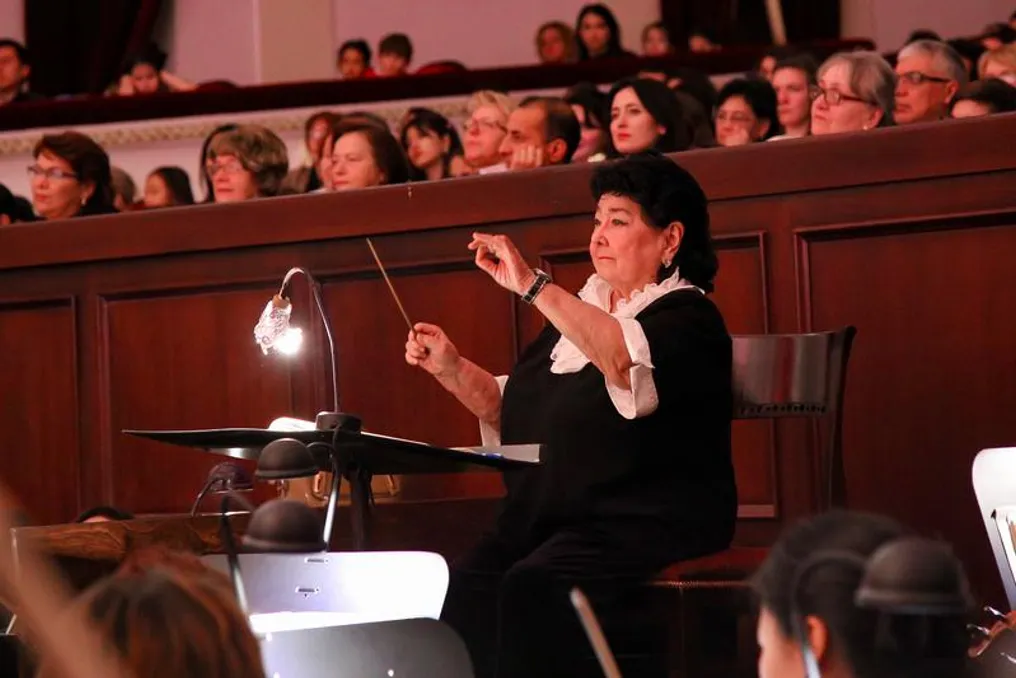
The State Academic Grand Theatre named after Alisher Navoi is preparing to hold a solemn evening titled 'Her Whole Life is Music,' dedicated to the 90th birthday of the outstanding Dilbar Abdurakhmanova. The event will take place on September 19th on the country's main stage, where the creative legacy of the People's Artist of the USSR and laureate of State Prizes, whose name became a symbol of success for the national conducting school, will be presented.
Masters such as the Merited Art Figure of Uzbekistan Fazliddin Yakubjanov, People's Artist of Karakalpakstan Aida Abdullaeva, and international competition laureate Bobomurod Khudaykulov will participate in the evening's program. The directorial score was prepared by the Merited Art Figure of Uzbekistan Andrey Slonim. The GABT named after A. Navoi's opera and ballet soloists, symphony orchestra, and choir will unite in a single performance so that every note reflects the unique talent of Maestro Abdurakhmanova.
Dilbar Abdurakhmanova was nicknamed the 'fiery conductor,' and this description perfectly matched her essence. She was the first female conductor in the East and a People's Artist of the USSR. Although she passed away on March 20, 2018, she would have turned 90 on May 1st of this year. Her contribution is recognized as a National Treasure of Uzbekistan.
For Dilbar Gulamovna, the State Academic Theatre of Opera and Ballet named after Alisher Navoi was not just a workplace but a sacred space where she dedicated almost 60 years to art. She progressed from a novice conductor to artistic director, concluding her career on stage. The programs she curated included opera, ballet, and symphonic works, demonstrating her deep love for musical theatre.
At the age of 38, she headed the renowned theatre, musically directing 64 opera and ballet productions. Her talent was recognized outside the country: she conducted the Moscow Grand Theatre's symphony orchestra, as well as ensembles in Egypt and Romania, and opened an opera house in Malaysia. Among her awards are the 'Dostlik' and 'Fidokorona Hizmatlari Uchun' orders, the 'Shuhrat' medal, and the title 'Citizen of the 21st Century Earth,' awarded by the Greek philosophical academy; however, she valued the title of Musician above all else.
Abdurakhmanova's performing style was characterized by a unique combination of high spirituality, spontaneous passion, and impeccable technique, complemented by artistry. She gained particular fame through her creative partnership with the director, People's Artist of Uzbekistan and Azerbaijan, Firudin Safarov. This duo created many masterpieces, offering audiences new, vibrant interpretations of classical works such as Sh. Gounod's 'Faust,' 'La Traviata,' 'Trovador,' 'Aida,' 'Othello' by J. Verdi, and 'Carmen' by Georges Bizet.
They also did not shy away from modern productions, including A. Petrov's 'Peter I' and S. Prokofiev's 'Fiery Angel,' as well as operas by Uzbek composers, such as S. Yudakov's 'Maysar's Mischiefs' and M. Bafoyev's 'Omar Khayyam.' The production of 'Fiery Angel' in 1984 drew admiration from Evgeny Svetlanov, who attended the premiere in Tashkent and called it a significant event for the cultural life of the capital of Uzbekistan.
Firudin Safarov always recalled this period of creativity as the happiest of his life, emphasizing that collaboration with Dilbar Abdurakhmanova was not just work but a deep merging of souls united by a love for music and theatre.
Despite her high status, Dilbar Gulamovna was known for her warm and welcoming nature. She was a very hospitable hostess who demonstrated mastery not only in music but also in cuisine, treating guests to aromatic plov and manty. She possessed a sharp mind and a sense of humor, and her stories about cultural life were extremely valuable. In conversation, she preferred to value sincerity over titles.
The scale of her personality is due to her background: her father, Gullam Abdurakhmanov, was a leading soloist of the theatre and the only Uzbek artist awarded the Stalin Prize, and her mother, Zukhra Faiziyeva, returned to the stage at the age of 60 after raising her children. An atmosphere of music always prevailed in their home. The girl was taught violin, piano, and foreign languages, instilling in her diligence and organization, but her strongest quality was her strong will.
From an early age, Dilbar did not just listen to music; she performed. Playing in unison with the Glier school violinists, she gained an innate understanding of the stage and never felt fear of it. The Navoi Theatre became her second home, and she strived to become a central figure in this large musical ensemble.
The beginning of her path to the conductor's podium happened by chance. Working as a accompanist in the school orchestra, Dilbar first held a baton. Her supervisor, N. Tretyakova, noticed her abilities and delegated her the conducting of rehearsals while she was at the conservatory. Soon, N. Tretyakova invited her to a final concert where she was seen by the famous maestro Ashrafi. When asked about her wishes, Dilbar replied that she wanted to be a conductor because she 'wants to make the orchestra sound like a single instrument!', which became a turning point in her life.
Meeting Mukhtar Ashrafi was an important stage in Abdurakhmanova's life. She enrolled in the conservatory, where she studied two fields concurrently: the class of opera-symphonic conducting under M. A. Ashrafi and the violin class with B. A. Titel, a student of P. S. Stolyarsky. Ashrafi trained many conductors, and Abdurakhmanova became a worthy successor to his work.
Over time, the student reached the level of her teacher. When Maestro Abdurakhmanova took up the baton, the audience's attention was completely focused on her. Her work was distinguished by plastic perfection comparable to ballet, as well as an exceptional ability to immerse herself in the performance, controlling every detail both on stage and in the orchestra.
It was very sad that Dilbar Gulamovna passed away, leaving behind a huge legacy. Despite poor health, she maintained a positive attitude and shared plans for future premieres, as if wanting to remain in the profession. Her spirit did not fade even in the face of illness.
The melody of her life ended on March 20, 2018. Firudin Sattarov deeply mourned the loss of an indispensable collaborator and friend. Later, on July 26, 2024, he also passed away. These two titans dedicated their lives to the stage, becoming a guide and conscience for the Uzbek Opera and Ballet Theatre. Their joint work remains a legend.
The greatness of Dilbar Gulamovna Abdurakhmanova can only be described as a National Treasure. She entered history forever. The upcoming anniversary evening will serve as a reminder of the greatness of this woman and the legacy that lives on in the music and every sound of the orchestra.