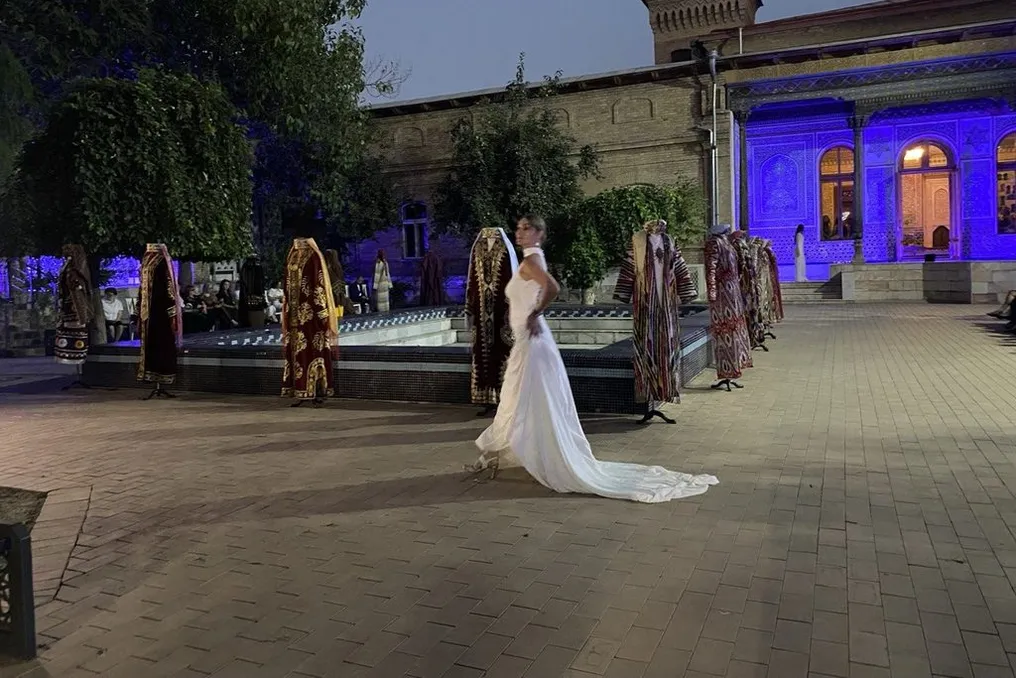
A special fashion show titled 'Silk: From Tradition to Modernity' took place at the State Museum of Applied Arts and Handicraft History of Uzbekistan. The event was organized in honor of the 35th anniversary of the independence of the Republic of Uzbekistan, as well as the 100th anniversary of the Textile Museum in Lyon, France.
The organizers of this event were the brand Bahor France, the Association 'Khunarmand' of Uzbekistan, and the State Museum of Applied Arts and Handicraft History of Uzbekistan itself. Uzbek sericulture has shaped a unique culture over many centuries, characterized by the diversity of fabrics, national ornaments, and features of decorative and applied arts.
Lyon, France, is famous for its long-standing school of textile and silk production, possessing rich traditions in fabric creation and making a significant contribution to world fashion. The combination of Uzbekistan's national colors and French textile craftsmanship with current fashion trends inspired Navbahor Bodo, the founder of the eco-brand and atelier Bahor France, to develop a new collection.
Navbahor Bodo, born in Khorezm, moved to France and founded a brand in Lyon specializing in premium clothing and home textiles made from natural Uzbek silk. Although the roots of the Bahor brand trace back to Uzbekistan, it has become a thriving enterprise in Lyon. Lyon has become a link between the designer and the history of fine and strong silk thread.
Navbahor Bodo shared that the main source of inspiration for her was history, and the collection represents a journey expressed through traditional colors. She noted that for the Bahor brand, using such a variety of colors is a debut, as they were previously associated mainly with a black and white palette. She frequently visits Uzbekistan to study local fabrics and patterns, which gives her a powerful creative boost. Bodo stated that she has learned to work virtuously and harmoniously with both Uzbek and Lyon silk, and it is deep knowledge of history and cultural heritage that allowed her to boldly unite them, integrating a bright palette of Uzbek colors into the French collection.
In the atmosphere of the courtyard of the State Museum of Applied Arts and Handicraft History of Uzbekistan, against the backdrop of its recognizable facade, and using samples of the national costume of Khalida Kamilova, showcasing the beauty of women's clothing from different regions of Uzbekistan, a grand presentation took place. The rich heritage of Uzbek sericulture found a new voice, merging with the fashion culture of Lyon. The show demonstrated the potential of national fabrics and craft elements in modern fashion, emphasizing the connection between history and contemporary creativity.
Gulnara Musaeva, Director of the State Ensemble of Dance of Uzbekistan 'Bahor', reported that about three years ago, the 'Bahor' ensemble signed a cooperation agreement with the Bahor brand. They agreed to participate in shows and jointly implement creative projects. This show was the first joint one. Musaeva added that the dancers easily work as models because they have excellent body control and know how to perform on stage, so they are interested in this format, and they plan to continue the cooperation. A major project is planned for next year, which is hoped to take place in Lyon, and it will include not only a collection show but also an exhibition of costumes, as well as a musical and dance program featuring the 'Bahor' ensemble.
The event attracted guests from Lyon and other parts of France, including the president and representatives of the Lyon Textile Museum Association, specialists in culture, fashion, and textiles, partners of Bahor France, as well as representatives of French cultural circles. During the show, an exchange of experience and opinions took place between designers, artisans, art and culture experts, as well as representatives of the tourism and textile industries of Uzbekistan and France.
Henri Brender, President of the Society of Friends of the Textile and Decorative Arts Museum in Lyon, shared his impressions, calling Uzbekistan an 'incredibly interesting, useful, and aesthetically beautiful destination.' He noted the hospitality of the residents and the splendor of the architectural monuments. Brender believes that the promotion of Uzbek culture, such as the appearance of Uzbek satin on world runways, is just beginning in Europe. He also mentioned that a stereotype persists among Europeans that Uzbekistan is merely a former Soviet republic, but after visiting, they saw a high level of development and aspire to become ambassadors for Uzbekistan in Lyon and France to popularize its heritage.
Thus, silk has served as a link between East and West for centuries. Today, it is gaining new meaning, contributing to the promotion of the rich heritage of Uzbek applied arts and handicraft, opening up new opportunities for the harmonious combination of national heritage with modern design, and symbolizing cultural cooperation, dialogue, and friendship between Uzbekistan and France.