Attention to horses has increased again due to the holding of the VI World Nomad Games in Kyrgyzstan, which took place from August 31 to September 6. The competition program included over 40 disciplines, a significant part of which involved horses. Participants competed in kok-boru, kokpare, horse racing, long-distance horse marathon, and er-enish, as well as various national wrestling styles.
The most successful athletes were from Kazakhstan and Kyrgyzstan. The Ministry of Tourism and Sports of Kazakhstan reported that Kazakh athletes won in disciplines such as joryq (long-distance horse racing) and tengge ilu. This success is attributed to Kazakhstan's support for the development of horse breeding and respect for the traditions of its nomadic ancestors.
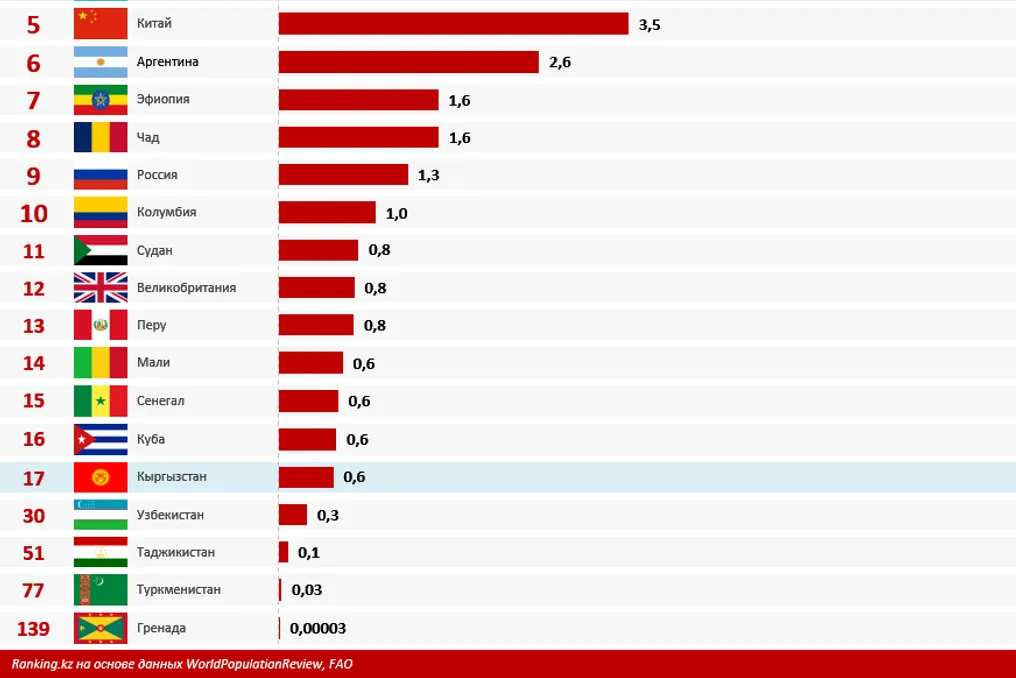
According to data from the Food and Agriculture Organization of the United Nations (FAO), Kazakhstan has held fourth place in the world ranking by the number of horses for several years. As of 2024, Mexico (6.4 million head), Brazil (5.7 million head), Mongolia (4.7 million head), Kazakhstan (4.4 million head), and China (3.5 million head) entered the top five countries with the largest horse populations.
International statistics show that the Republic of Kazakhstan is the undisputed leader in horse population in Central Asia, while other countries lag significantly. For example, Kyrgyzstan, which initiated the World Nomad Games, ranks only 17th in the world, having only 553.5 thousand head in 2024. Uzbekistan is ranked 30th with 283 thousand head, Tajikistan is 51st (92 thousand head), and Turkmenistan shows the worst result in Central Asia with 27.6 thousand head.
There are many factors explaining such a significant difference in livestock development between neighboring states. One of the most obvious is Kazakhstan's large territory, which exceeds 2.7 million square kilometers. Furthermore, Kazakhstan's leadership in the region in terms of herd growth is supported by regular funding for this sector. These investments are necessary not only to increase the number of animals but also to build, modernize, and reconstruct facilities, as well as to purchase equipment and transport.
Capital investments in horse breeding in 2020 amounted to 3.5 billion tenge, and this amount doubled over the following two years. The peak of investment activity was in 2023, when the inflow of funds sharply increased to 49 billion tenge.