In recent years, Uzbekistan and Azerbaijan have transformed their strategic partnership into a full-fledged alliance. Their interaction shows two aspects: on one hand, the institutional framework for cooperation is fully formed, while on the other, economic activity is only beginning to gain momentum.
Analysts believe that the future of Uzbek-Azerbaijani relations will depend on how the development of political and diplomatic mechanisms correlates with the actual substance of economic interaction.
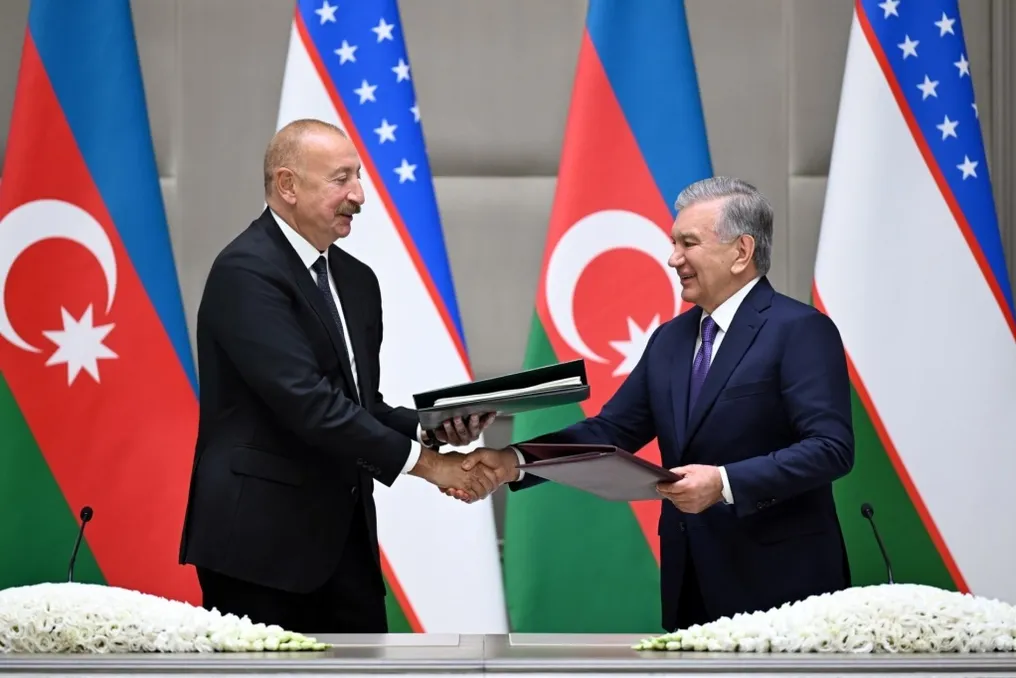
The architecture of bilateral ties developed by Tashkent and Baku is based on the principle of top-down coordination. This means that the main directions are determined at the level of heads of state, and their implementation is ensured by intergovernmental, departmental, and business structures. The key vectors of cooperation and its pace are set by the President of Uzbekistan Shavkat Mirziyoyev and the President of Azerbaijan Ilham Aliyev, which contributes to reducing decision-making times.
Thanks to this, an extensive system of interaction has gradually been established. In 2023, the Supreme Interstate Council was created, whose first meeting took place in 2024, and a Treaty on Alliance Relations was signed. In July 2026, the fifteenth meeting of the Intergovernmental Commission was held in Tashkent. Since 2020, the Uzbek-Azerbaijan Business Council has been functioning, brotherhood has been established between eleven cities, and over twenty high-level interparliamentary meetings have been held in the last three years; the first interparliamentary forum was organized in Khiva in 2025.
Such a high intensity of contacts is usually characteristic of neighboring states or countries with a much larger volume of mutual trade. For Uzbekistan and Azerbaijan, separated by the Caspian Sea and having relatively small trade turnover, the achieved level of institutionalization is of particular significance.
The practical effect of this framework is the reduction of administrative and political obstacles, acceleration of decision-making, and simplification of business access to the partner's market. Nevertheless, the institutional structure itself does not generate commodity flows or investment demand; it merely creates favorable conditions for business activity but does not replace the economic incentives that determine further dynamics.
Consequently, the next stage of cooperation will likely be determined not so much by increasing the number of existing formats as by their ability to transform achieved political ties into tangible economic results.
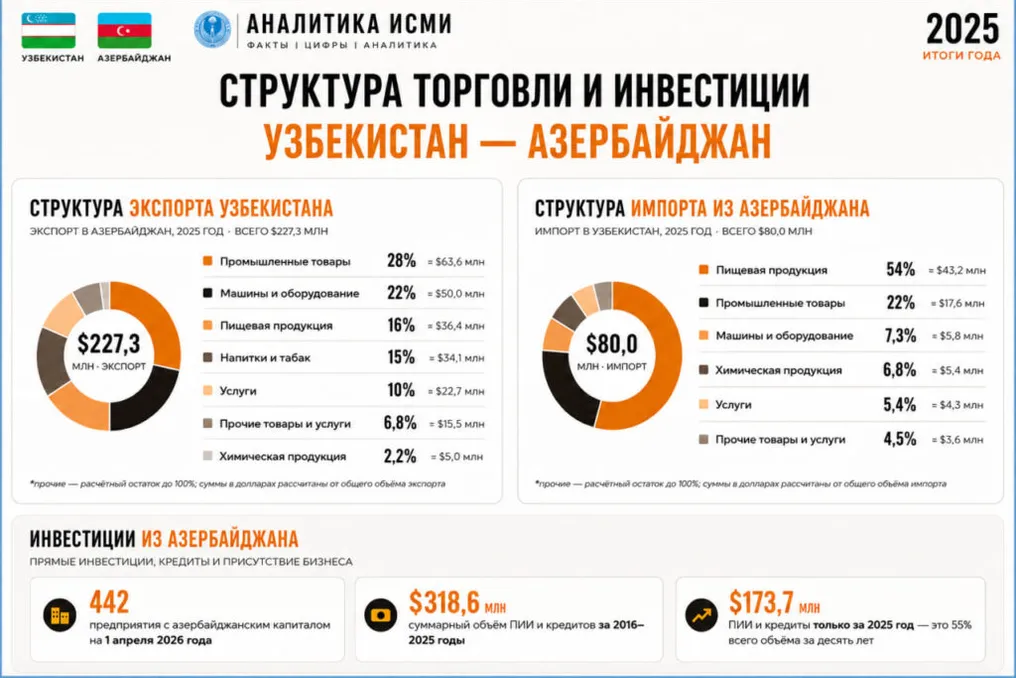
Political dialogue precedes real economic indicators, which is confirmed by statistics for 2025. Mutual trade reached 307 million dollars, showing an increase of about 15%. Uzbekistan's exports increased by 8%, amounting to 227 million dollars, while imports from Azerbaijan grew by 39%, reaching 80 million dollars. Furthermore, the nomenclature of Uzbek exports expanded by 116 items.
However, these figures look different when compared to Uzbekistan's total foreign trade turnover in 2025, which exceeded 81 billion dollars. Azerbaijan's share in this turnover was less than 0.4%.
This figure should not be interpreted as an assessment of the quality of bilateral relations, but rather demonstrates the complexity of transforming political rapprochement into large-scale economic ties. This is due to a number of objective structural factors.
These limitations include the lack of a common border, the need to use multimodal transport via the Caspian Sea, partial overlap in export goods (such as textiles, fruits and vegetables, some chemical products), and a similar diversification model where the parties often compete in third-party markets rather than complementing each other.
Based on this, the practical conclusion is clear: simply increasing traditional trade is unlikely to achieve the target of 1 billion dollars set by the heads of state. Growth must be sought through industrial cooperation and investment, where trade flows are formed through joint production chains.
Both countries realize the importance of such a systemic approach, so the focus of the agenda in recent years has shifted from trade to attracting investment. The Azerbaijan-Uzbek Investment Company (AUIC), established in 2023 with a charter capital of 500 million dollars, according to the Ministry of Investment, Industry and Trade of Uzbekistan, is already involved in 15 projects worth about 360 million dollars. The company's total portfolio is significantly broader and includes more than 20 projects worth approximately 6 billion dollars, and another 25 projects worth 1.5 billion dollars are in the preparation stage.
An example of how investment interaction goes beyond stated plans is the joint assembly production of 'Uzavtosanoat' and 'Azermash' companies in the Gadjigabul Industrial Park. More than 11 thousand Chevrolet cars and Isuzu buses have already been produced there. Currently, this project is moving to the stage of creating a full-cycle enterprise with investments exceeding 84 million dollars. Agro-industrial, logistics, textile, and sericulture clusters are developing in parallel.
The significance of such initiatives is determined not only by the volume of output but also by the formation of sustainable production links. Joint production guarantees constant demand for components, raw materials, and equipment, integrating bilateral trade into a single production chain. Such ties are less susceptible to market fluctuations as they rely on long-term production needs.
Furthermore, localizing production in Azerbaijan while adhering to rules of origin provides potential access to third-country markets where Baku has preferential trade regimes. Thus, joint ventures can serve not only to develop domestic markets but also as a platform for joint promotion of products outside Uzbekistan and Azerbaijan, although this requires the development of special trade, customs, and legal mechanisms.
The potential for expanding cooperation exists due to the established institutional framework and the results of economic interaction. However, its realization depends on the ability of the parties to overcome a number of structural problems.
The main obstacles remain the competition of similar goods in external markets, the instability of Caspian logistics related to seasonality and the condition of the ferry fleet. Additional difficulties include issues with direct bank transfers between the countries and cargo insurance, which increases the cost and duration of foreign trade operations.
Several practical measures are proposed to accelerate the pace of cooperation. One of the most effective steps could be the mutual recognition of certificates and laboratory test results, especially for agricultural products, which will reduce time and costs when goods enter the partner's market.
In the financial sphere, it is advisable to expand correspondent banking relationships and conduct settlements in national currencies through direct payments and convenient conversion mechanisms. This reduces dependence on intermediaries and makes trade and investment operations more predictable.
It is also important to pay attention to transport infrastructure: expanding the capacity of Caspian routes, unifying schedules and tariffs, and implementing digital cargo tracking will help reduce costs for businesses.
Ultimately, Uzbek-Azerbaijani relations have reached a point where accumulated political capital is beginning to find economic and practical expression, allowing for talk of a solid foundation for deepening allied ties.