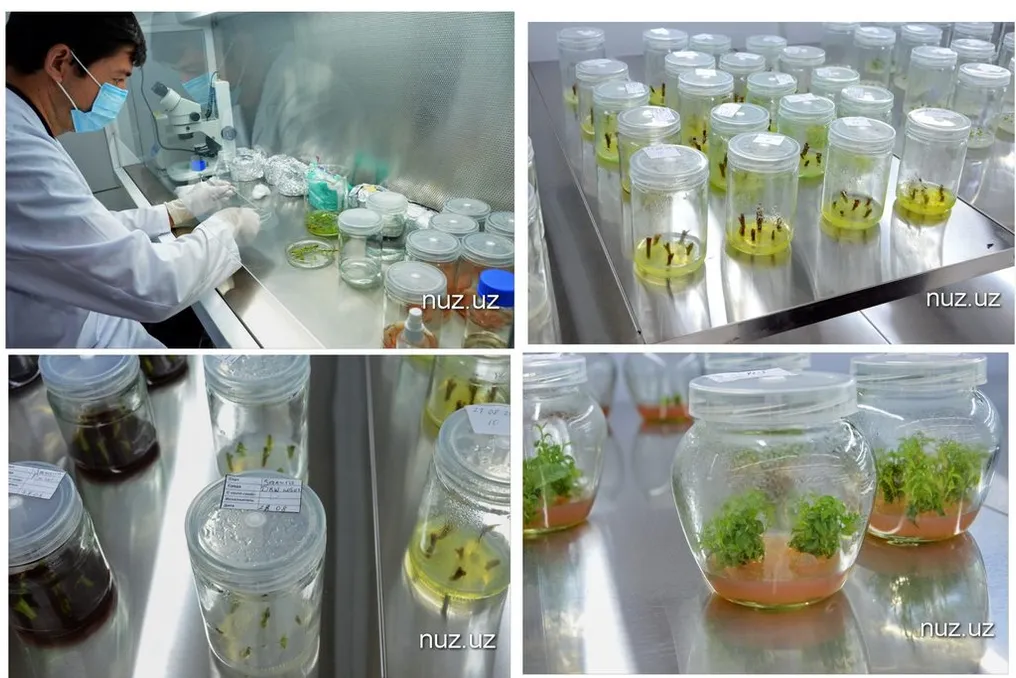
The Central Asian University of Environmental Studies and Climate Change, known as Green University, held an opening ceremony for the Innovative Laboratory of Forest and Ornamental Plants, as well as the 'In-Vitro' laboratory for forest and ornamental trees.
Thus, a complete laboratory complex has been formed, which includes five separate units: the in vitro laboratory, the medicinal plants laboratory, the soil science laboratory, the plant protection laboratory, and the laboratory dedicated to seed conservation, processing, and viability research of forest plants.
Bahodir Eshchanov, head of the university's department for commercialization of scientific and innovative developments, announced the establishment of this structure. The laboratory is intended to engage in plant propagation using the in vitro method, as well as the conservation of medicinal, forest, and ornamental species.
The main objective of the in vitro laboratory is to clone rare plants by extracting them from the growth point. The second goal is to obtain plants completely free from any diseases and viruses. This method guarantees the accurate transmission of genetic material from one plant to another. After extraction from the in vitro laboratory, the plants undergo an acclimatization stage before being planted in the field, where they demonstrate characteristics identical to the original plant.
Although the laboratory is still in the launch process, certain work has already begun. It is equipped with modern technical equipment that allows for the full support of both research and production processes.
The laboratory's responsibilities include preparing sterile nutrient media and controlling their quality. Furthermore, explant selection, washing, and sterilization, plant cultivation and micropropagation under in vitro conditions, as well as rooting and growth stimulation are conducted. This is followed by the acclimatization and adaptation stage to greenhouse conditions, obtaining virus-free planting material, and phytosanitary control. The complex is also involved in preserving genetic diversity, creating collections, conducting scientific research, experiments, and developing innovations, as well as analyzing and practically implementing the obtained data.
The process begins with selecting healthy and young plant raw materials, which undergo surface sterilization in sterile conditions. Then, the material is placed on nutrient medium for incubation. Shoot propagation is carried out using specific concentrations of nutrients and hormones. A special nutrient medium is used to form the root system. The cycle concludes with the acclimatization stage, when the plants adapt to the external environment, after which healthy seedlings are moved to the greenhouse.
This laboratory will contribute to obtaining high-quality, virus-free planting material and will allow for the cultivation of a large number of seedlings in a short period. It will also ensure the preservation of genetically resistant and valuable varieties, the creation of phytosanitary clean plantations, the introduction of biotechnological innovations into practice, and the increase in the efficiency of both agriculture and forestry.
Within the scope of research, species of woody plants capable of fast growth and yielding high-quality timber will be studied, as well as the breeding, seed production, and cultivation of planting material for nut-bearing trees and shrubs. Additionally, based on the research conducted, educational manuals, monographs, and scientific developments in forestry and related fields will be created.
In addition, the laboratory analyzes humus content, as well as general and mobile forms of essential soil nutrients (NPK): N-NO3, N-NH4, P2O5, K2O. Soil moisture (VWC), its structure, and mechanical composition, as well as the degree of salinization are determined. Monitoring of forest land soils is conducted, the level of nutrient supply to nurseries is assessed, recommendations for fertilizer use are developed, and agrotechnical and silvicultural methods are applied to prevent soil erosion and degradation.
This helps assess the ecological state of forest land soils through monitoring their fertility, leading to increased fertility and the creation of scientifically sound recommendations for improving forest ecosystems.
The laboratory also performs laboratory analysis of seeds of forest, ornamental, and desert plants. Parameters such as germination rate, purity, moisture content, and suitability of seeds for sowing are determined, and they are evaluated and certified according to established standards. Methodological recommendations for seed storage, drying, sorting, and cleaning are developed, and seed processing technologies are improved. Scientific research is conducted, new methods are implemented, scientific personnel are trained, and young researchers are supported, as well as international cooperation is developed.
Seeds of birch, coniferous trees, ornamental trees, shrubs, desert, medicinal, lawn, ground cover, subtropical, and rare plants, as well as seeds of other flora species, are analyzed. The results of this work will allow for obtaining a high-quality seed fund, accurately determining the quality and germination rate of seeds, which will provide forestry with high-quality seed material, increase its storage life, and reduce losses.
Specialists with appropriate qualifications and knowledge in biology and chemistry are required to work in the laboratory. Bahodir Eshchanov noted that the university attracts employees with bachelor's or master's degrees in these fields and organizes special training for them to become specialists.
Regarding the scale of production, the problems solved in the laboratory are considered at both national and global levels. Bahodir Eshchanov added that they study the difficulties faced by local populations or forestry enterprises and offer them solutions at the state level. At the same time, the production laboratory also operates on a commercial basis: produced seedlings, varieties, and various plants can be sold to local residents, state structures, or exported abroad.
Experts believe that the opening of this laboratory will not only preserve but also actively develop the gene pool of forest, ornamental, and desert plants.