Share of Information and Communication Technology Services in Uzbekistan's GDP Reached 2.9%
Read more
UzDaily
uzdaily.uz

Share of Information and Communication Technology Services in Uzbekistan's GDP Reached 2.9%

According to data from the National Statistical Committee, the share of information and communication technology (ICT) services in Uzbekistan's gross domestic product was 2.9% for the period from January to June 2026. This figure is higher than the previous year, when it stood at 2.8%.

The agency also reported that in the same period in 2024, the share of ICT services in the GDP was at 2.4%, demonstrating a growth of 0.5 percentage points over two years.

The total added value generated in the ICT sector in the first six months of 2026 reached 30.3 trillion soms. Computer programming, consulting, and related services accounted for the largest share of the ICT gross added value structure, making up 53.6%.

Communication services provided 28.9% of the sector's total added value, while data hosting and processing services, as well as web portal activities, accounted for 10.5%. Furthermore, software accounted for 4.4%, and computer and communication equipment repair accounted for 2.6%.

Thus, in January-June 2026, computer programming, consulting, and related services contributed the most to the ICT gross added value in Uzbekistan, followed by communication services.

Similar stories

Uzbekistan's exports reached $17.1 billion in the first seven months of 2026
Read more
uzdaily.uz

Uzbekistan's exports reached $17.1 billion in the first seven months of 2026

According to data from the Ministry of Investment, Industry and Trade of Uzbekistan, the total volume of Uzbekistan's exports for the first seven months of 2026 amounted to $17.1 billion USD. This figure exceeded the volume recorded for the same period last year by 132 percent.

From January to July 2026, products of domestic production were sent to 120 countries. Furthermore, Uzbek exporters expanded their presence into five new foreign markets: Sudan, Zimbabwe, Cambodia, Honduras, and Mauritius.

The main factors driving export growth were supplies of textile products, fruits and vegetables, jewelry, construction materials, food products, and electrical goods.

Support for Exporters and Financial Assistance

The Ministry and relevant agencies continue to support domestic exporters and promote Uzbek goods on the international stage. Over the seven-month period, 1141 business entities received financial assistance through the Trade Promotion Fund. Under pre-export financing mechanisms, $136.5 million USD was allocated to 113 enterprises, which contributed to subsequent shipments worth $1.53 billion.

Work on Resolving Operational Issues

One of the main tasks of trade authorities remains solving the operational problems faced by exporters. From January to July 2026, specialized export support centers reviewed 3044 requests from business representatives, of which 2547 were positively resolved, accounting for an 84 percent resolution rate. The Ministry continues to work on diversifying export geography, stimulating the export of high value-added goods, and improving state support mechanisms for commercial enterprises.

Uzbekistan ranks 63rd in the UN Global E-Government Development Index
Read more
nuz.uz

Uzbekistan ranks 63rd in the UN Global E-Government Development Index

Digital transformation is a crucial element of Uzbekistan's development, encompassing numerous aspects of life, including public administration, business, education, finance, and the provision of household services. In recent years, the country has been actively building its digital infrastructure, expanding access to online services, and integrating advanced technologies into the work of state structures.

One of the most significant achievements in this area is the development of e-government, which makes public services more prompt, convenient, and accessible to the population in a digital format.

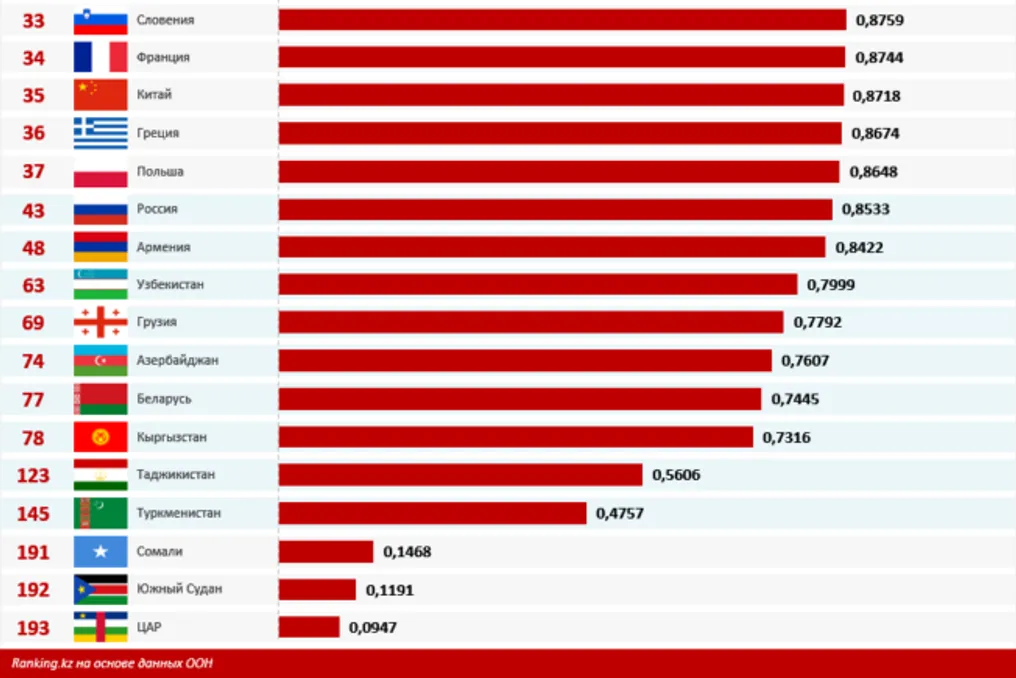
According to the latest UN report on the Global E-Government Development Index for 2024, Uzbekistan demonstrated a high level of assessment, ranking 63rd out of 191 countries with a score of 0.7999.

Comparing results with other regional states, Uzbekistan lags behind Kazakhstan, which entered the top 25 at 24th place, and Russia, which is ranked 43rd. However, Uzbekistan surpasses countries such as Georgia (69th place), Azerbaijan (74th place), Belarus (77th place), and Kyrgyzstan (78th place).

The digitalization process in Uzbekistan goes beyond simply moving certificates and applications online. Modern digital solutions cover almost all major points of interaction between the state, business, and citizens—from registering entrepreneurial activities and obtaining permits to social payments, healthcare, and educational services.

To promote the digital transformation of society and the economy, the Republic of Uzbekistan Digital Government Portal was launched on January 1, 2024. This step was taken in accordance with the Decree of the President of the Republic of Uzbekistan 'On additional measures to improve the rating of the Republic of Uzbekistan in the United Nations 'E-Government Survey'' dated September 14, 2023, No. PP-308.

Further development is enshrined in the 'Uzbekistan – 2030' Strategy, which aims to achieve 100 goals across five priority areas by 2030, defining corresponding efficiency metrics. Goals 33, 57, and 77 of this strategy directly relate to digitalization. Specifically, Goal 57 provides for the implementation of 300 priority projects within the 'Digital Government' program, as well as ensuring fifth-generation connectivity in Tashkent, Karakalpakstan Republic, and regional centers. Goal 77 also sets criteria for expanding the scale of public service digitalization.

Experts believe that, given the current pace of development, Uzbekistan has significant potential to enter the top 30 countries in the UN e-government development ranking in the coming years.


Popular