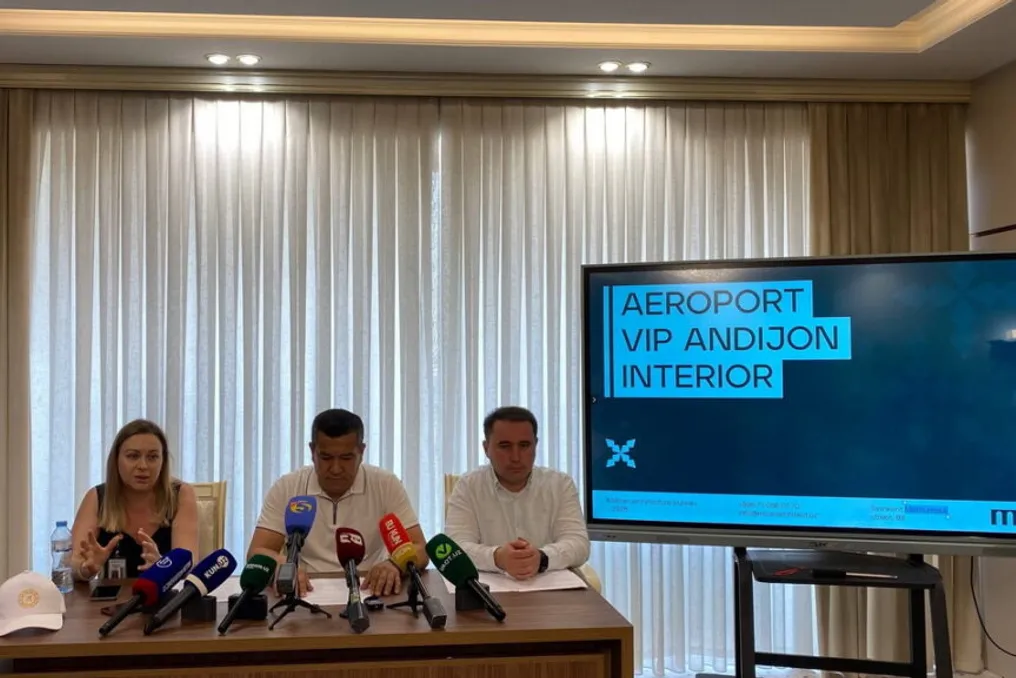
A new passenger terminal is under construction at the Andijan International Airport, intended to significantly increase the airport's capacity—from the current 200 to 1000 passengers per hour. Construction is planned to be completed by the end of 2026. This information was announced during a press tour of the site.
The new complex is part of an extensive airport modernization program. The future terminal will cover an area of 19,650 square meters, nearly eight times larger than the existing building, which was constructed in 1979. After commissioning, the new complex will enable the airport to handle over 1 million passengers annually.
Abdulnazarov Kobiljon Kharamovich, First Deputy Director of Andijan International Airport, emphasized that the main goal of creating the new terminal is to ensure comfortable conditions for all passengers and provide the airport with opportunities for further development. The new building includes separate zones and entrances for different passenger groups, including persons with disabilities and VIP clients. Additionally, special areas will be organized for those who see off or meet arriving passengers.
The international hall will occupy over 6,000 square meters. One of the most important elements of the terminal will be three jet bridges, which will significantly speed up boarding and disembarking processes, especially when handling wide-body aircraft. Abdulnazarov noted that speed of ground handling is critically important for airlines, as less time spent on the ground leads to greater flight efficiency.
The need for airport expansion is driven by the growing number of passengers. In 2025, after the airport opened on March 24, more than 94 thousand passengers were registered. In the first seven months of 2026, this figure reached 127 thousand people. By the end of the current year, the airport forecasts exceeding 200 thousand passengers, and after the full launch of the new terminal, reaching over 1 million passengers per year.
Currently, international flights operate from Andijan to Jeddah, Medina, Novosibirsk, Moscow, and Istanbul, as well as almost daily domestic flights to Tashkent. Kenjaev Sohibjon Abdukhalilovich, Director of Andijan International Airport, reported that international destinations are currently served approximately 8–9 times a week, while this figure is planned to increase to 60 weekly flights after the completion of the terminal construction.
The airport intends to expand its existing route network, paying special attention to destinations such as Turkey and China. Increased flight frequency to Moscow, St. Petersburg, Novosibirsk, and Kazan is planned for Russian destinations. Negotiations with airlines regarding the launch of new flights are also underway. To attract foreign carriers, the airport must comply with international standards, so an audit assessing safety, passenger and baggage service quality, and border and screening control operations is conducted before launching new routes. The design of the new terminal takes these requirements into account.
The modernization also affected the airfield section. The runway was extended from 2,985 to 3,300 meters, and its width was increased from 45 to 60 meters. The runway received concrete paving, which, with proper maintenance, can last for over 30 years. The number of aircraft parking spots has also increased: instead of six aircraft, the future airport will be able to accommodate up to 10 simultaneously.
These changes have already allowed the airport to accommodate larger aircraft. On July 3, Andijan first received a regular Airbus A330 flight from Flyadeal airline on the Medina—Andijan route, carrying 354 passengers. On August 4, the airport first received a full cargo flight Boeing 747-400F from Challenge Air Cargo. Abdulnazarov noted that previously similar aircraft could only make technical landings for refueling, but a full cargo flight with cargo was accepted specifically in Andijan.
Although the new passenger terminal is exclusively for passenger transport, a separate cargo terminal is planned to be built there in the future. As of August 14, the readiness of the new passenger terminal reached approximately 40%. Work on the drainage system, foundation preparation, foundation concreting, and installation of the plinth concrete have been completed. The structure assembly covered 13,104 square meters, and the installation of roofing profiles is fully complete. Currently, work is underway to install connecting metal structures, intermediate beams, and facade guides.
The project is being implemented by Uzbekistan Airports without the participation of private investors under a public-private partnership scheme. The contract for construction and installation works was signed on February 5, 2026. The general contractor is MARIN BUSINESS TRADE LLC, and the general designer is PRIME TOWER GROUP LLC. Furthermore, the reconstruction includes preserving the historical heritage of the airport: mosaics and other valuable elements of the old building will be preserved and moved to the new terminal, where a museum dedicated to the history of Andijan Airport will be created. After the demolition of the old building, an administrative building for staff, as well as a facility for military and relevant services, is planned to be located on its site.
Thus, the modernization aims to eliminate current infrastructure limitations and create a basis for the further growth of air transport. The airport strives to increase the number of flights, attract new international partners, expand its global route network, and develop cargo transportation in the future. For Andijan, this means transforming from an airport with limited capacity into a significant transport hub of the Fergana Valley.