The phenomenon of gender imbalance goes beyond a simple disparity in wages between genders; it encompasses a range of sociocultural factors affecting women's quality of life. These factors include a higher percentage of female unemployment, limited career opportunities due to the uneven distribution of domestic responsibilities, and differing access for men and women to high-paying economic sectors, alongside regional specifics and societal stereotypes.
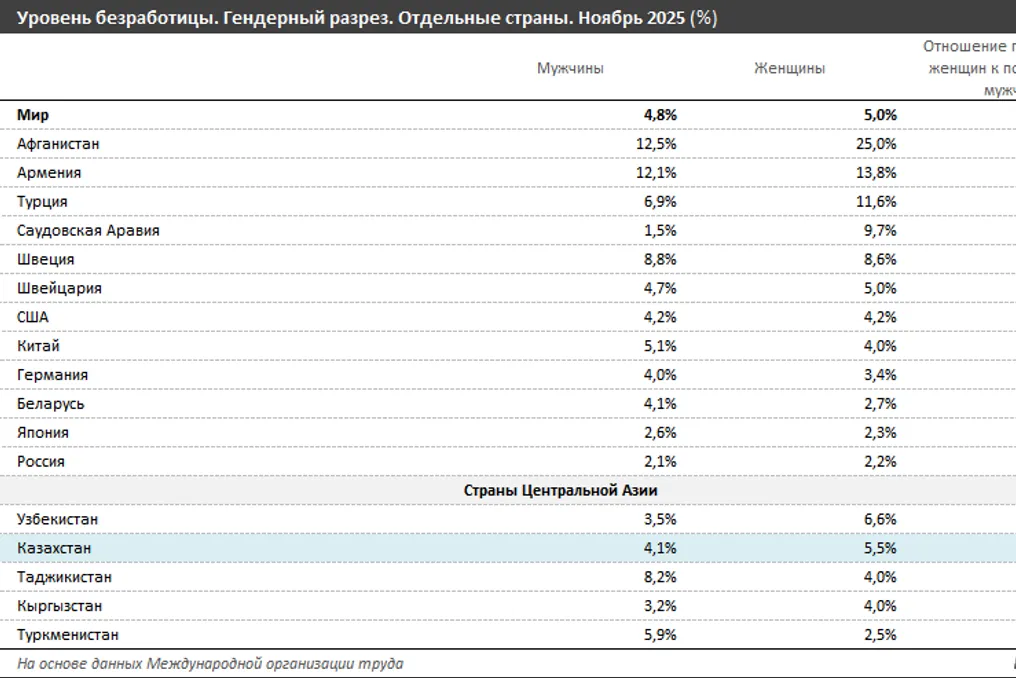
Older women are most vulnerable. According to data from the International Labour Organization (ILO), in November of the previous year, the unemployment rate among women in Uzbekistan was 6.6%, exceeding the rate among men (3.5%) by 3.1 percentage points.
The situation in Central Asia is diverse. Three countries in the region have recorded an elevated level of unemployment among women. In addition to Uzbekistan, a similar problem is observed in Kazakhstan (where the female unemployment rate is 5.5% compared to 4.1% for men) and Kyrgyzstan (4% among women and 3.2% among men).
In Tajikistan and Turkmenistan, the situation is the opposite: the unemployment rate among men is higher than among women. Experts point out that female unemployment figures in Central Asian countries may be understated due to a high level of informal employment among women. This employment rarely enters official statistics and is not classified as unemployment because women who are actually working are not seeking jobs.
When compared to global data, Uzbekistan is in the average range. For example, in Afghanistan, the gender gap in unemployment reaches 12.5 percentage points (25% among women and 12.5% among men), while in Saudi Arabia, this gap is 8.2 p.p.
At the same time, in some developed countries, such as Germany, Sweden, and Japan, gender differences are either negligible or favor women in terms of lower unemployment rates. The only country listed where complete equality on this indicator is observed is the USA, where the unemployment rate is 4.2% for both men and women.
ILO experts explain that the organization's data may differ from the statistics provided by the National Statistical Committee of the republic. The reason lies in some countries using their own internal methodologies instead of those recommended by the International Labour Conference. Therefore, the ILO independently calculates indicators based on initial data from countries to ensure comparability of statistical data internationally.