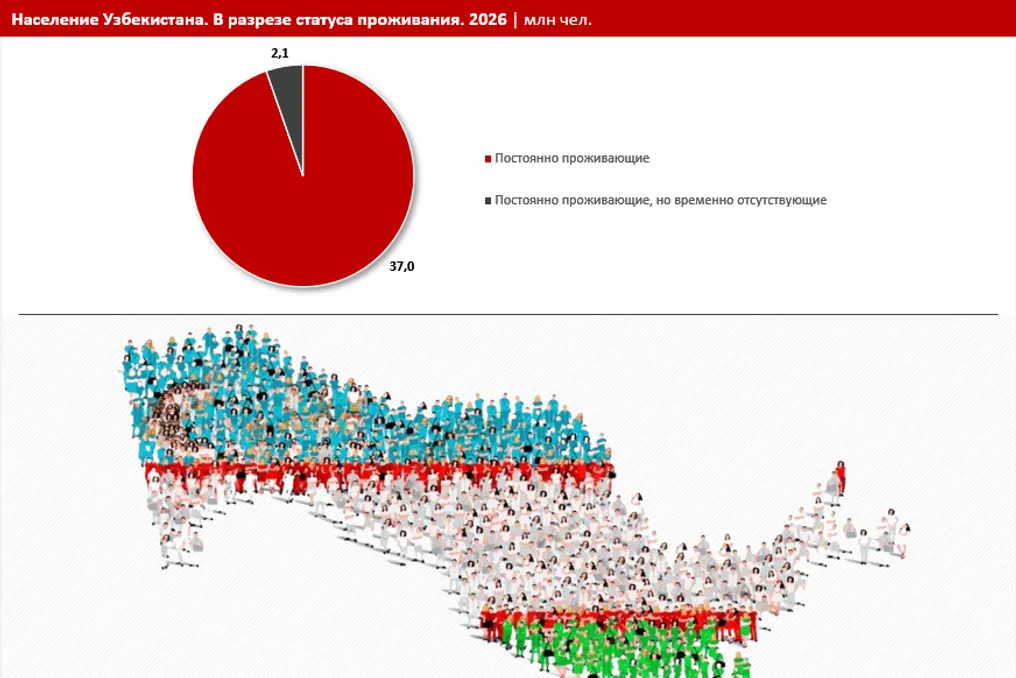
According to information presented in the census report by the National Committee of the Republic of Uzbekistan on Statistics, 5.4% of Uzbek citizens, equivalent to 2.1 million people, do not reside at their official registration address. Among this group, labor migrants constitute a significant share—78.6% or 1.6 million people, which corresponds to 8% of the country's total employed population. This category includes both internal migrants and those who travel abroad for work. Furthermore, two-thirds of those working outside their home region are men, while women in this group account for 36.7%.
The majority of other individuals not registered at their place of residence are students of higher educational institutions: their share reaches 15.7%, or 329.2 thousand people. A noticeable gender imbalance is observed in the education sector: the number of male students almost four times exceeds that of female students.
Labor migration holds particular importance for the economy of Uzbekistan, as many citizens seek better earning opportunities in other countries to subsequently remit funds to their families. In this regard, the Republic of Uzbekistan has adopted a policy of providing support rather than imposing bans on citizens traveling for work. Approximately six years ago, Uzbekistan undertook commitments to ensure safe, orderly, and legal migration. In October 2024, the Migration Agency under the Cabinet of Ministers of the Republic of Uzbekistan was established in the country.
Specialists at this Agency are responsible not only for the legal regulation of external labor migration processes but also for organizing professional training for those planning to leave, as well as conducting foreign language instruction. The Agency maintains its own registry of citizens leaving for extended periods. As of June 1, 2026, there are 1.9 million such citizens, of whom 1.3 million have left specifically for employment. Agency experts estimate that this represents 6.3% of Uzbekistan's working-age population.
It is important to note that this percentage varies significantly across different regions of the Republic of Uzbekistan. For instance, in Tashkent, the proportion of those temporarily traveling abroad is 3.1%, whereas in the mountainous Surkhandarya region, this figure reaches 22.8%, meaning that one in five working-age residents of the region leaves the country. Differences in these indicators are attributed to uneven economic development across territories.
More than half of all Uzbeks who have left for an extended period have chosen Russia as a temporary location for work or residence—this accounts for 51.4% of all those who left, or 998 thousand people. This choice is driven by the tolerance of the Russian Federation's migration legislation and the existing labor shortage in skilled trades in the Russian Federation. Kazakhstan is the second most popular destination, attracting 347.3 thousand Uzbeks. Turkey attracted twice fewer citizens from the Republic of Uzbekistan—151.2 thousand people.
To provide a more structured solution to employment issues, the Migration Agency under the Cabinet of Ministers of the Republic of Uzbekistan launched a specialized online platform. Over 2.6 million citizens have registered on this platform. The portal provides access to vacancies from both the Agency itself and private recruitment firms. As of the beginning of August of this year, the platform's creator posted 13.3 thousand job advertisements. Of these, 11.3 thousand (or 85.2%) concern vacancies in Russian cities, 926 are in Germany, and 350 are in Japan. Additionally, private recruitment agencies published 16.4 thousand vacancies, nearly half of which (7.2 thousand) relate to job offers in Israel. The overall geography of employment covers 14 different countries.
The salary size for labor migrants is determined by numerous factors: from macroeconomic conditions, such as the level of economic development of the host country and the nature of the work performed, to individual characteristics, including age and education level. An analysis of current vacancies showed that the largest number of available jobs is concentrated in the construction, agriculture, and industry sectors. The minimum offered wage for a worker in agricultural enterprises in the Russian Federation is 52 thousand rubles, which, at the current exchange rate, is equivalent to approximately 7.8 million soums. For comparison, the average nominal salary in Uzbekistan last year was 6.4 million soums.
In European countries, migrants are offered significantly higher incomes. For example, a production worker in Germany or a Category CE driver in Bulgaria can be offered 2.5 thousand euros. Converted to the national currency, this corresponds to 34.5 million soums, which is five and a half times higher than the average salary in Uzbekistan.