Instead of demolishing an old wooden house dating back to the 1970s, the Japanese studio HYAN decided to adopt the building, renovating it to serve as the residence and studio for its founders, located on the hills of Hayama in Kanagawa.
Instead of demolishing an old wooden house dating back to the 1970s, the Japanese studio HYAN decided to adopt the building, renovating it to serve as the residence and studio for its founders, located on the hills of Hayama in Kanagawa.
This house was built in the late 1970s during the development period of a residential neighborhood situated behind the former Imperial Village area of Hayama, and belonged to a generation prior to the implementation of the 1981 Japanese seismic code.
Upon taking the house as their home, architect Anna Naganuma and designer Shohei Hasegawa, members of HYAN, observed that the pillars and beams still possessed structural integrity despite the age of the construction. The studio rejected the common idea that old buildings need to be demolished and replaced, opting instead to preserve and strengthen what was already present.
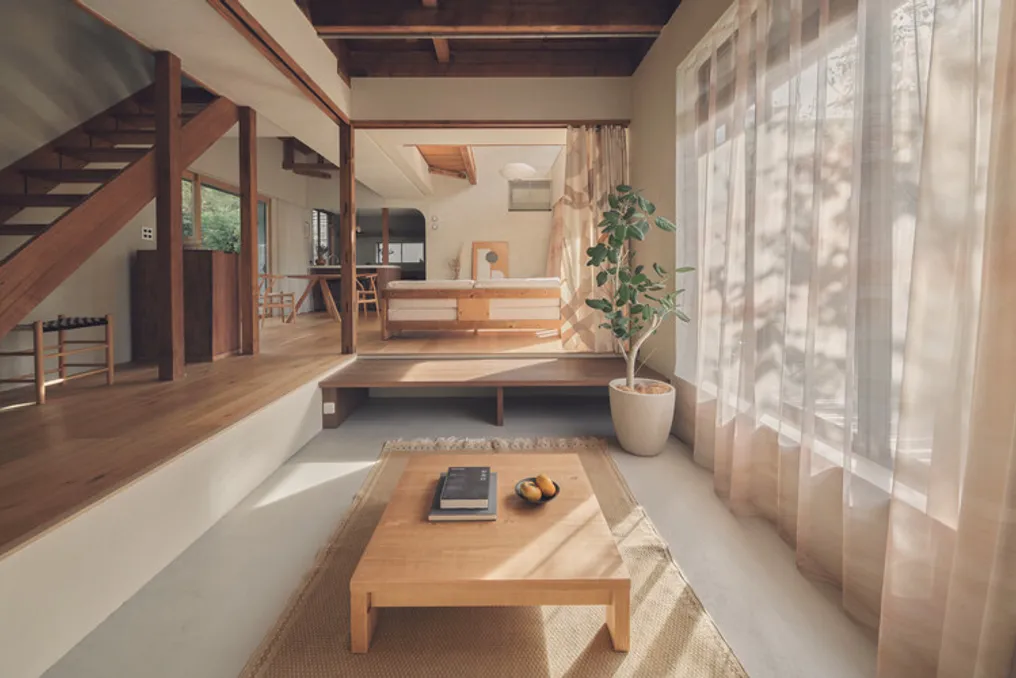
The original structural elements, such as pillars and beams, were maintained as the basis of the renovation, receiving seismic reinforcement and being reorganized under a new spatial concept. On the ground floor, a double-height living room functions as a subtle connection point between the kitchen, pantry, doma, office, and garden.
This arrangement creates a fluid sequence of spaces, contrasting with traditionally function-separated floor plans, allowing activities such as work, daily routine, and leisure to transition naturally throughout the day. The doma was conceived by adapting an old Japanese-style room; the tatami flooring was removed and the floor level was adjusted to mark a clear boundary, while a pre-existing built-in cabinet was repurposed as a small niche.
The division of spaces is not achieved through solid walls, but rather through the use of light, lines of sight, changes in materials, and movable textile elements. Curtains provided by textile designer Haruka Shoji filter the light and views around the large openings and the doma, modifying the character of the house as the day progresses and the surrounding vegetation changes.
The countertops in the kitchen and washroom, made from locally molded and manually polished granilite, establish a soft contrast with the original wooden structure, promoting a dialogue between past legacy and contemporary life. The Green Sandwich House advocates for a more gradual approach to residential renewal, prioritizing the structural strengthening and spatial reinterpretation of existing housing heritage, rather than starting with demolition.
This project, which was planned, inhabited, and tested by the creators themselves, serves as practical proof of how old Japanese single-family houses can be adapted to modern life without being erased. The HYAN team states: 'Light, green, and the seasons pass through the house, and our daily life gradually leaves its marks.' They add that they wanted to create a home that would evolve with the residents, rather than being a static space defined only at the moment of its completion.
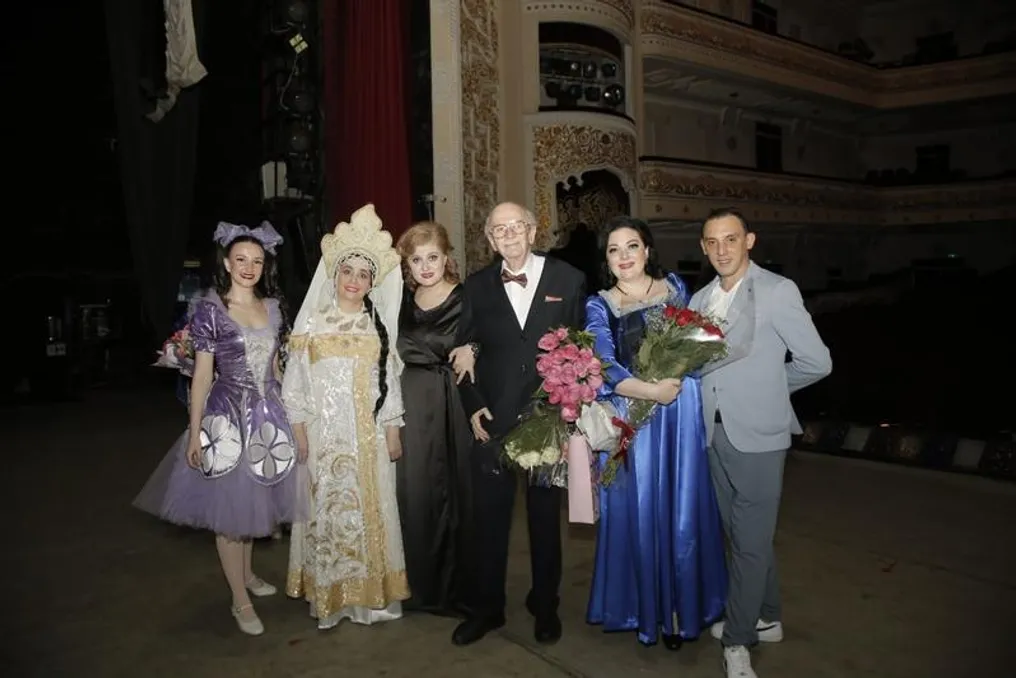
Andrey Evseevich Slonim is among the outstanding figures of world culture, whose achievements brightly illuminate the cultural firmament. As a director, scenographer, poet, and publicist, his multifaceted talent is an important part of Uzbekistan's cultural heritage. As an Honored Artist of the republic and a Knight of the International Association 'Art of Peoples of the World,' Slonim is recognized as an artist whose works are characterized by deep reflection, psychological subtlety, and faith in humanity.
Slonim's biography is an example of self-dedication and hard work. His creative potential blossomed in Uzbekistan, where he created many memorable performances, drawing inspiration from the atmosphere of ancient culture. The beginning of his journey in the world of art took place at the Alisher Navoi State Academic Grand Theatre. Born in Tashkent in 1949, he graduated from the Theatre and Art Institute in 1974, finding his calling.
Andrey Slonim is known for his ability to work with actors, revealing their best qualities and creating vivid, multifaceted images on stage. His productions represent entire worlds into which spectators immerse themselves, becoming witnesses to the joys and sorrows of the characters. He skillfully combines classical traditions with modern trends, making art understandable and relevant to the general public. Thanks to his activity in theatre, the Small Stage exists.
Slonim has acted as a director and set designer in over 70 productions of operas, dramas, and ballets. Today, he is considered a master of opera directing, whose works amaze with a unique combination of deep knowledge of musical dramaturgy and authorial intent, enriched by innovative techniques. He finds a balance between preserving the spirit of the era and the composer, imbuing characters with timeless psychological depth.
Throughout his career, Slonim has gifted the world over 80 performances, including masterpieces of world operatic classics such as Verdi's 'Rigoletto' and 'La Traviata,' Puccini's 'Tosca,' 'Madama Butterfly,' and 'La Bohème,' Rossini's 'The Barber of Seville,' and Mozart's 'The Marriage of Figaro.' From Russian classics, his repertoire includes Tchaikovsky's 'Eugene Onegin' and Rimsky-Korsakov's 'The Tsar's Bride.' His talent was also displayed on the Moscow stage: at the Gneshin Academy of Music Studio Theatre, he staged the operas 'The Witch' by V. Vlasov and V. Fere (1984) and 'The Queen of Spades' by Tchaikovsky (1986).
Since 1990, Andrey Slonim has been the leading director-producer and scenographer of the Alisher Navoi State Academic Grand Theatre of Uzbekistan. In the last twenty years, he has created more than 35 productions of Uzbek and world classics, as well as works by contemporary Uzbek composers. Among them, 'Lucia di Lammermoor' by G. Donizetti, 'The Magic Flute' by W. Mozart, 'The Gypsy Baron' by P. Mascagni, and 'Mavra' by I. Stravinsky were presented in Uzbekistan for the first time. A special place is occupied by N. Zakirov's opera 'Path to the Throne,' based on Shakespeare's tragedies 'Hamlet' and 'Macbeth.' New, bold interpretations, such as 'Hoffmann's Tales' by J. Offenbach, 'The Theatre Director' by W. Mozart, 'Aleko' by S. Rachmaninoff, and 'Boris Godunov' by M. Mussorgsky, delighted the public and earned critical acclaim.
In 1992, Slonim presented the opera 'Diloram' by M. Ashrafi, dedicated to the composer's 80th anniversary. His mastery as a scenographer was demonstrated in the design of the ballets 'Spartacus' by A. Khachaturian and 'Poetic Miniatures' by U. Musaev on the stage of the A. Navoi State Academic Grand Theatre, as well as in international cooperation with the Japanese 'Toyota City Ballet' on the ballets 'Don Quixote' by L. Minkus and 'The Sleeping Beauty' by Tchaikovsky.
Andrey Slonim is the author and producer of over 200 theatrical projects and concert compositions that skillfully combine operatic and chamber performance with poetry. He participated in organizing numerous events dedicated to great masters of word and music, including Navoi, Pushkin, Lermontov, Gogol, Dostoevsky, Blok, Turgenev, Yesenin, Glinka, Tchaikovsky, Schubert, Schumann, Shalyapin, Obukhova, Kozlovsky, and many others. He himself often performs poetic lyrics, demonstrating a deep understanding of poetry from different eras.
Recent achievements include a series of events dedicated to the anniversary of A.S. Pushkin in Uzbekistan, memorial evenings for K. Mukhitdinov, M. Ashrafi, M. Kari-Yakubov, as well as a cycle of gala concerts by the People's Artist of Uzbekistan and Karakalpakstan M. Razzakova.
For more than forty years, Slonim has been devoted to theatrical education, teaching young specialists the basics of acting. He taught the opera class at the Opera Studio of the Uzbekistan State Conservatory and headed the course of opera mastery at the Tashkent Theatre and Art Institute. He was invited to the Gneshin Academy of Music in Russia to conduct master classes on the skill of the opera singer-actor in Ryazan.
From 2015 to 2019, Andrey Slonim performed four times as a project author, director-producer, and host of memorial evenings for I.S. Kozlovsky in Moscow. In 2019, he organized the evening 'I Watched Everything Towards the Volga...' in Moscow, dedicated to the female image in romantic lyricism and 'Silver Age' poetry.
Slonim's contribution to the development of opera art in Uzbekistan is immense. In 2013, he staged the first production of F. Yanov-Yanovsky's opera 'The Princess in the Pea,' and in 2017, the first production of M. Bafoyev's opera-ballet 'Hamsa,' inspired by the poems of A. Navoi. During the same period, he presented the little-known opera 'The Pretender' by W. Mozart to the audience.
Andrey Slonim is a ten-time author of theatrical concert projects dedicated to the royal family. These works were included in the program of the International Festival 'Royal Days' in Yekaterinburg and Alapaevsk (periods 2015-2019 and 2022-2026). Under his direction, the creative group of the A. Navoi State Academic Grand Theatre has repeatedly received high praise from the public.
In December 2018, Slonim led the soloist group of the A. Navoi State Academic Grand Theatre at the International Festival 'Power of Faith' named after Metropolitan Seraphim (Chichagov) in St. Petersburg, where the soloists received awards. In December 2023, the same group successfully performed at this festival in Istry, and his wife Lyudmila Slonim was awarded the diploma 'Best Concertmaster of the Festival.' In December 2024, the group achieved success again at the festival in Vladimir.
In March 2025, together with Lyudmila Slonim and the soloist Begzot Sadykov of the A. Navoi State Academic Grand Theatre, Andrey Evseevich held four important events in Moscow dedicated to the 125th anniversary of I.S. Kozlovsky. These included the staging of a concert-theatrical performance based on Tchaikovsky's opera 'Eugene Onegin' in the hall of the K.S. Stanislavsky House-Museum, as well as the concert-composition 'Knight of Light and Goodness' in the Beethoven Hall of the Grand Theatre. In the same year, upon invitation from the All-Russian Pushkin Foundation, a composition based on Tchaikovsky's opera 'Eugene Onegin' was staged at the G.R. Derzhavin Estate Museum in St. Petersburg. This project was recognized as a bright cultural event of Russia and received gratitude from the Minister of Culture of the Russian Federation O. Lyubimova and the Committee for Foreign Relations of St. Petersburg.
In December of the same year, the evening 'In a Beautiful Country of Love,' dedicated to the anniversary of I.S. Kozlovsky, took place at the Concert Hall of the Central Music School – Academy of Performing Arts of Moscow. This event brought together leading soloists of Moscow opera theaters and the Youth Symphony Orchestra of the CMS.
For ten years, Andrey Evseevich led and inspired the Youth Studio Theatre 'Star of Youth' at the Cultural Center of Germans in Uzbekistan. Under his guidance, young artists embodied masterpieces of world drama on stage, including Goethe's 'Faust' and Shakespeare's 'Twelfth Night.'
A good Bluetooth headset is essential in daily life, whether for physical exercise, work, or simply enjoying music without the interference of wires. Three options currently on promotion on Amazon have been selected and deserve consideration to find the perfect model according to each user's style.
The Philips TWS model offers up to 24 hours of battery life when the earphones are used with the charging case, which is sufficient for long periods. It features a built-in microphone for calls, simple Bluetooth connectivity, and a discreet black finish that matches various looks.
There is also a pink version equipped with 13mm drivers, focusing on more pronounced bass for those who prefer to feel the music with more impact. Thanks to Bluetooth 5.3, the connection remains stable, and water resistance allows use during workouts, while 14 hours of playback ensure the battery lasts most of the day.
Additionally, the JBL Wave Beam 2 was launched with dust and water resistance, featuring a light and comfortable in-ear design. This model is recommended for people who use headphones during physical activities or in more challenging environments, combining JBL's characteristic sound with the convenience of wireless Bluetooth.
It is important to note that these offers may change at any time; therefore, if any of these models attract interest, it is recommended to access the link immediately to secure the purchase before stock or conditions change.
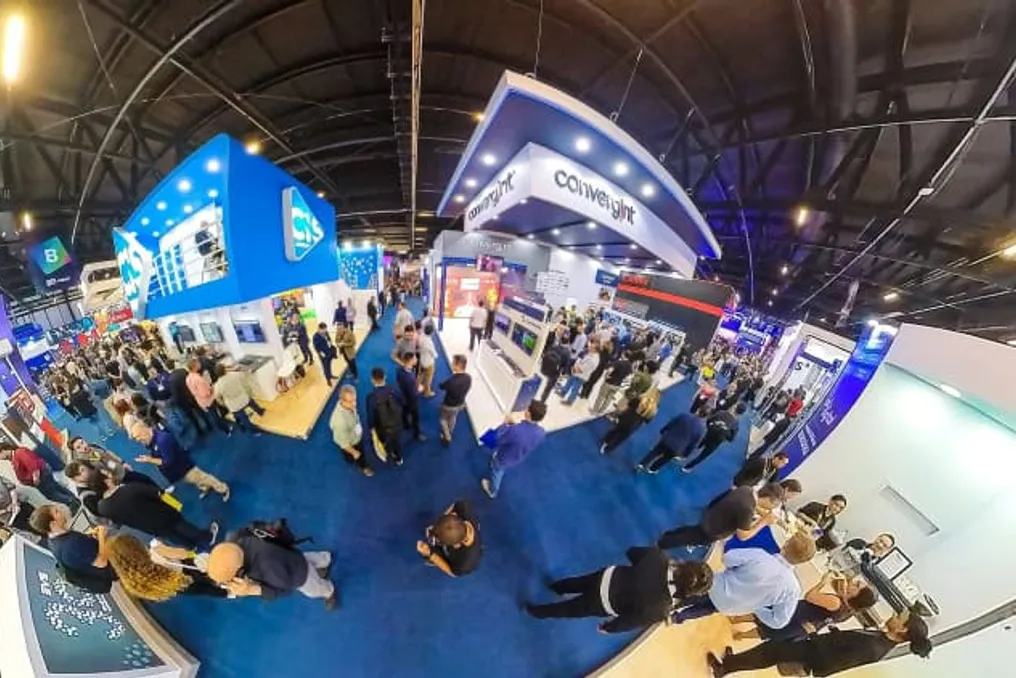
SET Expo 2026 is scheduled to take place from August 17th to 20th in São Paulo. The event aims to gather professionals and companies from the media, technology, audiovisual, telecommunications, entertainment, and innovation sectors.
Considered the largest Broadcast and New Media event in Latin America, the meeting will be held at Convention Centers I and II of the Anhembi District, located in the North Zone of the capital city of São Paulo. The full program includes a congress, an exhibition, and an arena dedicated to content.
The event will feature debates focused on industry trends, the display of technological innovations, the creation of business opportunities, and the promotion of networking. SET Expo targets all professionals and companies operating in the production, distribution, and technological development chain of media and entertainment.
The meeting invites executives, researchers, students, specialists, and various institutions to discuss the changes occurring in the audiovisual market. Among its main purposes are professional updating, business generation, presentation of technological solutions, and knowledge exchange among different sector agents.
One of the pillars of SET Expo is the congress, where Brazilian and international specialists meet to discuss strategic aspects related to the future of media and entertainment. This component includes panels, presentations, and debates on business models and the trends reshaping the segment.
The exhibition serves as the commercial and display arm of the event. It offers a space for companies to exhibit their products, services, and solutions for various niches of the audiovisual chain, also functioning as a venue for developing new professional relationships and businesses.
Additionally, there is the Content Arena, a specific space for demonstrations, presentations, and experiences related to market transformations. The intention is to showcase new trends and bring the public closer to emerging solutions and technologies in the fields of media and entertainment.
SET Expo aims to centralize various elements of the audiovisual market in one place. In addition to following discussions on innovation and learning about new technologies, participants have the chance to contact leaders, specialists, companies, and professionals in the sector. The general proposal is to unite content, technology, business opportunities, and networking, allowing a close observation of the transformations in the audiovisual industry.
In terms of dates, the SET Expo congress will begin on Monday, August 17th, extending until Thursday, the 20th. The exhibition will specifically take place between August 18th and 20th.