According to the National Statistical Committee of Uzbekistan, Uzbekistan's gross domestic product (GDP) reached 1,072.7 trillion soums at current prices during January to June 2026. This represents a real growth of 8.5% compared to the same period last year. It should be noted that the figures presented are preliminary and include results from statistical surveys assessing the unrecorded economy.
Dynamics over five years
The volume of GDP in the first half showed stable growth over the last five years. It increased from 441.5 trillion soums in 2022 to 527.7 trillion in 2023, then reached 670.1 trillion in 2024, 900.7 trillion in 2025, and amounted to 1,072.7 trillion soums in 2026. Real growth rates during this period fluctuated between 104.5% and 108.5%, with the first half of 2026 marking the highest growth rate for the entire five-year period.
Inflation and Deflator
The GDP deflator index relative to prices in January–June 2025 was 109.8%. Statistics recorded the highest deflator values in the industry sector (113.1%), agriculture, forestry, and fisheries (111.6%), as well as in other service sectors (111.5%). In sectors such as transport, storage, information and communications (103.2%), construction (105.6%), and trade, hospitality, and food services (106.2%), the deflators were below the national average level.
Structure of Economic Growth
The main driver of growth was the gross value added across all economic sectors, which reached 1,027.6 trillion soums (95.8% of GDP). This figure demonstrated an 8.5% growth, contributing 8.1 percentage points to the overall GDP increase. Net taxes on products amounted to 45.0 trillion soums (4.2% of GDP), increasing by 8.3% and adding another 0.4 percentage points.
Sectoral Indicators
Economic activity indicators were distributed as follows: agriculture, forestry, and fisheries—154.3 trillion soums, growing by 4.7% (contribution of 0.7 pp.); industry—272.6 trillion soums, growing by 8.0% (contribution of 2.0 pp.); construction—79.2 trillion soums, growing by 13.7% (contribution of 1.0 pp.); trade, hospitality, and food services—151.2 trillion soums, growing by 13.5% (contribution of 1.8 pp.); transport, storage, information and communications—88.0 trillion soums, growing by 18.6% (contribution of 1.5 pp.); other service sectors—282.4 trillion soums, growing by 4.1% (contribution of 1.1 pp.).
Changes in GDP Structure
Compared to January–June 2025, the share of industry in the GDP structure increased from 25.9% to 26.5%, the share of the service sector decreased from 51.1% to 50.8%, and the share of agriculture, forestry, and fisheries decreased from 15.3% to 15.0%. The share of the construction sector remained unchanged at 7.7%.
Sector Details
The 4.7% growth in agriculture was mainly driven by forestry, which grew by 6.3%, and fisheries, which increased by 35.8%. In industry, added value reached 272.6 trillion soums, compared to 223.2 trillion a year earlier. The main driver was manufacturing, which expanded by 8.8% from 183.2 to 227.6 trillion soums. Mining and mineral extraction grew by 2.1% (to 27.2 trillion soums), electricity and gas supply increased by 7.9% (to 16.1 trillion soums), and water supply and waste management grew by 15.9% (to 1.7 trillion soums).
Construction Sector
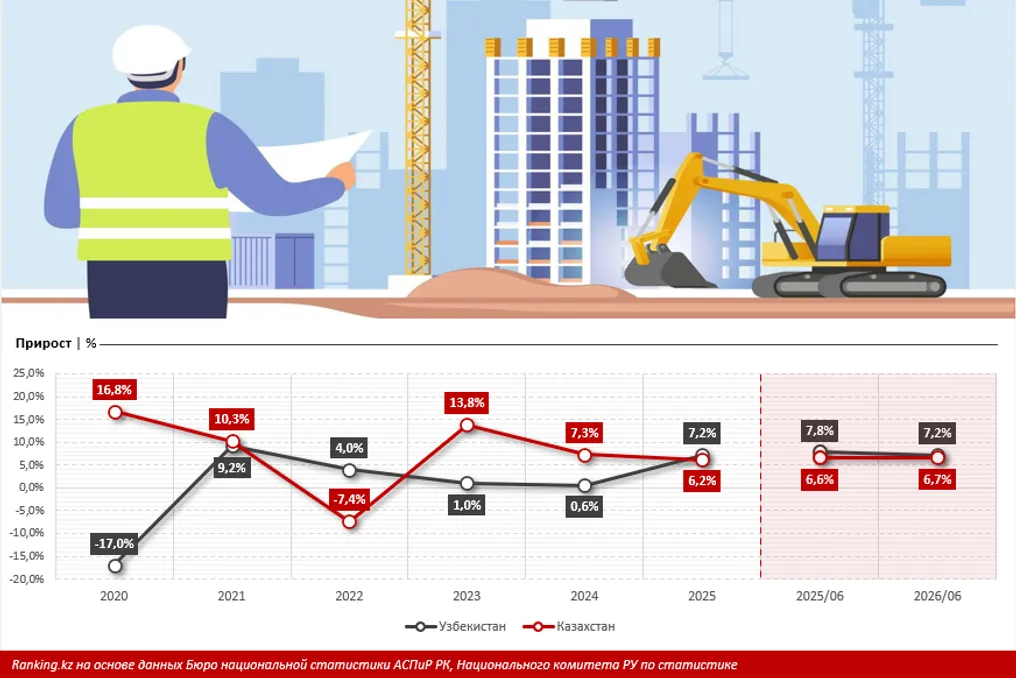
Added value in construction reached 79.2 trillion soums, which is 13.7% more. Within the sector, growth was shown by building and structures construction at 8.5%, civil engineering works at 21.5%, and specialized construction works sharply increased by 39.8%. This changed the internal structure of the sector: specialized works grew from 9.3% to 11.7%, and civil engineering works from 17.8% to 18.7%, while building construction decreased from 72.9% to 69.6%.
Service Sector
Total added value in the service sector amounted to 521.6 trillion soums, showing a growth of 9.2%. Retail and wholesale trade increased by 15.0%, hospitality and food services grew by 10.8%, transport and storage by 15.8%, information technology and communications by 23.2%, and other services by 4.1%. In trade, retail sales (excluding motor vehicles) accounted for the largest share at 42.7%, followed by wholesale trade (39.3%) and trade/repair of vehicles (18.0%). Transport and storage accounted for 5.3% of national GDP, with road transport being the largest share of added value in this sector (57.9%), followed by auxiliary transport services (17.7%), rail transport (8.4%), pipeline transport (8.1%), and air transport (7.9%).
GDP per Capita
GDP per capita in January–June 2026 reached 27,950.1 thousand soums, corresponding to a real growth of 6.6% compared to the same period in 2025. Over the five-year period, GDP per capita grew from 12,458.1 thousand soums in 2022 to the current level, with the real growth rate of GDP per capita accelerating from 102.4% in 2022 to 106.6% in 2026.
IT Sector
The share of information and communication technologies (ICT) services in the national economy increased to 2.9% compared to 2.8% in 2025 and 2.4% in 2024. The total volume of ICT grew to 30.3 trillion soums. Within ICT added value, computer programming, consulting, and related services accounted for the largest share (53.6%), followed by communication services (28.9%), data hosting/processing and web portals (10.5%), software publication (4.4%), and computer/communication equipment repair (2.6%).
Small Business
Small business entities generated 518.7 trillion soums in added value, accounting for 50.5% of the total economic added value. In small business activities, services accounted for 48.0%, agriculture, forestry, and fisheries—28.4%, industry—11.9%, and construction—11.7%. By sector, small businesses held a share of up to 95.4% in agriculture, forestry, and fisheries; 76.9% in construction; 47.7% in services, and 22.7% in industry.
Unrecorded Economy
The gross value added of the unrecorded economy, including household and private sector activities, amounted to 245.5 trillion soums. Its share in GDP decreased to 22.9% from 26.1% in January–June 2025. Household and private sector activities provided 165.5 trillion soums (15.4% of GDP), while the shadow economy amounted to 80.0 trillion soums (7.5% of GDP). Among the sectors of unrecorded economic activity, agriculture, forestry, and fisheries accounted for the largest share (60.5%), followed by services (23.0%), construction (17.8%), and industry (6.7%).