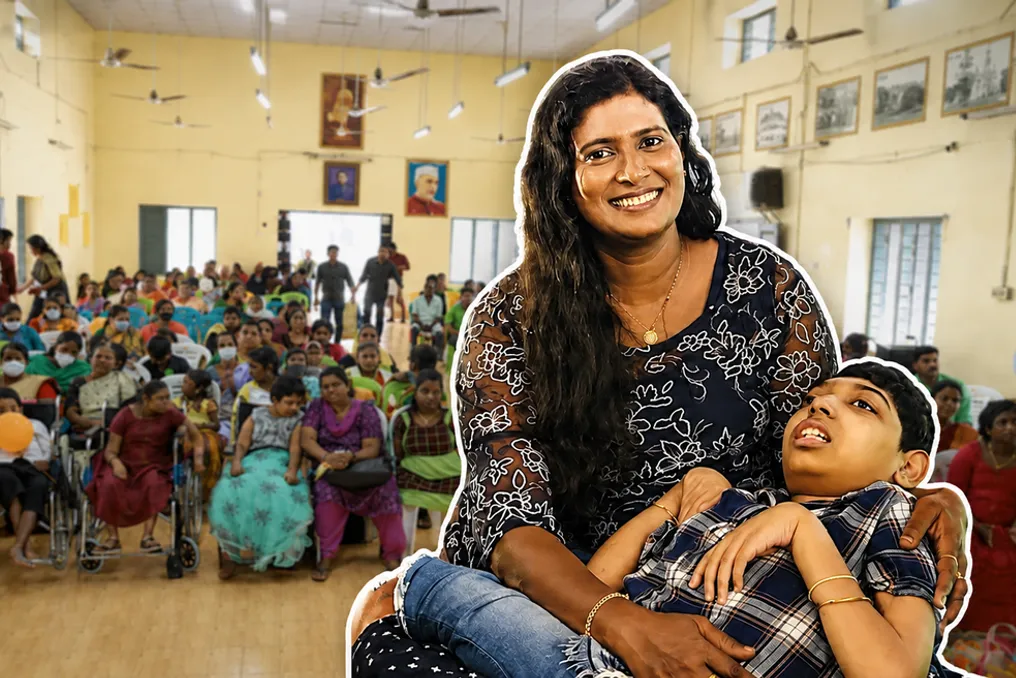
In March 2010, Sandra was born in the hospital in Thiruvananthapuram, Kerala. Within hours, doctors diagnosed her with microcephaly—a rare condition where the brain develops insufficiently. Although many children with this diagnosis do not survive, Sandra managed to live.
The difficulties of early years
However, survival was only the beginning of a difficult period filled with time spent in hospital corridors, intensive care units, the use of ventilators, and constant seizures that sometimes occurred twenty times a day. Treatment required continuous and expensive care. Sheeja admitted that in this whirlwind of events, she stopped recognizing the life she once envisioned.
Initially, the tension intensified at home, and then reached a critical point. Due to rising medical bills and the care becoming a full-time job, her marriage dissolved, and her husband left. Nevertheless, Sandra remained, and the care continued.
Hospital observations
As Sheeja observed around her, she began noticing other stories: many mothers carrying similar experiences. Before Sandra's birth, Sheeja's life had been more measured. She studied in Thiruvananthapuram, attended Manjadi and St. Xavier's schools in Payyad, and was more involved in sports and social work than academics. During her studies, she married with plans to continue her education.
After Sandra's birth, the trajectory of her life changed drastically. The hospital became a second home. Instead of counting hours or months, days were defined by admissions and emergencies. Despite eventually earning a degree and teaching qualification, finding formal employment proved difficult. She took up sewing and other domestic tasks, receiving support from her parents, Babu and Ushi, who helped with Sandra's care.
In the hospital wards, Sheeja noticed a pattern that worried her: mothers sitting alone next to disabled children. Some spoke of husbands who disappeared after the diagnosis, while others were completely abandoned.
Loss of identity
In these reception areas, Sheeja first met Vidhya. Vidhya previously taught mathematics at a private school in Attingal, Kerala. Her son, Aadi, nine years old, suffers from cerebral palsy. The diagnosis not only changed the family's routine but gradually ended her career. Vidhya recounted that she initially hoped to return to work in a year, but this period stretched to three years, and then forever.
Work was replaced by caregiving. Her identity gradually narrowed down to medical charts, therapy sessions, and hospital visits. When she met Sheeja in the hospital, what struck her was not sympathy, but recognition. Vidhya noted that people started asking about her son's condition instead of her activities, and she became 'his condition, not herself.'
Birth of a charitable initiative
The idea of creating the 'Snehasandram Charitable Trust' arose not as a plan, but as an accumulation of incidents over years spent in hospitals. There were cases where a couple, overwhelmed by the prospect of lifelong care, attempted suicide along with their disabled child; the parents did not survive, but the child remained alive and is now being raised by a grandmother.
Another case: a mother Sheeja vaguely knew entrusted her with her disabled child in the hospital corridor, promising to return, but then went up to the fifth floor and never came down. Sheeja emphasized that these are not isolated incidents, but those rarely spoken about. What touched her most was the grief and the lack of anyone to constantly support these mothers. This absence formed the basis of Snehasandram.
Creation of a support system
When Sheeja registered the Snehasandram Charitable Trust in August 2021, she made a decision that determined the organization's future work. Membership was open exclusively to mothers raising children with disabilities. Sheeja believed that only they could truly understand each other without unnecessary explanations.
The foundation started with a modest endeavor—work. It began providing sewing machines, teaching sewing, and providing livelihoods through activities like goat and poultry farming. The goal was not traditional charity, but ensuring stability. Sheeja stressed: 'We never wanted them to depend on us. We wanted them to be able to stand on their own again.'
Examples of help and community growth
Among the first to receive help was Shaily. She is 35 years old and spends her mornings sewing blouses in a small shared workspace supported by the trust. Her daughter has Down syndrome, and for many years, her life was tied to waiting—waiting for special school admissions, waiting for therapy sessions to end, waiting for moments that belonged only to her.
Thanks to the foundation, her waiting hours turned into working hours. Slowly, she began earning enough to cover part of her daughter's physiotherapy expenses. She shared that last month she paid for her daughter's physiotherapy herself, without asking her father for help.
As the community grew, so did the readiness to respond to crises. Network members helped order medicine, find wheelchairs, deliver diapers and essential groceries. This network held together not by formal structures, but by a shared sense of urgency. Rini's story illustrates this. Her husband didn't leave suddenly; he faded away gradually: first arriving home late, then getting a job in Kochi, then sending money for several months, and finally cutting off contact completely.
Rini said that 'he just dissolved over time, and it hurt more than if he had left abruptly.' Her son suffers from autism, and like many women in the group, she turned to Snehasandram after years of struggle, not after one dramatic collapse. There, she found a room full of understanding women.
Current activities and plans
Today, Snehasandram supports over 200 mothers in Thiruvananthapuram and surrounding areas, including families in the Kottur tribal settlement. The foundation operates from a modest office in Pappanamkode, but most of the work happens at home, in hospitals, and within informal support networks. One unusual source of aid is collected newspapers and magazines sold as recyclables, with the proceeds going towards emergency support for mothers. Additionally, individual donors and corporate social responsibility funding have supplemented this ecosystem, although the need continues to exceed resources.
A recent donation of 20 cents of land in Thiruvananthapuram opened the possibility of establishing a rehabilitation center where children with disabilities can live with caregivers, allowing mothers to work without choosing between earning and caregiving. The estimated cost of 40 lakh rupees is currently unattainable, but the vision remains unchanged.
Shared survival
Sheeja added her daughter's name to her own, becoming Sheeja Sandra. She describes this as constancy, not a symbol. Looking back at how a network of over 200 mothers grew out of hospital corridors, she speaks not of achievements, but of shared survival. 'We are mothers who repeatedly fail in life's trials,' she says. 'But every time we manage to help each other stand up, that is a small victory.'
Outside the office, life continues at its uneven rhythm: calls from hospitals, requests for diapers, and urgent needs that cannot be postponed. However, what holds it all together is simpler: mothers who once sat alone in hospital corridors are no longer alone.
Sandra, now sixteen, is undergoing home tutoring under the auspices of the Snehasandram Trust. Despite regular seizures, she feels supported from all sides. She notes: 'I don't feel lonely on this journey, and my mom doesn't either. There are other women supporting us, and that is the most important thing.' Sandra studies books independently, finding comfort in them because they 'do not judge.' For Sheeja, Sandra remains a pillar of support, a constant reminder of how far she has come—not only in building her own life but also in creating a life for many other families who previously had nowhere to turn. Sheeja notes that this is a very fulfilling experience before returning to administrative work supporting the foundation. This entire story is a miniature: a mother and daughter whose lives once seemed empty after a diagnosis are now themselves part of the reason why this room remains full for many others.