The global tourism market has undergone significant changes over the past decade due to numerous factors, including the coronavirus pandemic, geopolitical events, military conflicts, and sanctions. In response to these challenges, several countries have begun actively investing in developing their tourism sectors, modernizing infrastructure, improving transport accessibility, and creating more comfortable conditions for visitors.
Central Asia as a New Player
Against the backdrop of these global shifts, Central Asia, particularly Kazakhstan, Uzbekistan, and Kyrgyzstan, has intensified its focus on tourism development. These countries are increasing investments, improving infrastructure, and actively promoting their tourism potential on the international stage, which is already yielding tangible results.
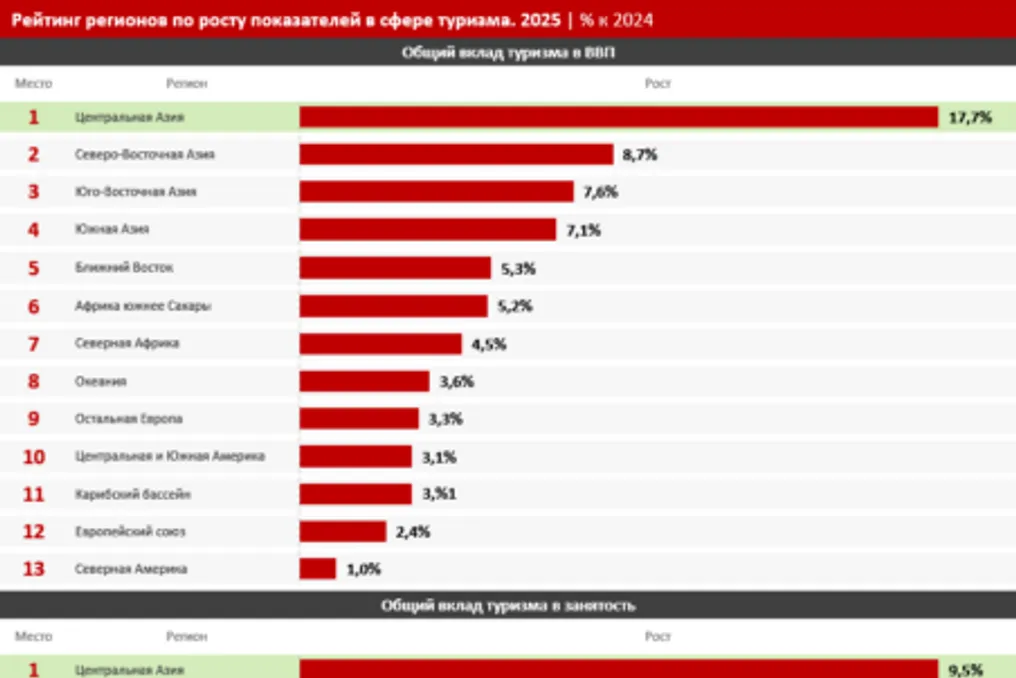
Although the tourism market in Central Asia is currently smaller compared to global scales, in 2025, the region demonstrated some of the highest growth rates across several key metrics. According to a report by the World Travel & Tourism Council (WTTC), the total contribution of tourism to the GDP of Central Asia increased by 17.7% in the year. This significantly exceeds the figures for Northeast Asia (8.7%) and Southeast Asia (7.6%).
Growth in Employment and Income
Central Asia has also taken leading positions in tourism employment growth: the number of jobs in the sector increased by 9.5% in a year, surpassing Sub-Saharan Africa (4.8%) and North Africa (4.6%). Even more impressive was the increase in Visitor Exports, which reached 26.4% growth in Central Asia in 2025, compared to 10.6% growth in Northeast Asia and 8.3% in Oceania.
Furthermore, the region entered the top three global destinations with the highest investment dynamism in tourism, where the volume of investments grew by 12.4% in one year.
Economic Impact of Tourism
As of 2025, the total contribution of the tourism sector to the economy of Central Asia reached $20.1 billion, accounting for 4.3% of the region's overall economy. It is worth noting that this figure was $15.8 billion in 2019, or 4.5% of the economy. Thus, over six years, the absolute economic contribution of tourism grew by 27.1%, although its share of the overall economy slightly decreased.
Experts predict that in 2026, the contribution of tourism could rise to $21.7 billion, and its share to 4.7%, indicating the growing importance of the sector to the region's economy.
Job Creation
The tourism industry plays a significant role in providing employment. In 2025, it provided about 1.7 million jobs in Central Asia, equivalent to 5.8% of total employment. Employment dynamics show that in 2019 there were 1.6 million jobs (6.0% of employment), and by 2026, 1.7 million jobs (5.9%) are projected, and by 2036, 2.2 million jobs (6.3%).
Structure and Types of Tourism
In 2025, the structure of total tourism expenditures in Central Asia was distributed as follows: 64.3% ($9.9 billion) went to international tourists, and 35.7% ($5.5 billion) went to domestic tourists. The main focus of the market is Leisure, accounting for 84.5% of expenditures, while Business travel made up 15.5%.
This creates favorable conditions for the development of mountain, ecological, cultural and historical, resort, wellness, gastronomic, and adventure tourism.
Sources of Tourist Flows
According to WTTC data for 2025, the main sources of tourists to Central Asia are Kazakhstan (29%), Uzbekistan (22%), Russia (20%), and Kyrgyzstan (19%). These four countries collectively accounted for 90% of inbound flows, indicating a predominantly regional nature of the tourism market. Among residents of Central Asia, the most popular destinations for leisure in 2025 were Uzbekistan (25%) and Kazakhstan (23%), followed by Kyrgyzstan (18%), Russia (16%), and Turkey (6%).
Leaders of the Tourism Market
Historically, Uzbekistan held strong positions due to its rich cultural heritage. However, the situation is changing: Kazakhstan and Kyrgyzstan are actively strengthening their positions. In 2025, tourism's contribution to Kazakhstan's GDP was $9.3 billion, the highest figure among Central Asian countries, with a growth of 16.2%. It is predicted that in 2026, the growth rate in Kazakhstan (nearly 13%) will be higher than in Uzbekistan (3.6%) and Kyrgyzstan (5.4%).
In the U.S. News & World Report ranking in the 'Tourism and Culture' category, Kazakhstan ranked 73rd in 2025, improving its position by 11 points over three years and overtaking Uzbekistan by 7 positions.
Uzbekistan traditionally maintains high significance for tourism in the national economy: in 2019, it accounted for 5.2% of the economy, and in 2025, 6%, with a projected growth to 6.1% in 2026. Although Kazakhstan surpassed Uzbekistan in absolute GDP contribution in 2025, Uzbekistan retains the lead in terms of tourism's share in the economy.