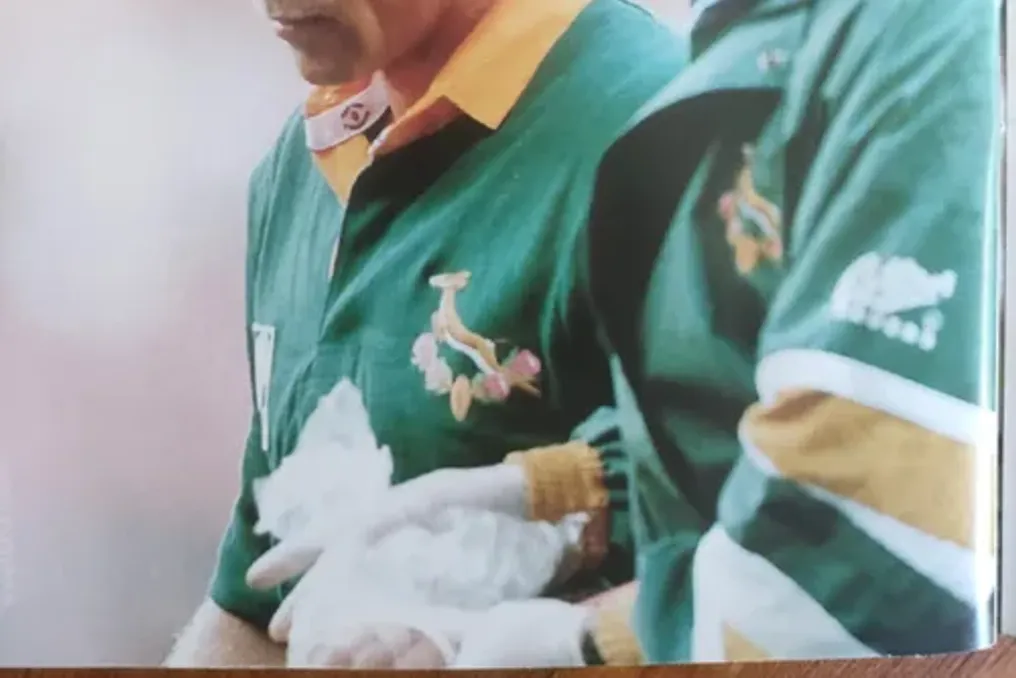
Andre Joubert left the field alongside the team doctor Frans Ferster after sustaining an arm fracture during the match against Samoa in the 1995 World Cup quarter-final.
Outstanding performance in 1995
Damian Willemse's impressive game against England at Ellis Park on July 4th reminded the author of the outstanding fullbacks from South Africa, among whom Andre Joubert stands out. His performance in the 1995 World Cup final was particularly noteworthy because he should have been in the hospital.
Joubert shared humble words about his condition after miraculously playing in the semi-final and final of '95 with three fractures in his left arm: 'Sometimes I could feel the bones moving, but the pain was minimal.'
Injury and recovery
The South African national team coach, Keith Christie, highly praised his modest fullback, calling him 'inhuman' and expressing disbelief at such bravery. Seven days before the semi-final against France, the team played in the quarter-final against Samoa. In the tenth minute of the game, Joubert bypassed winger George Harder, who, in a fit of frustration, punched Joubert's left arm.
Although the severity of the injury was later determined, Joubert continued playing despite the bandage, but ten minutes later, he was tackled hard by fullback Mike Umaga. After this, he left the field. That night at 11 p.m., Joubert underwent surgery to repair his broken arm. Typically, such an injury requires seven weeks of recovery, but South Africa needed Joubert back on the field within a week, as at 31, he was at the peak of his career and vital to the team's ambitions.
Accelerating recovery methods
To speed up recovery and give Joubert a chance to play against France, doctors offered him sessions in a decompression chamber simulating deep underwater conditions. Wearing an oxygen mask, he underwent two-hour thirty-minute sessions (he completed three in a week). His teammate Mark Andrews attended two such sessions with him. They were both able to converse, albeit in amusing high tones, which helped cope with intense boredom.
Joubert recalled: 'We sat in that steel cylinder while the pressure was reduced, which helped reduce the swelling. It would have been a trial if it weren't for my encyclopedic friend, Mark, who entertained me. He talked, and I listened.'
Return and recognition
The treatment paid off, and when a special rubber cuff was delivered from Ireland, Joubert was ready, as reasonably expected. After completing treatment in the hyperbaric chamber, Joubert held a press conference. SARU CEO Edward Griffiths recounted this amusing story: 'Smiling Joubert told reporters that he was equivalent to a depth of 14 meters underwater, but saw no fish (Joubert is an avid fisherman). Two Japanese rugby writers diligently recorded this marine observation in their notebooks.'
In the semi-final, Joubert's arm was checked repeatedly when the French lifted the ball in the air on that rainy day. He managed without complications and was fully ready for the final. Later that year, Joubert received his famous nickname, and the fitting place for it was the home rugby stadium in Twickenham. England was still recovering from its early exit from the World Cup in South Africa and sought to prove its mastery against the world champions. But on that cool autumn day, they could not withstand the team inspired by Joubert, who was in a class of his own.
He embodied elegance, gliding through the English defense. He was perfectly balanced under high ball and never lost his composure. When South Africa achieved a convincing victory over the hosts, and Joubert received the 'Man of the Match' award, England's coach Jack Rowell acknowledged his merits: 'Andre Joubert is the Rolls-Royce of fullbacks.'
Legacy and other appearances
It might take an Englishman to come up with a name that has stood the test of time, like these superbly crafted cars, but in South African rugby, there will always be only one Rolls-Royce. It seemed almost illogical that the South African national team's fullback would receive a name synonymous with exquisite classicism, given the reputation of South African rugby, which is far from delicate.
The author agrees with Andy Colkhoun's explanation. In his book 'The Chosen', he wrote: 'Joubert possessed incomparable elegance, which was a magnet for superb descriptions, but Rowell captured it best. At a time when the South African national teams admired and feared their power and virtues of resilience and tenacity, Joubert was an artist who added a golden hue to the green.'
In 1996, the 'All Whites' returned to South Africa and avenged their World Cup final defeat by winning the series in South Africa for the first time. Joubert faced a hamstring issue during this series, and it only recovered by the third match at Ellis Park, where he scored a magnificent try in the South African victory.
The 'All Whites' coach John Hart stated: 'He is a sensational player. Any coach would want him.'
Later that same year, Joubert once again demonstrated a masterclass before a packed crowd at Ellis Park. This time he played in the black and white jersey of the Natal Sharks, and the Transvaal were his opponents in the Currie Cup final. Joubert was brilliant in this final, radiating dignity, class, and elegance in his team's 33-15 victory. The final word on Andre Joubert belongs to a man forged from the same fine material, Marnu du Plessis. The South African national team legend said: 'Of all the South African teams I knew, Andre Joubert stands out as a person of absolute quality.'