Protests, which began as an online outcry over exam scandals, have escalated into a large-scale confrontation with India's education system, becoming one of the most serious challenges for Prime Minister Narendra Modi in his third term. This movement is led by the online Cockroach Janta Party (CJP), which has attracted millions of social media followers since May, thanks to 30-year-old PR graduate Abhijit Dipke.
Demands of the Protesters
The discontent arose after the leak of an entrance exam ticket for medical admission, forcing over two million candidates to retake the test. Protesters are demanding the resignation of Education Minister Dharmendra Pradhan, whom they hold responsible for a series of examination irregularities that have undermined confidence in India's education system. Furthermore, they are seeking compensation of 10 million rupees ($104,000 USD) for the families of about 20 students who, according to reports, committed suicide following the ticket leak.
The movement's agenda has expanded to include concerns about unemployment and youth opportunities, as well as what protesters describe as Modi's increasingly authoritarian style of governance. Despite rapid economic growth in the world's most populous country, millions continue to struggle to find stable and well-paid jobs.
Opposition Support and Demands
Opposition parties have supported the protesters and begun calling for the resignation of Modi and Home Minister Amit Shah, accusing them of allowing the police to use excessive force against students.
Government Reaction
After initially ignoring the protests, the government made a belated attempt to soften its stance. Pradhan, facing growing pressure over the examination issues, stated on Tuesday that the government remains committed to reforms. He emphasized: 'We owe it to them (the students) to provide answers, conduct reforms, and ensure accountability.'
Modi did not publicly comment on the protests, but a cabinet minister stated that he had promised to take 'the strongest steps' to protect students' interests. According to author and political analyst Nilanjan Mukhopadhyay, the government is currently on the defensive. He noted: 'If he (Modi) removes Pradhan now, it will be seen as a victory for public pressure, and that will be very dangerous for Modi.'
Significance of the Protest
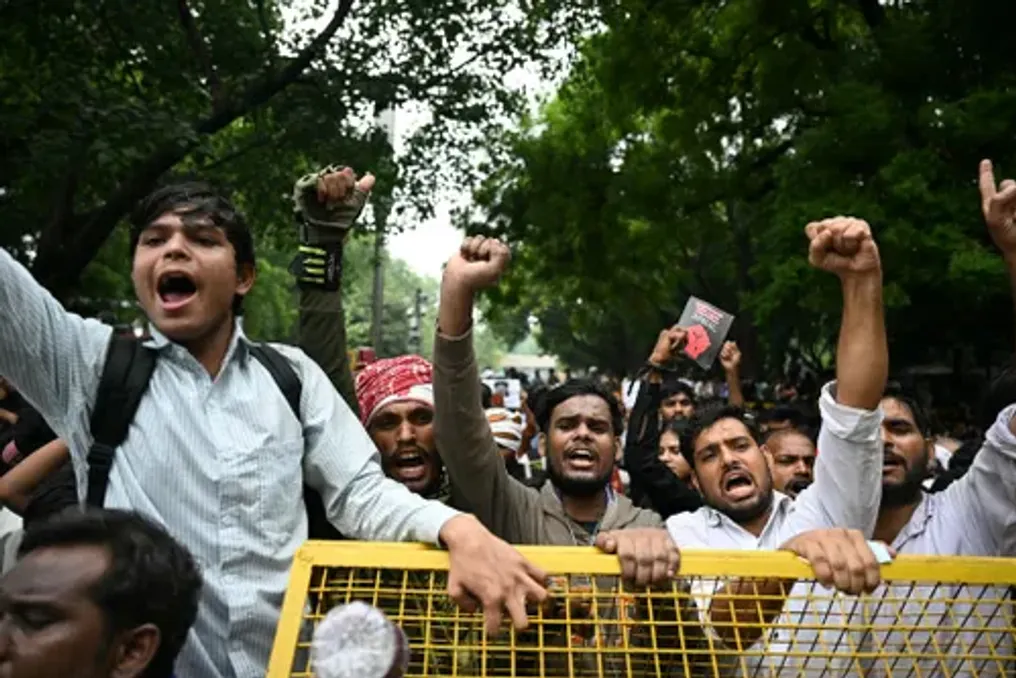
The protest has gone beyond memes and social media posts, touching upon widespread youth dissatisfaction regarding job scarcity and future anxieties. Students from across the country joined the demonstrations in Delhi, transcending caste, religious, and regional differences. Small demonstrations also took place in Mumbai, Bengaluru, and Goa.
The government finds it difficult to classify these protests, unlike the situation with farmer protests against agrarian reforms five years ago. Some members of the ruling party tried to portray participants as Sikh separatists aiming to divide the country. Previously, Muslims protesting the Citizenship Law in 2020 were labeled 'anti-nationalists.' Mukhopadhyay believes the latest action was 'more serious because it does not allow the government to frame it as a protest by one community.'
Events in Delhi
On Monday, tens of thousands of protesters, most of whom were young students, gathered at the Jantar Mantar in the heart of the Indian capital following a call by CJP to march to Parliament. The police attempted to stop the procession using tear gas and batons, to which the protesters responded by throwing stones. This became the largest street demonstration in the capital in approximately the last five years. According to Delhi Police, at least 178 people were injured, including 118 security personnel. Protesters claim that hundreds of demonstrators were injured after being 'brutally beaten' by the police.
Future of the Protest
Despite police action and intimidation, CJP vowed to continue its actions until its demands are met. The government is exercising caution after youth protests in neighboring Nepal and Bangladesh in recent years have overthrown incumbent regimes. Political scientist Suhas Palshikar stated that it is difficult to predict how the protests will develop in the coming days. He noted on social media: 'The Cockroach movement has started its journey. We do not know if it can survive.'
Mukhopadhyay believes that if the protest continues for a few more days, 'it will become a big problem for the government.'