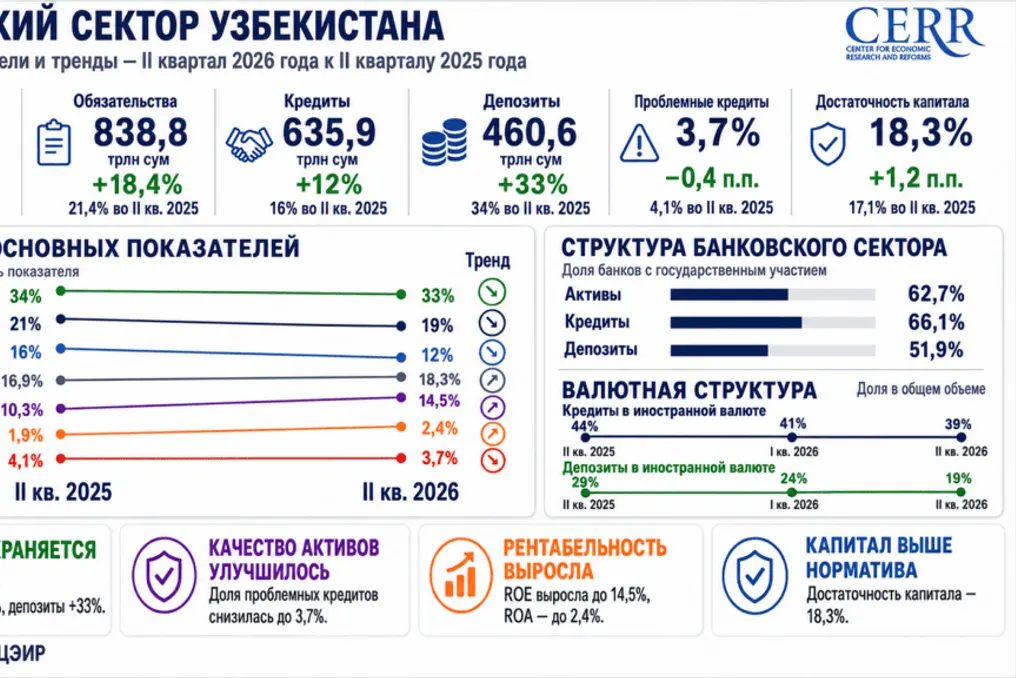
The Center for Economic Research and Reforms (CEIR) presented an updated Bank Rating, based on the 'Bank Activity Index,' for the second quarter of 2026. During this period, the banking sector demonstrated stable development, characterized by an increase in the deposit base and profitability, a decrease in the share of non-performing loans, and a reduction in dollarization, while the capitalization level remained high despite a slowdown in asset growth rates.
Methodology and Scope of the Study
The study covered 34 commercial banks in the republic. For comparison purposes, these banks were divided into two groups: 20 classified as large and 14 as small. The index was calculated using 27 sub-indicators, grouped into 8 main areas, including aspects such as capital adequacy, asset quality, financial intermediation, and accessibility, as well as profitability and liquidity.
When calculating indicator values, comparisons were made with the average data across the entire banking system and compliance with applicable international standards, particularly the requirements of the Basel Committee on Banking Supervision, which aligns with generally accepted international financial practices.
Sector Financial Indicators
As of June 1, 2026, the assets of the banking system reached 984.4 trillion sums, representing a 19% increase compared to the previous year. Liabilities grew by 18.4% to 838.8 trillion sums, while the basic market structure remained unchanged. Sixty-two point seven percent of total assets and sixty-six point one percent of the loan portfolio belong to nine state-owned banks.
It is noted that deposit growth outpaced lending rates: over the year, credit investments increased by 12%, while the volume of deposits grew by 33%. This circumstance contributes to strengthening the banking system and maintaining a high level of liquidity. A difference in collateralization is observed: in state-owned banks, there are 57 sums of deposits for every 100 sums of loans, whereas in private banks, this figure is 103 sums, indicating greater dependence of state institutions on external funding sources.
Improvement in Profitability and Asset Quality
The financial results of the banking sector significantly strengthened: net profit increased by 66.7%, reaching 8.5 trillion sums. The key factor was the 2.5-fold increase in non-interest margin to 15.8 trillion sums. As a result, Return on Assets (ROA) rose from 1.9% to 2.4%, and Return on Equity (ROE) increased from 10.3% to 14.5%. Furthermore, the share of highly liquid assets grew by 4.2 percentage points, reaching 21.6%.
Asset quality improved as the share of non-performing loans (NPL) decreased from 4.1% to 3.7%. Nevertheless, in some state and private banks, the NPL level remains relatively high. Dollarization further decreased: the share of foreign currency loans fell from 41% to 39%, and the share of foreign currency deposits dropped from 24% to 19%. Capital adequacy ratios consistently exceed the minimum established requirements by 1.5 times.
Changes in the Large Banks Rating
Based on the second quarter of 2026, changes occurred in the positions of 12 out of 20 large banks: 7 improved their rankings, 5 declined, and 8 maintained their current positions. The rating dynamics were determined by fluctuations across various components of the Index.
Dynamics by Index Components
The positive trend of the Index was recorded mainly in parameters such as financial accessibility, capital adequacy, asset quality, and financial intermediation. However, several banks faced a decline in positions regarding liquidity, management efficiency, and asset quality.
In terms of financial accessibility, 12 large banks showed increased activity, while 4 lost ground. The greatest progress was made by 'Hamkorbank,' 'Infibank,' 'Uzpromstroybank,' and 'Turonbank,' each rising two positions. Significant weakening was recorded by 'Microcreditbank'—a drop of 11 positions.
Regarding financial intermediation, 7 large banks improved their results, while 9 showed a decline. 'Orient Finance Bank' made a strong leap, rising 10 positions, and 'Turonbank' improved its result by 5 positions. The sharpest decline in activity was recorded by 'Microcreditbank'—a fall of 10 positions.
In terms of asset quality, 9 large banks strengthened their positions, and an equal number failed to maintain them. 'Ipoteka Bank' demonstrated the greatest increase in activity—a rise of 7 positions. 'Uzpromstroybank' also rose 3 positions. Weakening was recorded by 'Tenge Bank' (a drop of 5 places) and 'Anor Bank' (a drop of 4 positions).
In the area of capital adequacy, positive dynamics were observed in 8 large banks, while 9 maintained their positions. The greatest strengthening was shown by 'Davrbank' and 'Ipotekabank'—by 3 positions each. Meanwhile, 'Tenge Bank' showed a significant decline, losing 10 positions.
In terms of management efficiency, 7 large banks improved their positions, and the same number declined. 'Ipotekabank' became the leader in dynamics, rising 7 positions. Pronounced declines were shown by 'Tenge Bank' (losing 7 places), followed by 'Infibank' (a drop of 4 positions) and 'Davrbank' (a drop of 3 positions).
Bank activity regarding profitability was distributed almost evenly: five banks improved their positions, five declined, and ten maintained their previous standing. 'Orient Finance Bank' showed the greatest improvement (rising 2 positions), while 'Asia Alliance Bank' noted the most noticeable weakening (a drop of 2 positions).
In the liquidity category, 3 large banks improved their positions, while 6 showed a decline in activity. 'Orient Finance Bank' showed the greatest growth (rising 9 positions). 'Tenge Bank' improved its result by 3 positions. Significant decreases were recorded by 'Asaka Bank' (a drop of 5 positions), 'Uznatsbank' (a drop of 3 positions), and 'Ipak Yuli Bank' (a drop of 2 positions).
Overall Dynamics and Transformation
No changes occurred in the top three of the aggregate rating of large banks: 'Kapitalbank' held first place, 'Hamkorbank' second, and 'Asia Alliance Bank' third. 'Ipotekabank' showed the most pronounced positive dynamic in the aggregate rating, rising 4 positions to take 7th place, which resulted from improvements in asset quality, capital adequacy, and management efficiency indicators.
Following in terms of activity growth were 'Davrbank' and 'Infibank,' both gaining 3 positions. 'Davrbank' reached 5th place due to improved financial performance in the areas of accessibility, asset quality, capital adequacy, and profitability. 'Infibank' took 6th place, supported by high results in financial accessibility, capital adequacy, and asset quality.
A noticeable decline in the second quarter was demonstrated by 'Ipak Yuli Bank,' which lost 4 positions and took 8th place in the overall rating, linked to deteriorating financial intermediation and liquidity indicators. Among the banks showing a decline in activity, 'Anor Bank,' 'Halk Bank,' and 'Tenge Bank' stand out, each losing 3 positions.
'Anor Bank' took 9th place amid deteriorating financial accessibility, asset quality, management efficiency, and profitability indicators. 'Halk Bank' moved to 10th place due to declining asset quality, management efficiency, and profitability. 'Tenge Bank' took 13th place, correlating with a decrease in capital adequacy, management indicators, and asset quality.
Small Banks Rating
The top three in the small banks rating also remained unchanged: 'TBC Bank' held first place, 'Universal Bank' second, and 'AVO Bank' third. 'Octobank' showed the strongest positive dynamic in the aggregate rating, rising 3 positions to take 6th place, ensured by improvements in profitability, financial accessibility, and management efficiency indicators.
'Khayat Bank,' 'UzKDB Bank,' 'Soderot Bank,' 'Madad Invest Bank,' 'Open Bank,' and 'Uzum Bank' gained one position, with their improvement linked to enhanced financial accessibility, asset quality, liquidity, and capital adequacy indicators. On the other hand, 'Garant Bank' showed a noticeable decline, dropping 4 positions to take 14th place due to worsening financial accessibility, asset quality, and liquidity indicators.
Among the banks that declined, 'Poitakh Bank' stands out, losing 3 positions and taking 9th place. 'Apex Bank' and 'Ziraat Bank' each dropped one position due to changes in individual Index components.