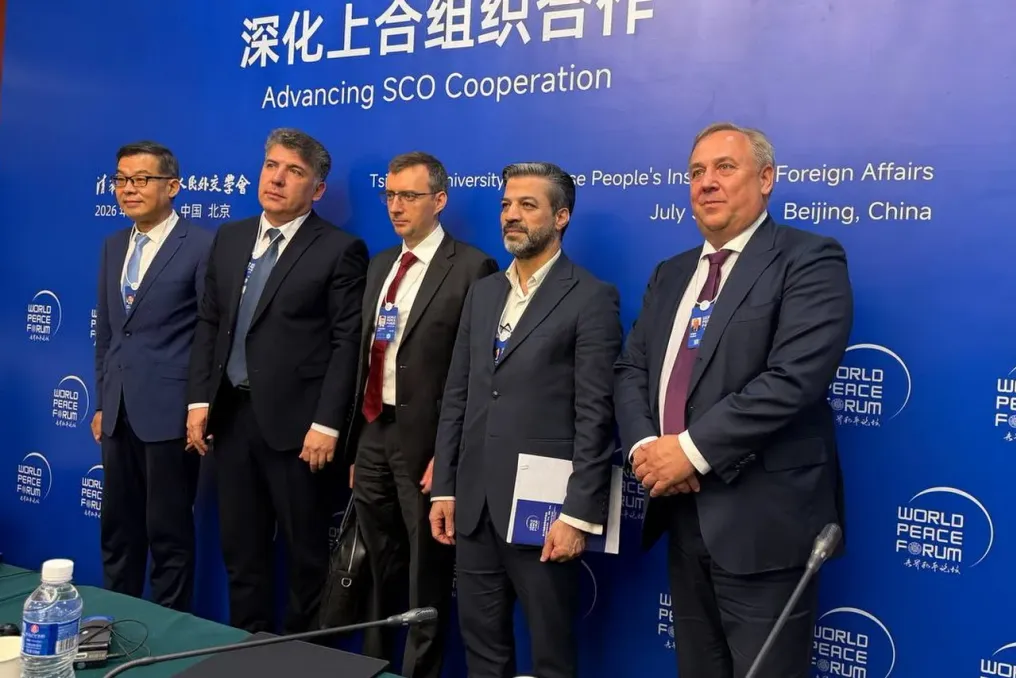
The delegation of the Institute of Strategic and Interregional Studies under the President of the Republic of Uzbekistan (ISMIS), led by Akromjon Nematov, First Deputy Director of ISMIS, participated in the XIV World Forum of Peace, which took place from July 2 to 4, 2026, in Beijing.
Event and Participants
The forum was organized by Tsinghua University with the support of the Ministry of Foreign Affairs of the People's Republic of China and gathered over 400 delegates from 60 countries. Participants included representatives from political, diplomatic, and academic circles from the USA, Russia, Europe, Asia, Latin America, Africa, and the Middle East.
China's and Uzbekistan's Position
Vice President Han Zheng of the People's Republic of China delivered a speech at the opening ceremony, outlining Beijing's main approaches to forming a new architecture of international security, emphasizing the importance of multilateral cooperation amid growing geopolitical instability.
During a session dedicated to prospects for cooperation within the Shanghai Cooperation Organisation (SCO), Nematov presented Uzbekistan's concept for the further development of the Organization. He quoted President Shavkat Mirziyoyev, noting that for Uzbekistan, the SCO is not just a platform for foreign policy but an instrument for ensuring security, sustainable development, and mutually beneficial cooperation.
Significance of Regional Interaction
According to the expert, the significance of regional interaction mechanisms is increasing amidst profound changes in the global system. Nematov noted that when global governance institutions face disruptions and cannot always respond promptly to new challenges, the role of regional formats increases, which objectively enhances the importance of the SCO.
At the same time, the expert stressed that the SCO maintains its uniqueness. He stated that the Organization is not a military bloc and was never conceived as an alternative to existing international structures. Its specialty lies in uniting states with diverse political systems and interests while retaining the ability to develop common approaches. In a fragmented world, the ability to maintain dialogue itself becomes a strategic resource.
Economy and Security
Great attention was paid to the transformation of modern problems. The expert believes that issues of security and development can no longer be viewed in isolation: 'Without a stable economy, security cannot be ensured, and without security, sustainable development cannot be achieved.'
For this reason, the President of Uzbekistan, Shavkat Mirziyoyev, consistently advocates for creating a new model of economic partnership within the SCO, based on interconnectedness and sustainability. This does not mean isolating the region, but rather strengthening its potential to jointly counter external economic shocks by developing industrial cooperation, transport and digital connectivity, expanding trade, and forming resilient production chains.
The ISMIS representative added that 'economic interdependence is not only a source of growth but also an element of collective security.'
New Agenda and Trust
Thus, the First Deputy Director of ISMIS concluded that the further evolution of the SCO must be based on a new agenda, where issues of security, economic integration, transport connectivity, and technological development are viewed as complementary elements of a single strategy to ensure stability and sustainability within the Organization's space.
The necessity of maintaining an atmosphere of trust within the Organization was also highlighted. According to Nematov, 'against the backdrop of growing international tension, it is important to prevent the transfer of external contradictions inside the Organization. Therefore, a culture of dialogue becomes not just a value, but a condition for the development of the SCO.' Recognizing the inevitability of disagreements between states, he emphasized that dialogue, consultations, and confidence-building mechanisms are necessary so that they do not undermine the overall agenda.
Central Asia as the Core of the SCO
Describing Uzbekistan's approaches to the Organization's development, the ISMIS representative emphasized that the republic 'consistently supports the open and neutral character of the SCO and the strengthening of good neighborliness.'
The key message of the speech was the assertion that Central Asia must remain the strategic core of the SCO. As Nematov stressed, 'this is enshrined in the Tianjin Declaration adopted at the Beijing summit in 2025. But more importantly, it reflects the objective structural reality of Eurasian cooperation.'
He explained that Central Asia ensures the internal cohesion of the Organization because, from the perspective of geography, economy, and security, it is evident that Central Asia guarantees this cohesion. The region serves as a key transit hub for Eurasia, through which routes connecting East and South Asia, Russia, and the Middle East pass. Furthermore, the principles of the 'Shanghai Spirit' are most consistently implemented here, and the countries of the region are moving from strengthening trust to implementing large-scale infrastructure projects.
As an example, ISMIS cited the China-Kyrgyzstan-Uzbekistan railway, stating that 'this is not just a transport line. It is a strategic corridor capable of changing the architecture of regional connectivity.'
He also recalled that the SCO Summit in Samarkand in 2022 was a 'real turning point,' after which the 'strategic and conceptual contours of the new economic architecture of the SCO' were defined.
Security and Afghanistan
Key elements of the Organization's security system are concentrated in Central Asia: the Regional Anti-Terrorist Structure in Tashkent, as well as new centers in Dushanbe and Bishkek. Nematov summarized: 'essentially, today Central Asia performs the function of a systemic stabilizer for the entire Organization.'
A special place in his speech was given to the problems of Afghanistan. The ISMIS expert noted that the SCO's ability to act as a responsible player in global governance directly depends on the effectiveness of ensuring stability in its own space. He stated that 'Afghanistan is a key element of regional security. Its instability affects the entire wide Eurasian region—from terrorism and drug trafficking to transport connectivity and economic integration.'
In this regard, the First Deputy Director of ISMIS pointed out the need to move from discussions to practical actions. He stressed that it is important not only to maintain attention on Afghan issues but also to move towards practical mechanisms of interaction. It is necessary to resume the work of the SCO Contact Group on Afghanistan, as well as develop dialogue with Afghan authorities and support efforts to restore the country's economy. Without the economic recovery of Afghanistan, it is impossible to talk about long-term stability in the region.
Dialogues with Chinese Experts
Parallel to the forum, the ISMIS delegation held meetings with leaders of leading Chinese think tanks and universities, including Sun Zhuangzhi, Director of the Institute of Russia, Eastern Europe and Central Asia at CASS; Ding Xiaosin, Director of the Institute of Eurasian Studies at CICR; Xu Baofeng, Head of the World Sinology Center, and Professor Yan Xuetong, Director of the Institute of International Relations at Tsinghua University.
During these conversations, Chinese specialists unanimously concluded that thanks to the policy of President Shavkat Mirziyoyev, Uzbek-Chinese relations have reached the level of 'all-weather comprehensive strategic partnership.' They also particularly noted the role of the head of Uzbekistan in strengthening good neighborliness in Central Asia, promoting regional integration, and shaping the concept of 'New Central Asia.' As a result, today the region is perceived by China as a space of new opportunities and one of the key centers of Eurasian cooperation.
Simultaneously, special attention is planned to be given to the high-tech field; in particular, the Chinese side expressed readiness to further expand cooperation with Uzbekistan in the fields of digital economy, artificial intelligence, innovation, and expert exchange.