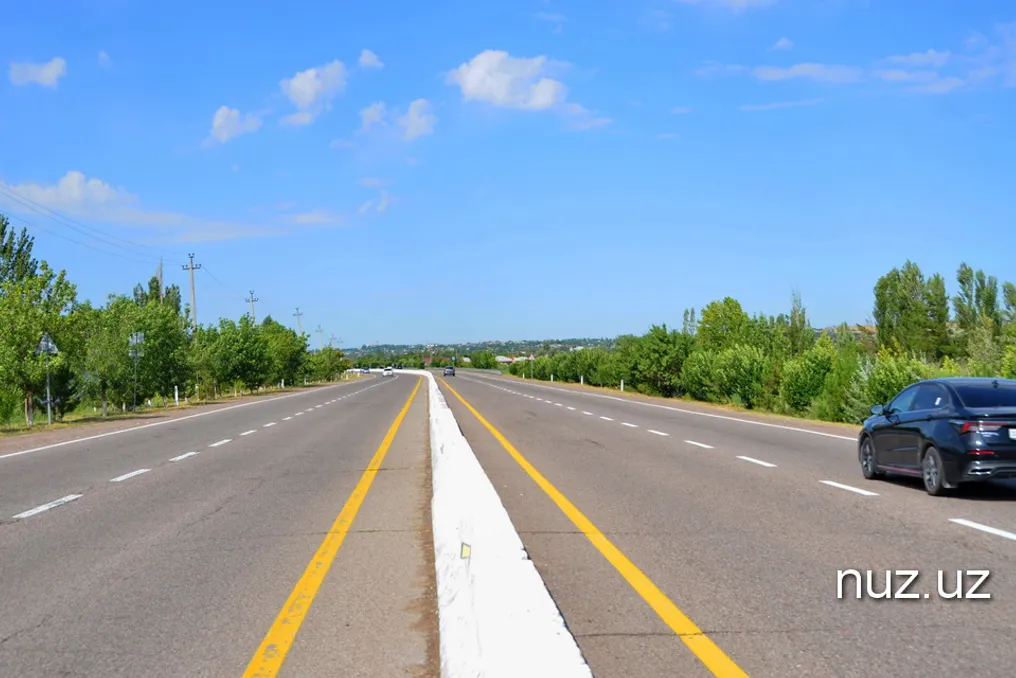
Since 2021, the Burchmullin Forestry Enterprise has been implementing an ecological initiative to green a 30-kilometer section of the 4R12 highway. As part of this project, approximately 25 species of trees and shrubs suitable for the local climate are being planted on vacant areas along both sides of the road, thereby transforming the roadside area into a green zone.
Representatives of the forestry enterprise specified that the planted plants include both native and ornamental species, such as Syrian rose, ash, maple, and Crimean pine. Karagach and various types of poplar are also being planted. Specialized equipment is used to maintain the health of the plantations. The greening work continues under the supervision of the leadership of the Agency for Increasing Forests and Green Areas and Combating Desertification at the National Ecology Committee of Uzbekistan.
The improvement of the roadside landscape through the planting of 25 species of plants also has ecological significance: deciduous trees help absorb dust and partially function as a sound insulation barrier for residents living near the road. The project complies with the approved plan and aims to improve the ecological condition of the region.
Further development and possible expansion of the project to the entire highway depend on resolving two key issues: the allocation of additional land plots by the local government and ensuring stable funding.
The Burchmullin State Forestry Enterprise possesses extensive experience in reforestation, which began back in 1947. The enterprise's area of responsibility covers 380 thousand hectares of land, of which over 80 thousand hectares are covered by forests, and the actual forest area amounts to nearly 4000 hectares, including almost 3880 hectares of non-contiguous plantations.
The enterprise is located in the Western Tien Shan region and encompasses six mountain ranges. Approximately 1800 species of plants grow here, more than 80 of which are listed in the Red Book of Uzbekistan. Additionally, about 230 species of animals inhabit this area, 32 of which are listed in the Red Book of Uzbekistan and the International Red Book.
The rivers Chatkal, Koksu, Pskom, and Ugam flow through the territory of the Burchmullin Forestry Enterprise, merging to form the Chirchik River. This river is a source of drinking water for Tashkent and the entire Tashkent region. The department's activities are not limited to roadside areas; it also manages other facilities.
The enterprise includes numerous branches: Chatkalsky, Pskomsky, Sidzhaksky, Sargardonsky, Khumsansky, Okbulaksky, Chakaksky, Burchmullin, Korongutukaysky, Aigaingsky, and Jurakbausky. Nurseries and seedlings stations 'Chakak', 'Ozodbash', and 'Yusufkhona' also operate on the territory. In addition to forestry work, there are farms engaged in commercial production, such as growing almonds on an area of 29 hectares.
Almonds are known for their drought resistance and require only natural irrigation. Trees planted in 2014 are in good condition. Employees of the enterprise note that with proper care, almond trees can live for 70–80 years, demonstrating an example of sustainable agriculture in the mountains.
The Deputy Director of the Burchmullin Forestry Enterprise, Mirza Rakhimov, explained that the nurseries grow seedlings and saplings of various trees, including Crimean pine, juniper, eastern thuja, chestnut, oak, linden, ash, maple, poplar, karagach, Japanese soapberry, walnut, rosehip, apple, apricot, plum, and cherry. The total area of the nurseries exceeds 55 hectares, and the Crimean pine plantations have reached an age of over 50 years.
Thus, the Burchmullin Forestry Enterprise makes a significant contribution to improving the environmental situation of the republic by participating in the national project for mass tree planting and growing seedlings for the country's needs.