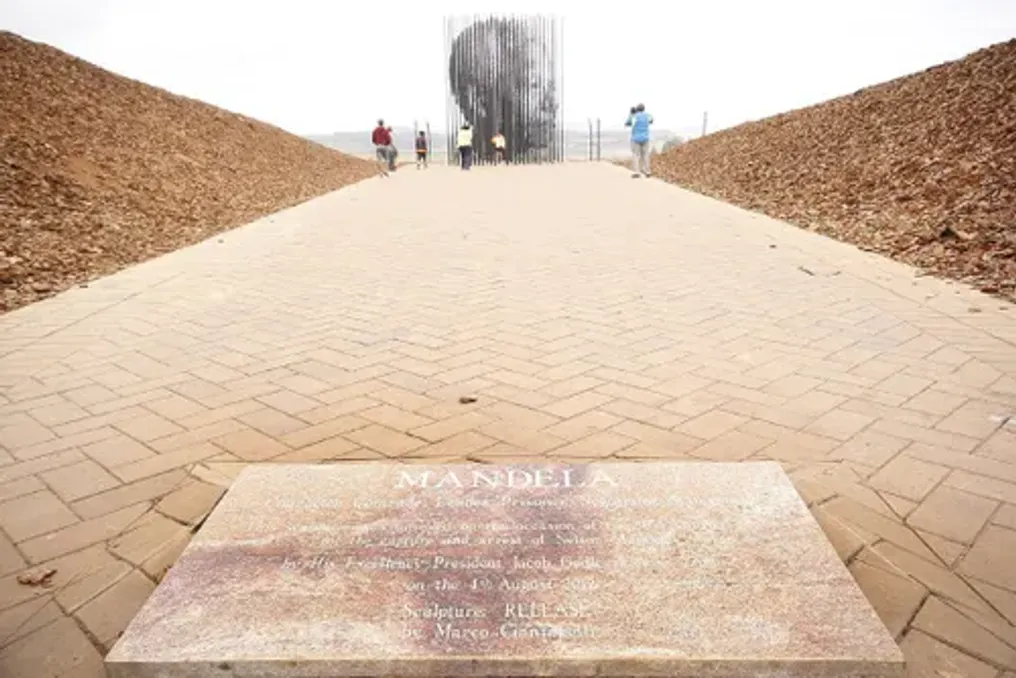
In the Midlands area of KwaZulu-Natal province, near the town of Howick, stands one of the country's most impressive monuments. This work of art consists of 50 laser-cut steel columns that form the face of a young Nelson Mandela when viewed from a certain angle. This monument marks the exact location where his 27-year journey into prison began.
The 1962 Arrest Events
On August 7, 1962, after evading police pursuit by the apartheid regime for 17 months under the alias 'Black Pirineal,' Mandela was driving past Howick, disguised as a driver, with activist Cecil Williams as a passenger. They were overtaken by white men in a car near Sedara. It was the police, indicating that someone had reported his whereabouts. Mandela was arrested on the spot and held until his release in February 1990.
Mandela's Recollections of the Arrest
In his autobiography, 'Long Walk to Freedom,' Mandela detailed the circumstances leading up to his arrest. He recalled: 'Cecil and I were discussing sabotage plans while driving through Howick, 20 miles northwest of Pietermaritzburg. In Sedara, a small town just past Howick, I noticed a Ford V-8 full of white men driving past us on the right... I knew in that moment that my life on the run was over; my seventeen months of 'freedom' were about to end.'
Mandela considered jumping out of the car but understood he could be shot. He describes the moment of stopping: 'When our car stopped, a tall, thin man with a stern expression walked right up to the passenger window. He was unshaven, and it seemed like he hadn't slept for quite some time. I immediately assumed he had been waiting for us for several days.'
Interrogation and Detention
The unkempt man introduced himself as Sergeant Forster from the Pietermaritzburg police. He demanded to know his name. Mandela replied that his name was David Motsamaiyi. The sergeant then asked him several questions about where he was and where he was headed. Mandela evaded providing much information. The sergeant appeared irritated and stated: 'Ah, you are Nelson Mandela, and this is Cecil Williams, and you are under arrest!'
Despite the police recognizing him, Mandela refused to give his name or make any statements. In solitary cells, he was able to reflect on his situation. Although he had always anticipated the possibility of arrest, he realized he was unprepared for the reality of capture and imprisonment. He wrote that he was distressed and anxious because the police had found his location, knowing he was in Durban and planning to return to Johannesburg. On November 7, he was sentenced to five years in prison.
Modern Significance of the Monument
Today, the Nelson Mandela Arrest Site is one of KwaZulu-Natal's most visited historical locations, receiving over a hundred foreign tourists daily. The sculpture by Marco Cianfanelli has become as much a symbol of struggle as Robben Island, reminding people, as one IOL publication notes, that even the noblest journeys are marked by temporary setbacks.