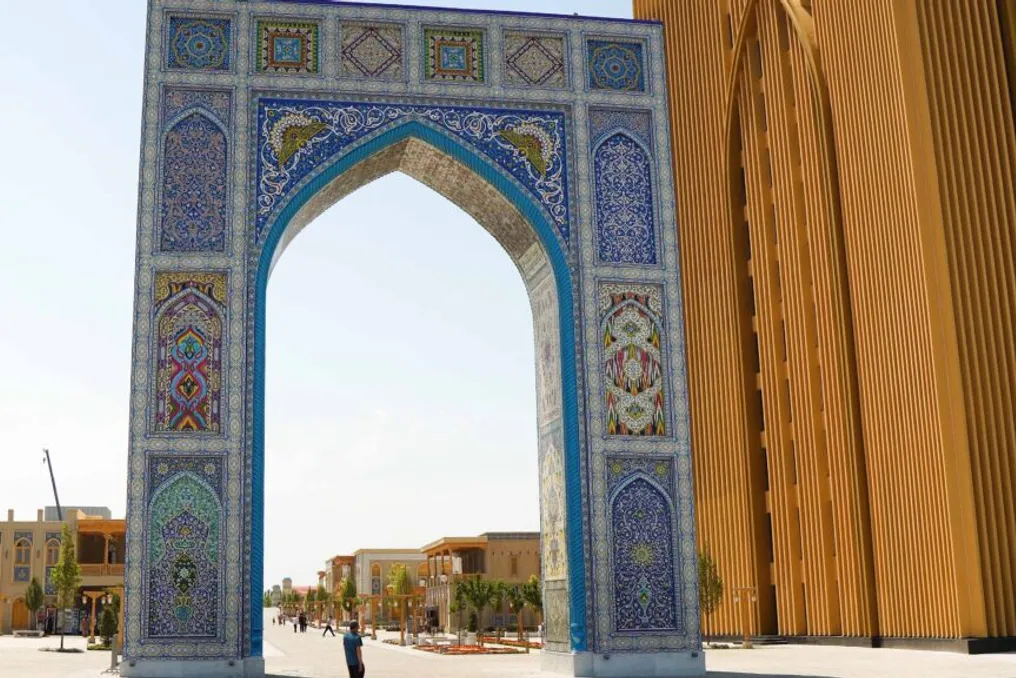
Significant transformation is taking place in Margilan, one of the oldest settlements in the Fergana Valley. A scientific and educational and tourist complex named 'Burkhaniddin Marginani' has been created here, demonstrating the effective use of the region's historical potential.
Characteristics and Project Implementation
This project, with a total cost of 1.7 trillion soums, was designed by the Turkish architectural bureau Studio Vertebra. It was implemented based on the 'city within a city' concept on a 35-hectare territory, successfully combining traditional architecture with modern infrastructure.
The entrance area of the complex is adorned with majestic Margilan gates approximately 27 meters high, which are richly decorated with numerous unique mosaics. The complex is named after the outstanding scholar and founder of Islamic jurisprudence, Burkhaniddin Marginani.
Science, Culture, and Infrastructure
Marginani's scientific heritage formed the basis of the concept, as an Institute of Islamic Jurisprudence and a library are already operating on the complex's grounds. However, the project covers a broader range of areas, including culture, history, and crafts.
A developed infrastructure is provided for visitors: it includes hotels, a caravanserai, a national bazaar, and a craft center where artisans work with weaving and embroidery. Of particular interest is the Otabek and Kumush House museum, whose walls immortalize scenes from Abdullah Kadiri's novel 'Bygone Days'. The cultural life is complemented by the Makom theater and the writers' alley.
Scale and Economic Potential
The scale of the decorative works is impressive: nearly 20 thousand square meters of walls are covered with unique tiles and mosaics, whose patterns are almost never repeated. It is expected that once the complex reaches full operational capacity, it will be able to host up to 250,000 foreign tourists annually and provide employment for two thousand people.
Dissemination of Project Experience
The success of the Margilan complex is viewed as a model for other initiatives. It is planned that the experience of 'Burkhaniddin Marginani' will be applied to the 'Eternal Bukhara' projects in Bukhara, the development of the Imam Maturidi mausoleum infrastructure in Samarkand, Urda in Kokand, the Akhsikent architectural monument in Namangan, and the old city of Tashkent.