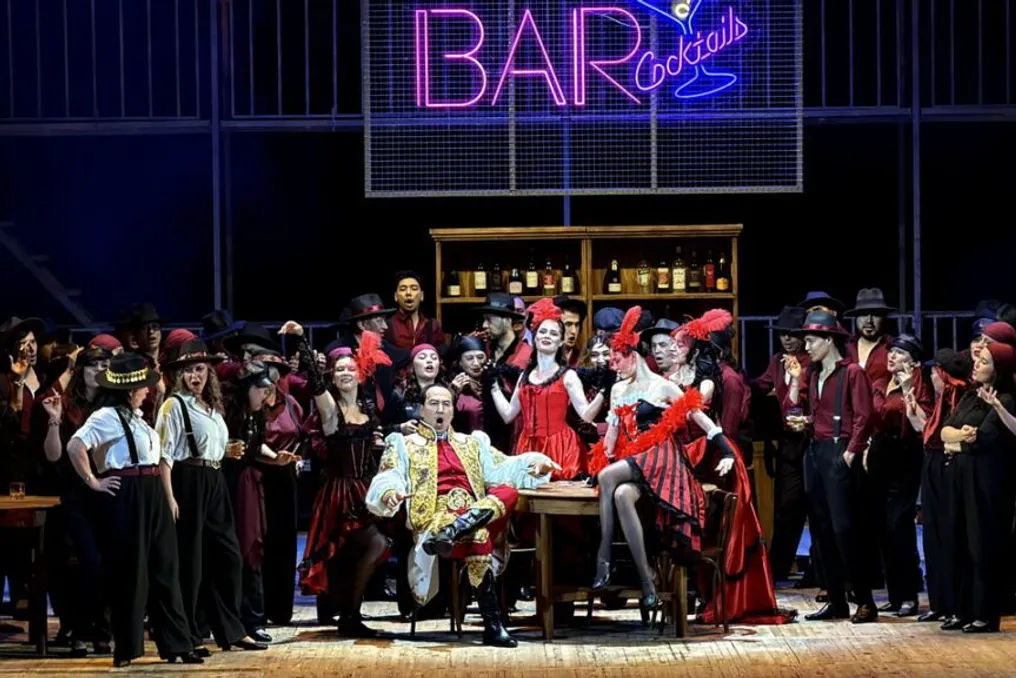
The opera 'Carmen,' a work that has existed for over a century and a half, has consistently found new interpretations in different eras, but the new version presented by the State Academic Bolshoi Theatre named after Alisher Navoi, directed by Konstantin Kamynin, has generated particular interest.
Change of Temporal Context
In this production, the time setting was altered: the plot is relocated to Spain during the 1940s and 1950s. Against the backdrop of the world order forming after the war, the central theme of the performance became not so much tragic love as the story of the individual herself. Carmen, in this context, acts as a symbol of inner freedom, refusing to submit to others' dictates and unwilling to sacrifice her independence for anyone else's fate. Her final choice is interpreted not as a defeat, but as an affirmation of human dignity.
Musical and Scenographic Design
The musical accompaniment of the production was convincing. The orchestra, conducted by chief conductor Vyacheslav Chernukho-Volich, sounded powerful, emotional, and subtle, allowing Georges Bizet's music to remain the leading element of the narrative. Artists Davron Radzhabov, Alexey Gromyko, and Zhavohir Botirov created an expressive stage space that helped focus attention on the characters' inner world rather than distracting with spectacular solutions.