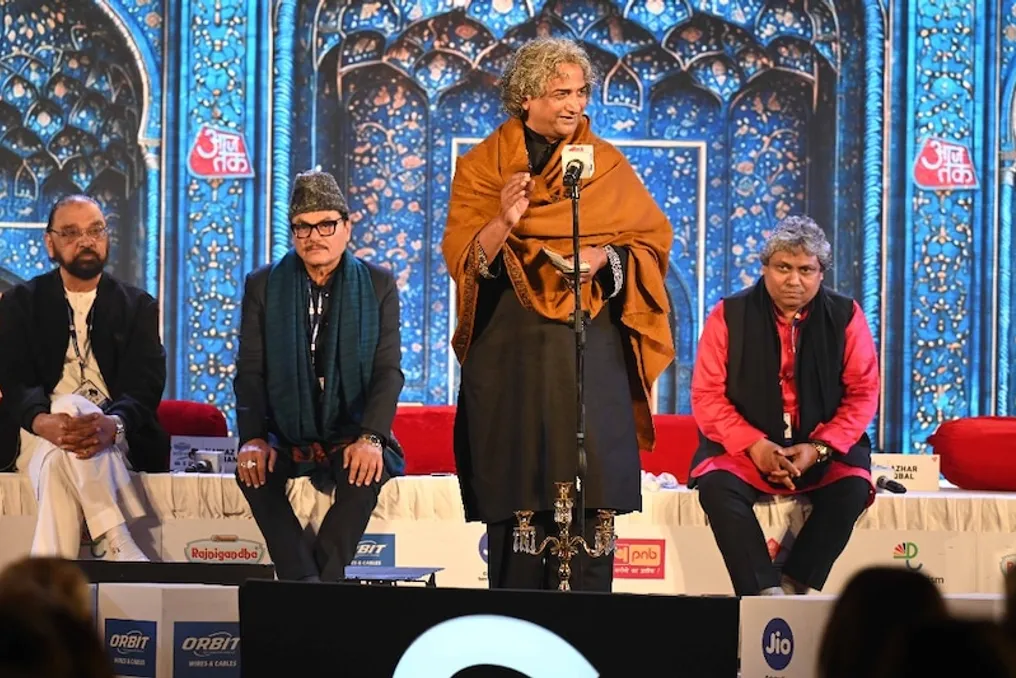
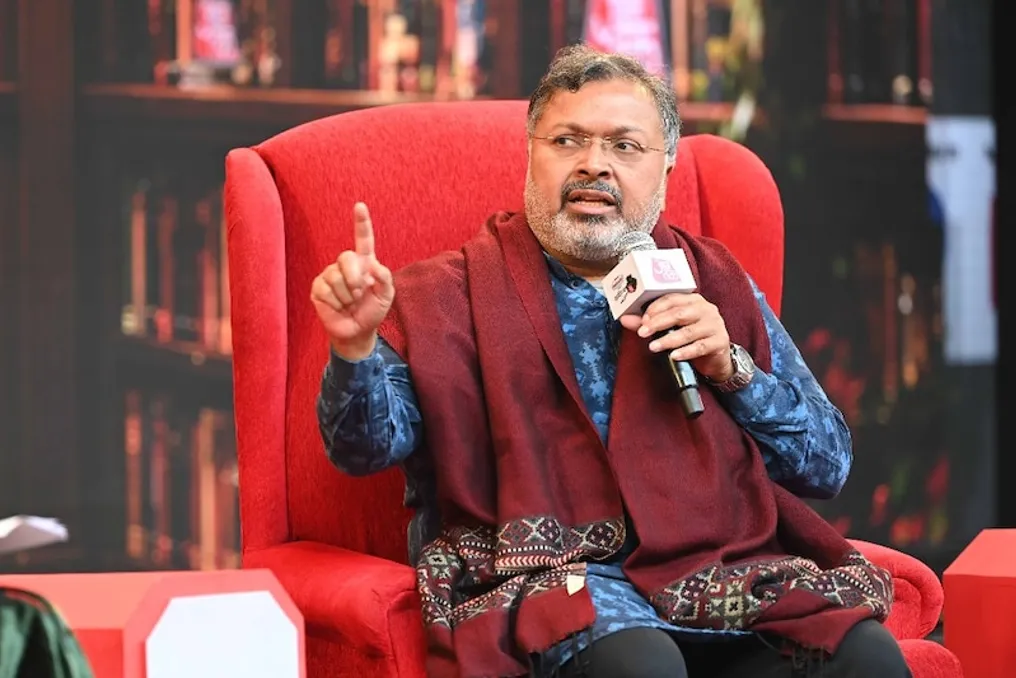
During the session 'Hinduism: Religion, History and Myths' on the Sahitya Aajtak platform in 2026, renowned mythologist, writer, and artist Devadhatta Patnaik shared his views on religion, Indian traditions, the Vedas, history, and philosophical debates. He also commented on modern trends such as the rise of religious events, bhajan clubs, and television debates.
Devadhatta Patnaik noted that while bhajan clubs have their value, they do not contribute to the increase of knowledge. Curiosity, dialogue, and philosophical disputations (shastrartha) are necessary for gaining knowledge.
When asked whether contemporary religious events, where kirtans and bhajans are gaining popularity, will include philosophical debates and religious dialogues, Patnaik replied that bhajan clubs are for some people, and shastrartha is for others. He emphasized that some people dislike participating in shastrartha, even if they are connected to this tradition.
He refused to deem bhajan clubs wrong, stating that bhajan club sessions will also be held in temples in the future. In a humorous manner, he mentioned that nowadays people engage in bhajan clubs while consuming sattvic food. He added that if a child tells their parents they are going to a club, they might not approve, but if they say they are going to a bhajan club and will eat sattvic food, the parents will gladly agree.
'People are afraid because they do not believe in their religion'
Stressing the need to read one's own scriptures, Patnaik stated that he has observed that people lack sufficient understanding of Indian history and modernity. He gave an example, noting that Indian history is considered ancient, around 5000 years old, whereas the rule of Muslim sultans lasted approximately 500 years, and British rule lasted about 200 years. In his opinion, these periods should be viewed in the context of the entire history.
He believes that when people discuss these eras, it indicates their distrust in their own religion and traditions. They are so frightened that they lack knowledge of their sacred texts. Patnaik concluded that understanding Indian tradition requires knowing its long history and tradition of knowledge.
Explaining the difference between debate and dialogue in the context of religious discussions, Devadhatta Patnaik noted that the technique of debate is called argumentative and has roots in Greek tradition. According to him, this style of debate entered the Indian tradition after Alexander's arrival in India, through Greek intellectuals.
He asserted that there was originally a tradition of dialogue in India. As an example, he cited Janaka Sabhu, where people gathered not to defeat each other, but to find out how much knowledge each person possessed and what a new person could contribute.
He quoted the thought: 'Saraswati is born from curiosity.' In his view, the Upanishads, Brahmanas, Aranyakas, and Vedas gatherings show a tradition of dialogue, where questions were asked, opinions were listened to, and new knowledge was sought.
When asked if the freedom of doubt and argumentation within Hinduism can be considered a specialty, Patnaik replied that the concepts of 'right' and 'wrong' are not part of the Vedas. He linked this to Western thinking, explaining that in Indian philosophy, a person does not possess complete knowledge of the whole truth. He referred to Shankara's statement: 'The world is an illusion, Brahman is the truth,' asserting that every person possesses only partial truth. One may be an expert in one field, and another in another, so curiosity must be shown to learn from each other's experiences and knowledge.
Giving the example of journalism, he said that if he sits with a journalist, he must be curious about their experience and life. Similarly, the journalist can ask questions about the interviewee's topic. Thus, both can learn from each other and expand their knowledge.
Commenting on social media discussions, Patnaik noted that arguments begin when curiosity disappears. In his opinion, in today's debates, people strive to defeat their opponent rather than understand them. When he watches television debates, he sees egoism, not soul. He also mentioned disputes between gurus and religious figures on social media, calling languages like 'panchd khim', 'dibenkd khim', and 'slapd khim' a language of violence, not knowledge and dialogue.
Devadhatta Patnaik concluded that ignorance breeds egoism. Although bhajan clubs can excite people's emotions and bring them pleasure, the real question is whether they enhance intellect and knowledge.