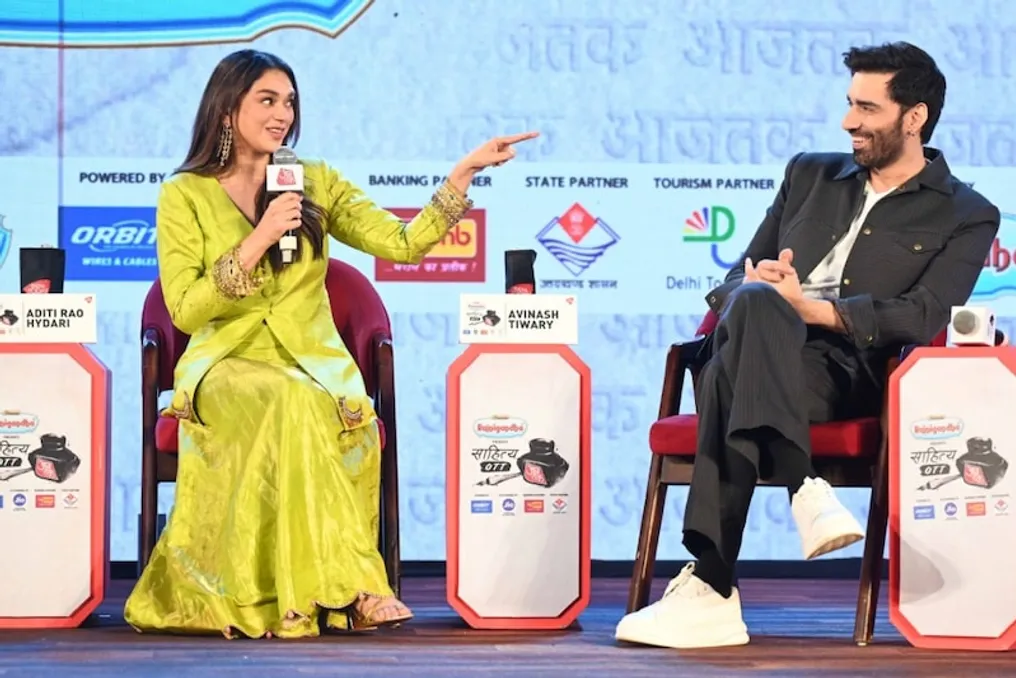
Director of 'O Saati Re' Aditi Rao Hydari and Avinash Discuss Post-Love Relationships
Read more
Aaj Tak
www.aajtak.in

Director of 'O Saati Re' Aditi Rao Hydari and Avinash Discuss Post-Love Relationships

At the 'Sahitya Aajtak' event held at the Meijer Dyanchannd National Stadium in New Delhi from November 27 to 29, 2026, many prominent figures from the worlds of politics, cricket, and entertainment gathered. Among them were actress Aditi Rao Hydari, actor Avinash Tiwari, and director Arif Ali.

The three thoroughly discussed their upcoming web series 'O Saati Re,' touching upon various aspects of the plot, relationship complexities, directorial nuances, and the actors' personal experiences.

The story of the web series 'O Saati Re' begins with a divorce. Discussing this topic, Aditi Rao Hydari admitted that she does not have specific ideas about it, but she enjoys stories related to love. She recalled how, previously, while acting in romantic stories, she used to wonder about the amount of drama and the reasons for her crying. When she asked her mother about this, her mother suggested that the director thought she could portray it well. Aditi emphasized that what she did on screen does not necessarily have to match her real life.

Speaking about her series 'O Saati Re,' Aditi mentioned that she and Avinash Tiwari conducted numerous workshops during script reading. Both paid great attention to the depth of the story and their characters. According to Aditi, when they were not on set, they joked around a lot with each other, which helped maintain a light and relaxed working atmosphere.

When the question arose as to why Imtiaz Ali's story begins with a breakup, director Arif Ali explained the true reason. In his opinion, little is usually said about what happens after people fall in love. This series features a character who achieves their dream, but the real story begins after that, because love does not always remain the same. The essence of the narrative lies in the circumstances that arise when love turns into a relationship. His team also contemplated this issue during the work.

Aditi noted that the main feature of this story is that it allows one to get to know oneself better. Avinash Tiwari humorously joked that these three brothers do not like his face. Furthermore, Avinash expressed a unique desire—he would like to play a female character.

Aditi shared an interesting experience regarding the differences in the working methods of Imtiaz Ali and Arif Ali. She said that Imtiaz Ali watches the actor intently during shooting. Unlike him, Arif works differently: he simply records the shots and stays near the monitor. Aditi also added that since Imtiaz wrote this series, he is deeply involved in the story and the entire process.

When asked about her personal love life, Avinash Tiwari answered very briefly and wittily that pain is necessary for art, and that is what is happening now. When Aditi asked if she felt lonely amidst all this, she replied that she agrees that loneliness is necessary for every artist. In Aditi's opinion, only in silence can one hear their inner voice, which is why she also likes pauses in life.
Similar stories

Discussion at 'Sahitya Aajtak': Instead of War, Women Should Become Warriors of Dialogue
Read more
www.aajtak.in

Discussion at 'Sahitya Aajtak': Instead of War, Women Should Become Warriors of Dialogue

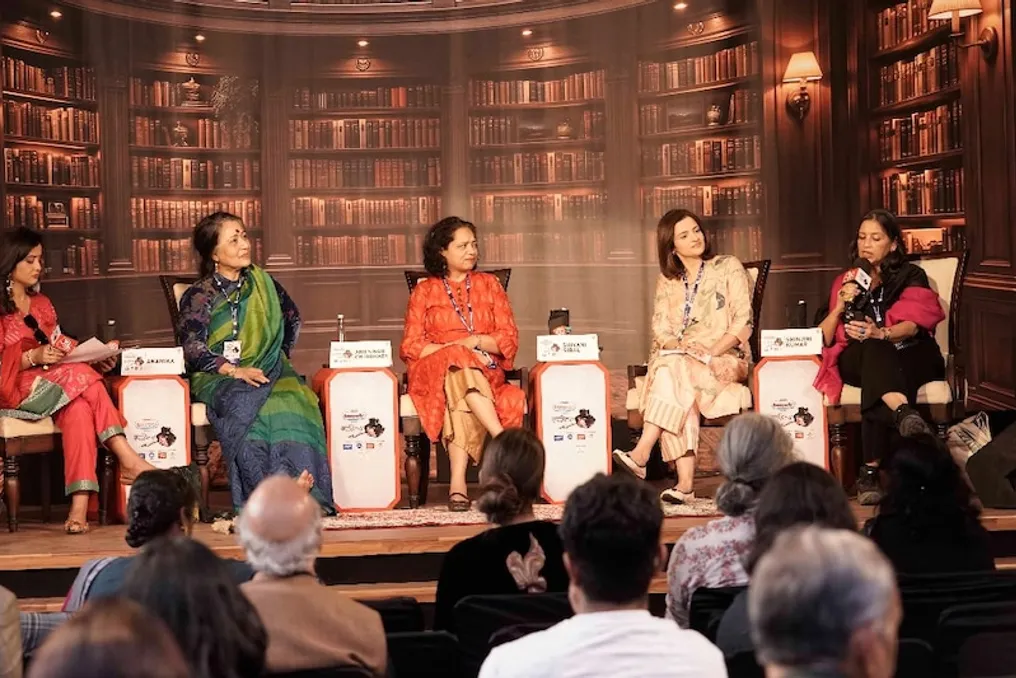
During the second day of the 'Sahitya Aajtak' event in 2026, interesting discussions took place regarding literature, cinema, female discourse, and freedom of expression. In a special session titled 'Beyond the Pages: Fiction, Yatharth aur Imagination,' writer and poet, Dr. Anamika, recipient of the Academy of Literature award, writer Shinjani Kumar, and screenwriter Anu Singh Chaudhary participated.

These three writers shared their thoughts on topics such as realism and imagination in literature, female entrepreneurship, patriarchy, and the boundaries of language. A debate was also discussed concerning the portrayal of Sita's mother in the film 'Ramayana' and the use of the address 'tum' (you) to Lord Rama.

Responding to the question about portraying Sita's mother as a warrior in the film 'Ramayana,' Dr. Anamika noted that there is also a form of psychological warfare. Women wage a battle for their subconscious through language, which is the most effective tool in this psychological war.

She emphasized: 'We should not become like men; men should become like us. Therefore, communication is necessary. Resorting to violence is not a solution.' Anamika cited an example from her novel where her Sita manages a school in the forest, teaching tribal children not to plan revenge. Even Shurpanka and Shambuk are taught in this fictional school. In her view, the new Sita should be taught to resolve problems through dialogue, not war, which is possible thanks to the power of education and language.

Regarding the dispute about Sita's mother addressing Lord Rama with 'tum' in the film, Anamika stated that she had not watched the film. Nevertheless, she believes that outsiders should not interfere in the relationship between two people. She argued: 'Who are we to spy on how two men and women talk? Whether they say 'tu' or 'tum' to each other is not a subject for public debate. It is a game, and we cannot censor it.'

Citing examples from religious and Sufi literature, she added that even devotees address God with 'tu'. In the private world of love, no dictates can exist.

Screenwriter Anu Singh Chaudhary spoke about the boundaries of language in creativity and freedom of expression. She raised the question of why, when men use certain language towards women, it is not considered violent, but when women use the same language, it is declared violent. She questioned: where does the boundary of language begin and end, and who determines it?

Anu Singh Chaudhary shared that as a screenwriter, she tries to remain honest to her characters and the story. Often, sincerity and boldness in writing texts are lost when trying to please everyone.

Writer Shinjani Kumar mentioned her childhood experience and time spent in Munger, Bihar. She recounted that in the linguistic environment in which she grew up, profanity was part of daily speech. When she started writing poems in Hindi, the language of that environment appeared in her poetry. She mentioned the tradition of singing songs with profanities at weddings in Bihar, calling it the voice of collective resistance of women.

Anamika countered that women do not need to imitate men to insult. Through the power of metaphor and allegory, one's thought can be expressed convincingly through satire and humor.

Shinjani Kumar shared her research experience for her book 'Busy Women.' She visited 30 small towns across the country and surveyed 300 women. During this trip, she discovered a surprising fact: in places where patriarchy is stronger, women are more open in expressing their opinions.

She gave the example of an entrepreneur from Patna who, after her husband's death, decided not to stay at home but to start a business servicing elevators. This woman has been working in the field of elevator installation and maintenance for 20 years and now runs its production.

Shinjani Kumar also questioned the financial support provided by governments to promote female entrepreneurship. She noted that governments compete by offering women 10,000, 20,000, or 40,000 rupees, but money alone is not enough to create a successful entrepreneur. She stated that if money could make anyone an entrepreneur, all the children of wealthy people would become successful businessmen. Favorable social and cultural conditions are also necessary for business success.

She insisted on the need to link traditional arts and skills with economic activity, noting that if an artist cannot support a family with their art, they will abandon it for another job, leading to the disappearance of many traditional arts in the country.

Dr. Anamika continued the theme in her book 'Door Desh Ke Parinde' that relationships between a man and a woman are not always physical.

Popular