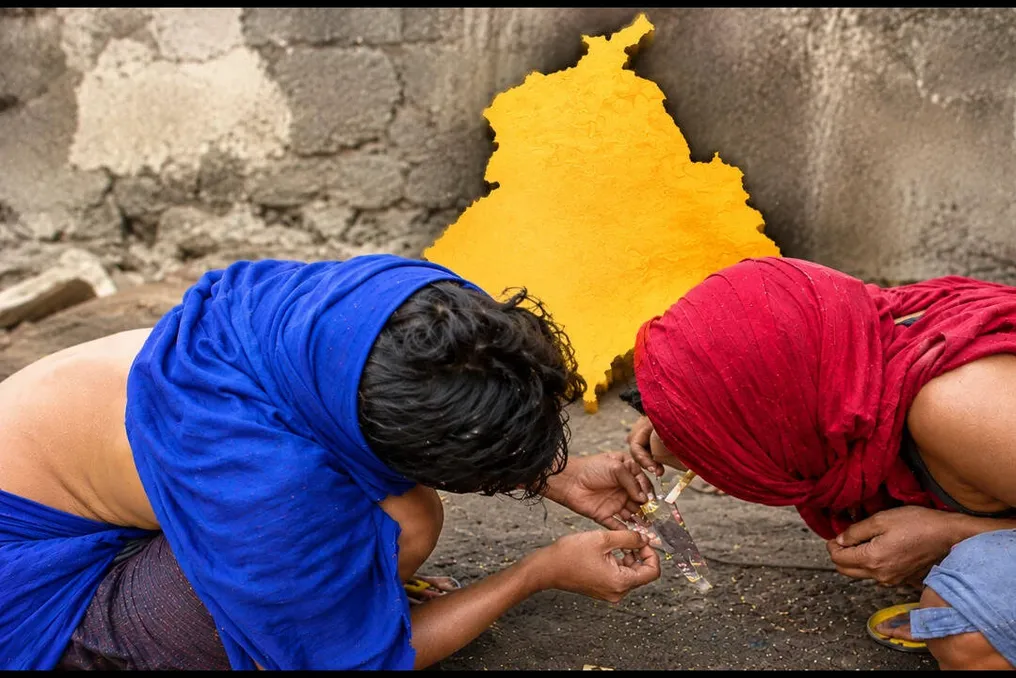
Residents of Punjab state that the focus should not be on fighting the problem itself, but on addressing the individuals suffering from it, pointing to the stigma surrounding addiction in the state.
The state's fight against drugs goes beyond simply restricting supplies or sending people to rehabilitation centers. For many, the real battle begins after leaving these institutions, when they face social condemnation, lack of family and societal support, and limited opportunities for rebuilding their lives.
Despite promises from successive governments regarding action against drug networks and expanding rehabilitation programs, the risk of relapse remains a serious issue without continuous care and support. This raises a broader question: are there enough rehabilitation centers to address the deep-seated problems of addiction?
According to the latest NCRB report on accidental deaths and suicides in India (ADSI), Punjab recorded the second-highest number of overdose deaths in 2024—106 cases. Previously, in 2022 and 2023, the state held the top spot for this metric.
Nationally, 978 such deaths were registered, with Tamil Nadu leading with 313 cases, followed by Punjab (106) and Madhya Pradesh (90). Although Punjab ceased to lead in overdose deaths, the number of deaths in the state increased from 89 in 2023 to 106 in 2024, though this figure was lower than the 144 deaths recorded in 2022. Across the country, the total number of overdose deaths was 681 in 2022 and 654 in 2023.
Among neighboring regions, Himachal Pradesh reported 31 deaths (compared to 21), and Haryana reported three (up from zero the previous year). Chandigarh recorded seven deaths, less than eight, while Jammu and Kashmir reported four, one fewer than in 2023.
Furthermore, the NCRB report on crime in India for 2024 showed that Punjab has the second-highest rate of crime under the Narcotic Drugs and Psychotropic Substances (NDPS) Act in the country—29 cases per lakh population. The state registered 8,973 cases, the fourth largest in the country. Kerala led both in crime rate (75.5 cases per lakh population) and total cases (27,149), followed by Maharashtra with 15,641 cases and Tamil Nadu with 11,037. The national average stood at 7.8 cases per lakh population with a total of 109,890 registered cases nationwide.
Of all NDPS cases in Punjab, 6,060 were related to storage for trafficking, the highest number among all states. Uttar Pradesh followed with 3,219 cases, and Rajasthan with 2,758.
Various administrations in Punjab have adopted different approaches to combating substance abuse: from the detoxification infrastructure emphasized by the SAD-BJP government to outpatient treatment programs by the Congress government and enhanced anti-drug network efforts by the AAP government.
The SAD-BJP government (2007–2017) established state detoxification centers in district hospitals and 22 rehabilitation centers known as Navjeevan Kendras, focusing on counseling and vocational training. In 2014, it also launched a large-scale police campaign amid concerns over synthetic drugs and smuggling.
The Congress government (2017–2022), initially led by Captain Amarinder Singh and later by Charanjit Singh Channi, introduced Opioid Overdose Treatment (OOAT) clinics, allowing individuals with opioid dependence to receive medication without long-term hospitalization. It also established a Special Task Force (STF), launched a network of Drug Abuse Prevention Officers (DAPOs), and implemented a Buddy Programme in schools and colleges to raise youth awareness.
The AAP government, led by Bhagwant Mann, operating since 2022, has placed greater emphasis on law enforcement, border surveillance, and public participation. Its 'Yudh Nasheyan Virudh' campaign, launched in March 2025, included large-scale police raids and arrests. The government also deployed anti-drone systems along the international border, took action against property allegedly linked to drug proceeds, and mobilized village-level volunteers called 'Pind De Pehredar' to monitor drug-related activities.
Nevertheless, political debates about these measures continue. Opposition parties accuse the AAP government of being unable to stop drug trafficking and prioritizing publicity and policing over rehabilitation. The Congress and AAP, in turn, exchange accusations that previous administrations failed to handle the crisis, as the drug problem persists despite changes in government.
While each government cites arrests, anti-drug raids, treatment facilities, and awareness programs as proof of its efforts, the persistence of drug-related deaths and crimes raises a deeper question: did successive governments focus enough on sustainable recovery, or has Punjab's fight against drugs largely remained focused on promises and coercive measures?
Aman, who moved to Mohali in 2023 for studies and found work at a pizzeria, recounted that his exposure to drugs began out of curiosity rather than dependency. Initially, he occasionally consumed alcohol but became interested in cannabis after reading about it, watching documentaries on the hippie movement, and studying travelogues of seekers of nirvana and enlightenment.
Near the end of 2023, he first acquired marijuana and learned to roll joints via YouTube. He described his first intoxicated experience as something that calmed his mind and softened the sharp edges of daily anxiety. What started as occasional use gradually became more frequent. Over the next year, he experimented with weed and hash before eventually trying LSD during a trip to Kasol with his cousin.
Although he claims to still use cannabis, he states that he reduced consumption after realizing he was smoking three or four times a day. Gradual reduction and longer breaks helped him lower the frequency to occasional weekend use.
Aman believes that emotional stress, family pressure, and the inability to express feelings can push young people toward substance use. He argues that simply placing a person in a rehabilitation center or helping them quit drugs does not solve the root causes of addiction.
In his view, rehabilitation centers must approach patients with compassion, rather than viewing addiction as a moral failure. He believes that recovery also requires family support, psychiatric care, and opportunities to build a new life.
Regarding drug availability, Aman asserts that access often depends on money and personal connections. He notes: 'Drug use is quite common in Punjab, and it often starts in families, as substance use is passed down through generations. Opium (afium) and poppy husk (dode) are widely used, and their use is often celebrated in songs. As for availability, these substances are everywhere. Psychedelics, on the other hand, are rare in Punjab, and people more often resort to methamphetamine, cocaine, and heroin.'
The need to look beyond substance use and understand the person behind the addiction is emphasized by Dr. Bhupendra Chaudhary, a philosopher-scientist, author, and speaker. He stated: 'Addiction cannot be understood merely as a habit or substance dependence; it is equally important to understand the person behind this behavior.'
He also explained how self-awareness can help people recognize behavioral patterns and regain control over their choices. Dr. Chaudhary added: 'When a person begins to observe their automatic reactions, discover how their conditioning is driving them, and reconnect with their true 'self,' they gradually gain greater freedom of choice by making more conscious decisions.'
For Aman, solving the drug problem in Punjab requires more than just a change in political leadership. He believes the government can play a significant role in resolving the crisis but insists on the importance of accountability within the system. He alleges that officials are also involved in illegal activities, including drug trafficking, although these allegations could not be independently verified.
He says people need to see elected representatives and officials working for the good of the state. He also stresses the need to educate people about substance use and make conversations about addiction less taboo so that young people can seek help without fear of judgment. A more complex task for the government is ensuring that its response does not end with arrests, confiscations, or admission to rehabilitation centers. Continuous counseling, mental health support, family involvement, and aftercare are equally important.
As Punjab approaches the next assembly elections, the state's response to the drug crisis is likely to remain a key issue of political accountability. For voters, the question will not only be what parties promise to do against drug networks but also what they offer those struggling with addiction and trying to rebuild their lives. Ultimately, the success of the rehabilitation system should be measured not only by the number of people admitted to its centers but also by whether they receive support to rebuild their lives after their stay.