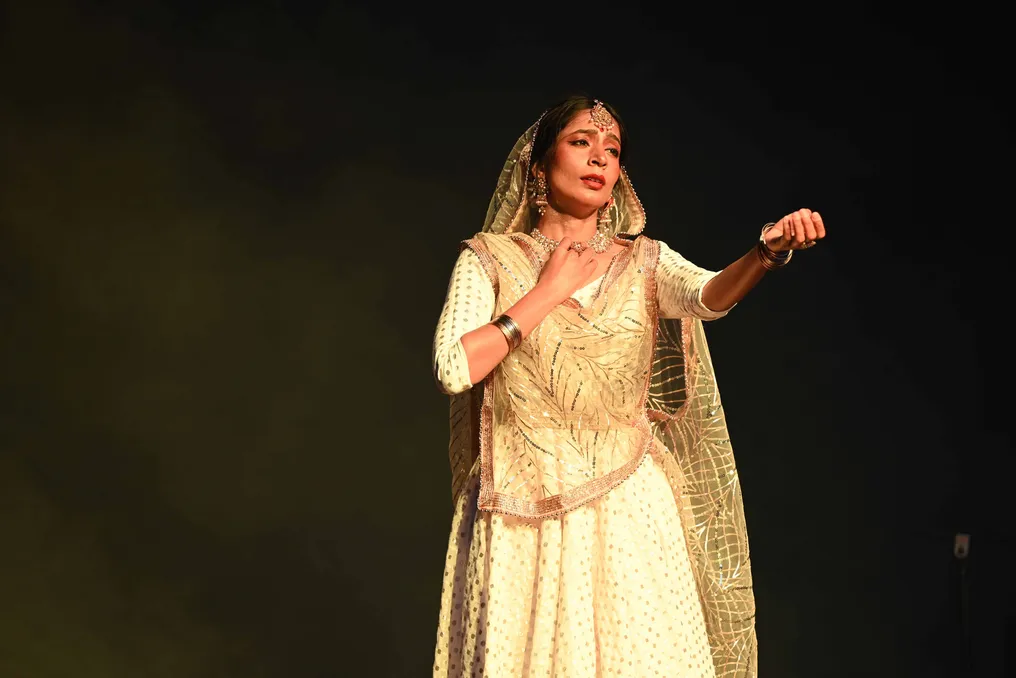
Devan Ekambaram's composition 'Varuvaaiy,' which is a modern interpretation of Subramania Bharati's poetry, has achieved historical significance for Tamil music by receiving a Grammy nomination.
When the nominations were announced on November 16, Ekambaram, who was working on the project in Sri Lanka, could not watch the ceremony and instead visited a temple. He recalls being too nervous to watch the broadcast. However, around 18:47 IST, his phone notified him of congratulations from a friend in Los Angeles, after which he received many similar messages and cried upon realizing what had happened.
The song 'Varuvaaiy' is an independent Tamil recording that Ekambaram composed and produced in collaboration with vocalist Suchiksha Rangarajan, known as Suha. This composition was nominated for 'Best Global Music Performance' at the 69th Grammy Awards, making it the first Tamil song to receive such a nomination.
For Ekambaram, this moment embodied a childhood dream—watching Michael Jackson win a Grammy for 'Thriller' and hearing host Whoopi Goldberg urge young viewers not to give up. This success was achieved without a family musical tradition, as he comes from a family of doctors and engineers, and he had to start this journey alone.
Musical upbringing in childhood
Growing up in New Jersey, often being one of the few Indian children in his area, Ekambaram struggled with adaptation. Music became a source of confidence for him. His mother introduced him to various genres, and programs like American Bandstand and Solid Gold exposed him to artists building careers around music.
He started playing the guitar between the seventh and tenth grades, then joined the school choir and marching band. He learned to distinguish harmonies and how musical parts combined, and began recording music at home. Ekambaram notes that while he was aware of his weaknesses, he found his strength through choir, harmony, and arrangement.
Grammy nominations came into his imagination around this time. He remembers watching Michael Jackson's win for 'Thriller' and hearing Whoopi Goldberg's call to young viewers to hold onto their dreams. This became his goal. At the age of 19 or 20, while studying electrical engineering at the University of Illinois, he explored musical possibilities during holidays in India. He eventually dropped out of engineering and moved to Chennai at age 21.
Ekambaram admits that he simply dropped out of his engineering degree in the US and came here without support or direction, which was the scariest thing because he had never seen anyone do such a thing in his circle.
Creating a life in music and finding the right voice
Ekambaram's move to Chennai gradually opened doors for him. His 1998 album 'Kamban Oru Kannile,' created with S. P. Charan, attracted the attention of A. R. Rahman, leading to work on 'Kadhalar Dhinam.' In 1999, he debuted as a performer with the song 'Oh Maria' and subsequently recorded over 500 soundtracks, working simultaneously as a composer, vocal artist, and vocal arranger.
He participated in Grammy-recognized projects such as 'Winds of Samsara' (2015) and 'Divine Tides' (2022). However, this time he wanted to create something uniquely his own: an independent album reinterpreting Subramania Bharati's poetry using modern arrangements.
For the first single, he had a specific voice in mind. Ekambaram met Suchiksha Rangarajan, known as Suha, in 2007 when they appeared on the television program 'Coffee with Anu.' He wanted to collaborate with her ever since, but the opportunity didn't materialize. When he started working on the Bharati project, he contacted her again.
In June 2026, Suha arrived at his home studio with her mother, Lakshmi Rangarajan. The composition they were going to record was given to Lakshmi, and the melody was written by L. Krishnan and had existed for about 40–50 years. The process of generating ideas was unusually fast. Ekambaram asked Suha to sing, and the recording was finalized within the next two or three hours.
For him, her voice brought together the musical elements required for the song. Suha, trained in Carnatic music and having studied jazz at the University of Toronto, could switch between the classical foundation of the composition and the modern sound he aimed to create. She was also developing her own independent music career, including participation in NEXA Music, an initiative by A. R. Rahman and Clinton Cerejo, where she was selected among 24 artists in 2019. Ekambaram emphasized that without her singing, no one would have listened to the song.
Giving new life to an old poem
He intended to restore the traditional arrangement while preserving the character of the melody. Ekambaram described this as 'giving it a new look,' wondering how he would want to hear it himself. His goal was to make the form appealing to a new generation of listeners unfamiliar with Carnatic music, without stripping it of its uniqueness.
The arrangement, based on the raga Desh, combines Carnatic phrasing with piano, slide guitar, acoustic guitar, bass, and tabla. Ekambaram played keyboards and handled the track production. It featured pianist Anil Srinivasan, slide guitarist Prakash Sonthakke, guitarist Navin Samson, bassist Joseph John, and tabla player Sarvajit Krishna Mohan. Roshan Sebastian handled mixing and mastering. The collaboration was largely remote: Suha recorded in Ekambaram's home studio, and instrumentalists sent their parts from other locations. Ekambaram noted that he coordinated the musicians and worked with Sebastian on the final mix, resulting in a three-minute and 26-second recording released independently on August 12, 2026.
Suha's contribution was central to the sound he envisioned. Her training in Carnatic music, study of jazz at the University of Toronto, and contemporary sensibility shaped this recording. In 2019, she was one of 24 artists selected for NEXA Music, a project by A. R. Rahman and Clinton Cerejo. Her debut album 'Love Language' was released in August 2026.
The poem, written over a century ago, does not have an exact date, although it is believed to date back to Bharati's time in Pondicherry. Its imagery calls for strength to penetrate human thought and dispel darkness, and it was read as a metaphor for resistance against oppression and colonial rule. This purpose attracted Ekambaram. Instead of creating a new song with modern lyrics, he wanted to present a poet whose words shaped the social life of Tamil Nadu to a younger audience.
Releasing under tight deadlines
To release the single on time, a difficult decision had to be made. Ekambaram reported that the labels he approached were hesitant because the foundational work was in the public domain, and the permission process threatened to delay the release. Before the approaching deadline for Grammy submissions, he decided to release the track independently and handle distribution himself. He did not expect how well it would work out.
He had previously submitted works and participated in Grammy-recognized projects, but this time he focused on 'Varuvaaiy,' preparing links for streaming in the 'Best Global Music Performance' category. He mentioned that there were 526 entries in this category, and seeing names on the nomination list did not guarantee a nomination.
On the day of the nominations announcement, the song had about 300 views on YouTube, according to Ekambaram. As the news spread, the count rose to approximately 35,000. Thank you messages were received from musicians, including Scott Hoying of Pentatonix and Chandrika Tandon.
What's next after the nomination
Recognition came while Ekambaram was contemplating his next steps. He considered staying in Chennai or returning to the United States if the work did not progress. He wanted to create a body of work that listeners could associate with, rather than just a film or a star. He worried that short-term online trends leave less room for songs that remain in people's hearts.