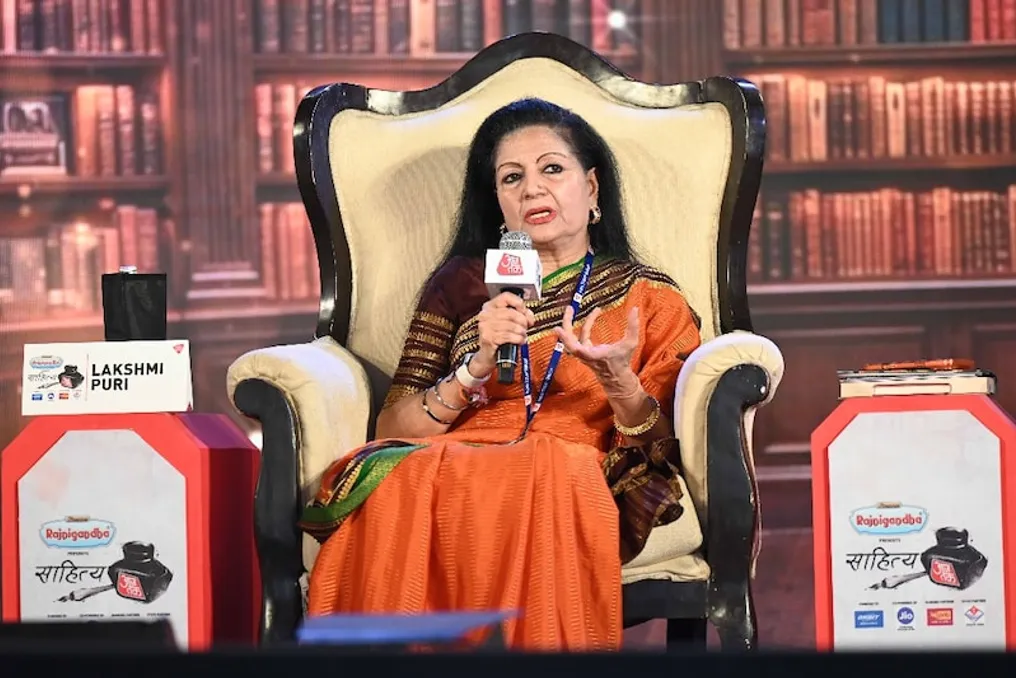
Lakshmi Puri discussed the status of women in India, freedom, and past traditions
Read more
Aaj Tak
www.aajtak.in

Lakshmi Puri discussed the status of women in India, freedom, and past traditions

At a session during the 'Sahitya Aajtak' 2026 event, themed 'Why the Past Attracts Modern Writers,' former diplomat and writer Lakshmi Puri, renowned writer Namita Gokhle, and former diplomat and author Navatej Sarna spoke. Lakshmi Puri addressed issues concerning the status of women within Indian traditions, female empowerment, women's contribution to the independence movement, and the cultural significance of the sari.

She emphasized that the divinity of women holds a special place in Indian civilization. However, according to her, the patriarchal system has repeatedly distorted noble traditions to suit its own interests, leading to the emergence of social vices.

Referencing her novel 'Swallowing the Sun,' Lakshmi Puri noted that it is a story written for and about youth. The novel is set approximately one hundred years ago and is inspired by the unusual lives of her parents. She shared that both her parents held feminist views and participated in the fight for independence. The novel is a tribute to a generation that modern young people are gradually forgetting.

This generation took on the commitment to break free from the mentality of servitude, revive the pride of their civilization, and change society. Cultural forms such as poetry and theatre also served as sources of inspiration in the struggle for independence. Lakshmi Puri reported that a web series based on her novel is being produced to meet the needs of a young audience.

Lakshmi Puri recounted that her novel depicts women who, about a century ago, received education, became lawyers, and participated in the independence struggle. They loved for love and chose partners outside their community. She acknowledged that the status of women has significantly improved compared to the past but believes much still requires change. The fight for gender equality and women's empowerment must continue, and she called her novel a manifesto for female empowerment.

During the discussion, she was asked why she mentioned Chanakya in her novel in the context of women's desires and empowerment, given that Chanakya is usually referenced in fields like politics, diplomacy, economics, and strategy. Lakshmi Puri replied that she faced accusations of using Indian traditions, scriptures, the Ramayana, and the Mahabharata to strengthen the position of women's empowerment and equality. She explained that during her research, she came across a quote from Chanakya mentioning women's desires, appetite, courage, and cunning. She incorporated this quote through one of her novel's characters. Lakshmi Puri also mentioned that at the United Nations, she proudly spoke about the value that Indian civilization places on women and girls.

Lakshmi Puri stated that noble traditions are sometimes misinterpreted, which leads to the appearance of social vices. The patriarchal system interprets traditions according to its convenience, selecting only those aspects that align with its views. She stressed the necessity of understanding history, as history provides us lessons for the present and guides the future. Youth will play an important role in building a developed India, so they should study the struggles and contributions of their ancestors.

Referring to her book 'The Saree Eternal,' Lakshmi Puri urged Generation Z and especially young women to continue the tradition of the sari. She asserted that the sari is a symbol of Indian civilization. How this cultural heritage will be passed down in the future depends on the new generation. She said, 'This is my letter of love to you, and the sari is also a letter of love.'

Lakshmi Puri noted that today's young women are themselves starting new trends regarding the sari, and the love for this attire is growing again. She called on young women to contribute to making this tradition eternal.
Similar stories

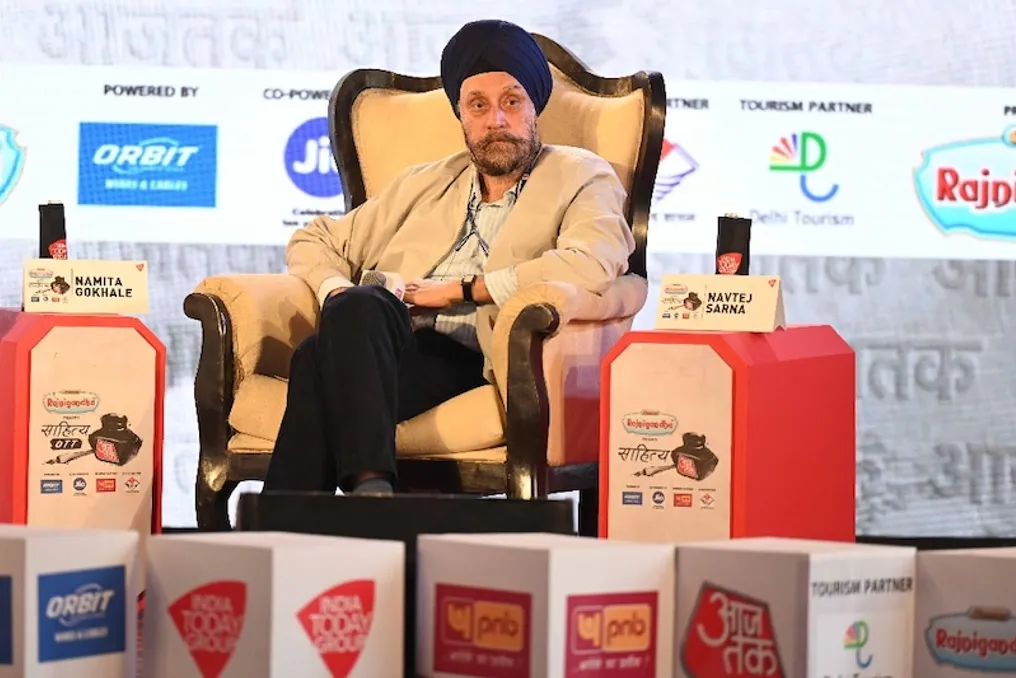
Navatej Sarna speaks on the Jallianwala Bagh and Koh-i-Noor Uprisings, stating that empires do not apologize for their past
Read more
www.aajtak.in

Navatej Sarna speaks on the Jallianwala Bagh and Koh-i-Noor Uprisings, stating that empires do not apologize for their past

During literary discussions held on the third day of the 'Sahitya Aajtak' event in 2026, several authors shared their thoughts on various topics. The session dedicated to the question, 'Why does the past attract writers?' garnered particular interest. Participants included former diplomat and writer Navatej Sarna, renowned writer Namita Gokhale, and former diplomat and writer Lakshmi Puri.

During the conversation, all three highlighted plots from their books and touched upon numerous non-obvious aspects of history, mythology, Indian culture, colonial legacy, and women's empowerment. Important issues were raised concerning the tragedy at Jallianwala Bagh, the return of the Koh-i-Noor, forgotten characters from the Mahabharata epic, the ecological crisis in the Himalayas, and the role of women in Indian traditions.

The authors emphasized that the past enriches not only their creativity but also provides perspective for understanding the present and improving the future.

Former diplomat and award-winning author of the 'Sahitya Akademi,' Navatej Sarna, presented his views on questions such as: 'Why has the British government still not offered an official apology for the Jallianwala Bagh tragedy? Why has the Koh-i-Noor not been returned to India?' He discussed British colonialism, lesser-known pages of history, and the responsibility of writers through the lens of his works in detail.

Refusal of the Koh-i-Noor Project

Navatej Sarna recounted that he was initially supposed to be the third author of a book about the Koh-i-Noor, written by William Delrimple and Anita Anand. He was slated to write the third book, and the contract had already been signed. However, during this period, he was appointed as the High Commissioner of India in Britain. This placed him in a moral dilemma: if he wrote such a book and traveled to Britain, it could complicate the task assigned to him by the Government of India. For this reason, he withdrew from the project himself.

Cannot Wait for Apologies

Addressing the Jallianwala Bagh tragedy and the return of the Koh-i-Noor, Navatej Sarna noted that the injustice committed during colonial rule cannot be denied. Nevertheless, he stated that one cannot simply wait for the Koh-i-Noor to return or for an apology for Jallianwala Bagh to be issued in order to move forward. He recalled that Britain expressed deep regret on the centenary of the Jallianwala Bagh tragedy. At that time, he wrote an article arguing that a mere expression of regret is insufficient. Sarna concluded that it is sad that empires do not apologize for their past. He added that India's dignity lies in the fact that regardless of whether the opponent apologizes for its mistake or not, India must move forward.

Justifications for Refusing the Return of the Koh-i-Noor

Navatej Sarna pointed out the numerous arguments put forth by Britain regarding the return of the Koh-i-Noor. The question arises as to whom it should be returned, since it belonged to Maharaja Ranjit Singh and was associated with Lahore. Pakistan and Afghanistan have also made claims regarding this. He noted that regardless of whether the Koh-i-Noor is returned, future generations can be told where, how, and under what circumstances it was acquired.

Translating His Father's Stories

Navatej Sarna also shared his experience translating his father's stories about the partition of India. His father wrote about a hundred stories on the partition, from which Sarna selected thirty. Sarna said, 'If you cried reading these stories, I cried translating them. I heard my father's voice.' He explained that his father personally experienced the tragedy of partition and lost his sister. The main goal of his work was to show that there are good and bad people in every religion, and that hope in humanity should not be lost even in the toughest times.

Historical Date of Flags

In his new book, which mentions the history of the national flag, Navatej Sarna clarified that the commonly held belief that the tricolor was hoisted over the Red Fort on August 15, 1947, is incorrect. According to him, the flag was hoisted over the Red Fort on August 16, 1947. The day before, on the evening of August 15, the flag was publicly hoisted at Prince Park near the India Gate. He urged people to respect the national flag and observe the related rules.

Devadhatta Patnaik discusses the transformation of deity worship traditions in India from temples to music
Read more
www.aajtak.in

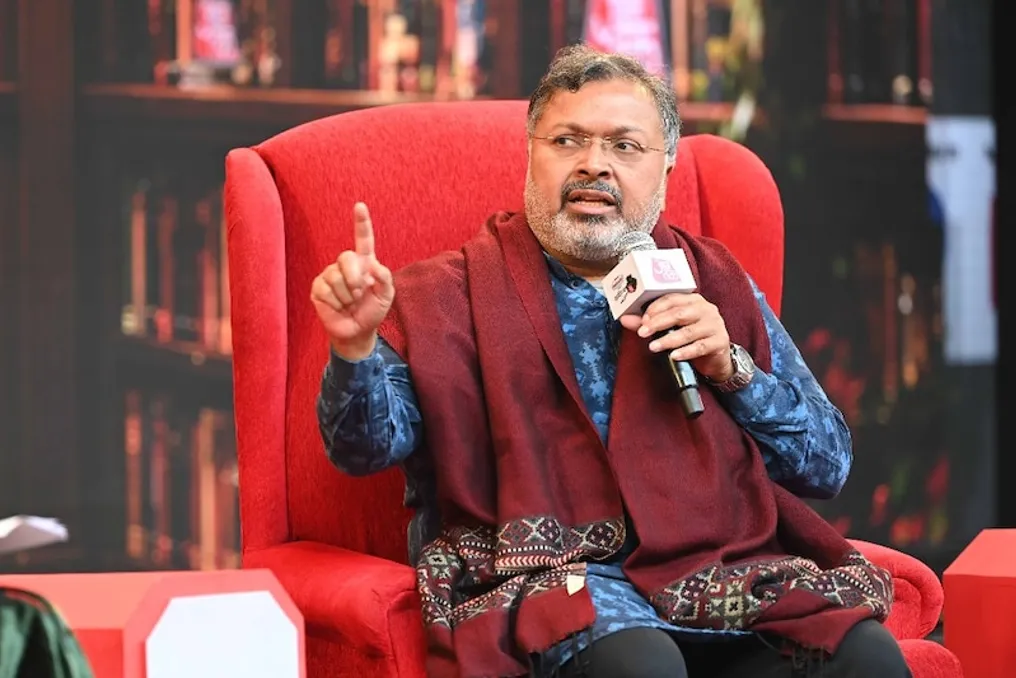
Devadhatta Patnaik discusses the transformation of deity worship traditions in India from temples to music

During the session 'Hinduism: Religion, History and Myths' on the Sahitya Aajtak platform in 2026, renowned mythologist, writer, and artist Devadhatta Patnaik shared his views on religion, Indian traditions, the Vedas, history, and philosophical debates. He also commented on modern trends such as the rise of religious events, bhajan clubs, and television debates.

Devadhatta Patnaik noted that while bhajan clubs have their value, they do not contribute to the increase of knowledge. Curiosity, dialogue, and philosophical disputations (shastrartha) are necessary for gaining knowledge.

When asked whether contemporary religious events, where kirtans and bhajans are gaining popularity, will include philosophical debates and religious dialogues, Patnaik replied that bhajan clubs are for some people, and shastrartha is for others. He emphasized that some people dislike participating in shastrartha, even if they are connected to this tradition.

He refused to deem bhajan clubs wrong, stating that bhajan club sessions will also be held in temples in the future. In a humorous manner, he mentioned that nowadays people engage in bhajan clubs while consuming sattvic food. He added that if a child tells their parents they are going to a club, they might not approve, but if they say they are going to a bhajan club and will eat sattvic food, the parents will gladly agree.

'People are afraid because they do not believe in their religion'

Stressing the need to read one's own scriptures, Patnaik stated that he has observed that people lack sufficient understanding of Indian history and modernity. He gave an example, noting that Indian history is considered ancient, around 5000 years old, whereas the rule of Muslim sultans lasted approximately 500 years, and British rule lasted about 200 years. In his opinion, these periods should be viewed in the context of the entire history.

He believes that when people discuss these eras, it indicates their distrust in their own religion and traditions. They are so frightened that they lack knowledge of their sacred texts. Patnaik concluded that understanding Indian tradition requires knowing its long history and tradition of knowledge.

Explaining the difference between debate and dialogue in the context of religious discussions, Devadhatta Patnaik noted that the technique of debate is called argumentative and has roots in Greek tradition. According to him, this style of debate entered the Indian tradition after Alexander's arrival in India, through Greek intellectuals.

He asserted that there was originally a tradition of dialogue in India. As an example, he cited Janaka Sabhu, where people gathered not to defeat each other, but to find out how much knowledge each person possessed and what a new person could contribute.

He quoted the thought: 'Saraswati is born from curiosity.' In his view, the Upanishads, Brahmanas, Aranyakas, and Vedas gatherings show a tradition of dialogue, where questions were asked, opinions were listened to, and new knowledge was sought.

When asked if the freedom of doubt and argumentation within Hinduism can be considered a specialty, Patnaik replied that the concepts of 'right' and 'wrong' are not part of the Vedas. He linked this to Western thinking, explaining that in Indian philosophy, a person does not possess complete knowledge of the whole truth. He referred to Shankara's statement: 'The world is an illusion, Brahman is the truth,' asserting that every person possesses only partial truth. One may be an expert in one field, and another in another, so curiosity must be shown to learn from each other's experiences and knowledge.

Giving the example of journalism, he said that if he sits with a journalist, he must be curious about their experience and life. Similarly, the journalist can ask questions about the interviewee's topic. Thus, both can learn from each other and expand their knowledge.

Commenting on social media discussions, Patnaik noted that arguments begin when curiosity disappears. In his opinion, in today's debates, people strive to defeat their opponent rather than understand them. When he watches television debates, he sees egoism, not soul. He also mentioned disputes between gurus and religious figures on social media, calling languages like 'panchd khim', 'dibenkd khim', and 'slapd khim' a language of violence, not knowledge and dialogue.

Devadhatta Patnaik concluded that ignorance breeds egoism. Although bhajan clubs can excite people's emotions and bring them pleasure, the real question is whether they enhance intellect and knowledge.

Kumar Vishwas shared thoughts on Rama and Sita at a literary event in Delhi
Read more
www.aajtak.in

Kumar Vishwas shared thoughts on Rama and Sita at a literary event in Delhi

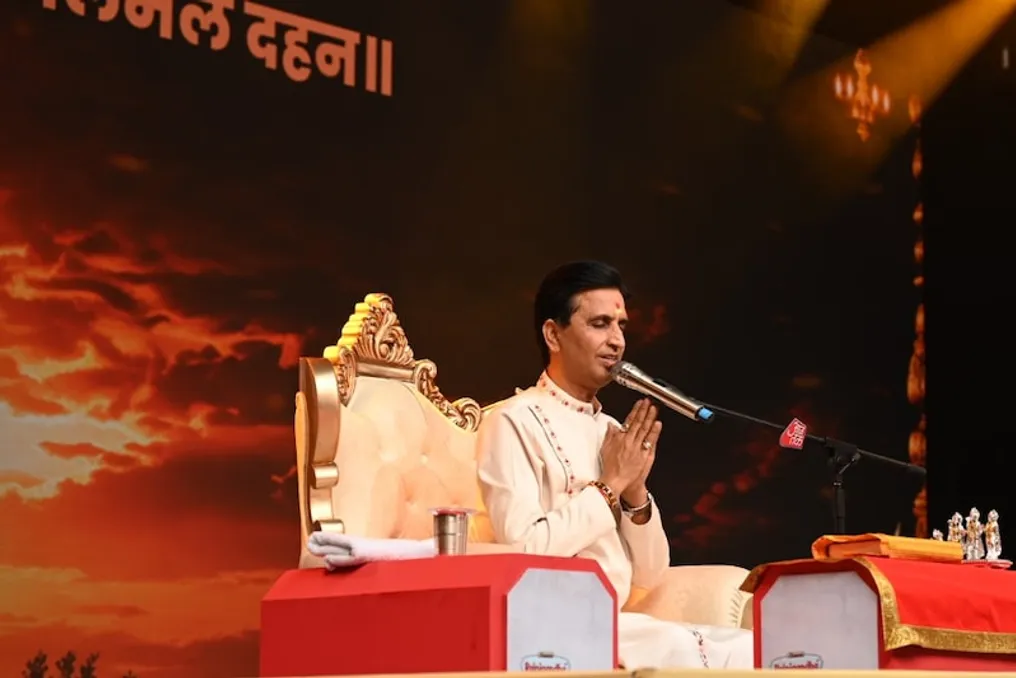
During an event organized by the group India Today at the Major Janchand Stadium in Delhi, poet Kumar Vishwas spoke about the sacred event of the wedding of Rama and Sita. He discussed the cultural richness of Mithila, marriage traditions, and the significance of married life.

On the second day of the annual literary gathering 'Sahitya Aajtak-2026', poet Kumar Vishwas presented his speech titled 'Apne-Apne Ram' (Each One's Rama), explaining to the audience the essence of Shri Rama's life story. This day was dedicated to one of the most interesting and noble episodes of the Ramakhyan—the wedding of Shri Rama and Sita in Janakpuri, Mithila.

Through the story of the marriage of God Rama and Mother Sita, he revealed concepts of love, self-sacrifice, family life, friendship, and royal duty. He also described the cultural abundance of Mithila, local wedding customs, and the unique connection of the people of Mithila with God Rama. Furthermore, he shared his experience writing a song about the wedding of Rama and Sita for the film 'Ramayana.'

Vishwas noted that much is said about Ayodhya, but little about Mithila. He emphasized that not only God Rama, but also eight seasons and four holy places came to the threshold of Mithila. Expressing this thought, he recited his poem: 'Kalachakra ko rok nimeś me aṭhon yām paḍhare haiṁ, Janakpuri ki dehrī chhune charaṇ dham paḍhare haiṁ' (Eight seasons came to stop the wheel of time, four holy places came to touch the threshold of Janakpuri).

Addressing poets, Kumar Vishwas advised them to write about love, country, or any topic, but stated that divine discourse would only be blessed if it were dedicated to Rama.

He also recounted his experience working with director Nitesh Tiwari and composer A.R. Rahman. Creating a song about Mother Sita's wedding required a lot of effort. Even after five days of work in the Chennai studio, if satisfaction was not achieved, the work on the song continued. On the seventh attempt, he felt the song turned out suitable. After the song's release, he attended four weddings, and at all four ceremonies, this song was played during the exchange of garlands. He wanted such a song to be written that every daughter would want to hear it while taking the vermilion into her hands.

Using the example of the wedding of Rama and Sita, Kumar Vishwas touched upon the theme of marital relationships in the modern era. He argued that marriage is not a doll's game, but a lesson in self-sacrifice towards each other. He noted that the most important relationships in families are marital ones, and that people have ruined precisely that. He mentioned the rise in divorce cases in India. Although living in discomfort with someone is not life, he added that one should try to live within one's existence with some degree of comfort.

He also mocked the actions taking place during the garland exchange at wedding celebrations. Kumar Vishwas urged the youth to show modesty towards the girl who stands with the garland in her hands to become part of your home, leaving her family. He reminded that God Rama also bowed his head before Mother Sita, folding his hands in prayer.

Kumar Vishwas vividly described the tradition of singing abusive songs during weddings in Mithila. He said that in his life, God Rama heard only praise: he was praised by sages, praised by his father, even dying demons praised him. However, in Mithila, women used to utter curses against him during the wedding, and he listened to them, smiling. He jokingly suggested that on that day, Rama decided that next time he would be born in a place on Earth where curses sounded everywhere, and then he was born in Braj.

Speaking about the importance of friendship, Kumar Vishwas stated that no matter how rich and powerful you become, you will remain poor if you do not have a friend who can talk to you using coarse language. He told the story of one of his old friends and quoted his line: 'Dost na mil sake, vo shohrat-sama na ho, darika kya hai, dhana koi sudama na ho' (If there is no friend, there is no glory or wealth; what is Dwarka if there is no Sudama).

Popular