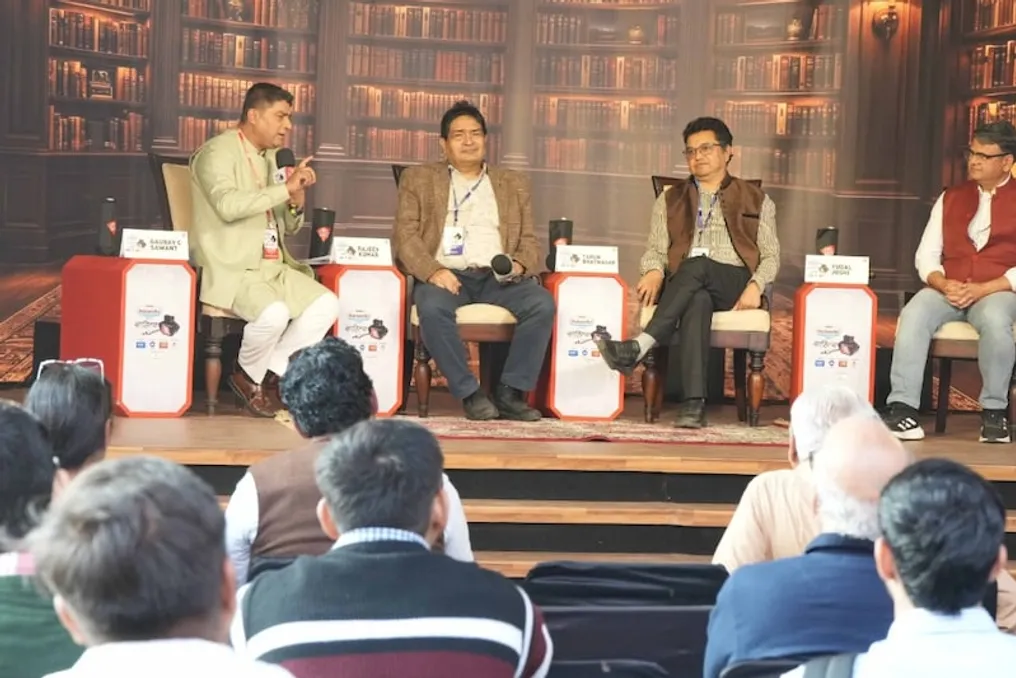
Authors shared interesting stories from the history of Kalidasa's poem and Jahar's love
Read more
Aaj Tak
www.aajtak.in

Authors shared interesting stories from the history of Kalidasa's poem and Jahar's love

At the event 'Historical Windows: Narrative, Characters, and Era,' held on the Sahitya Aajtak platform in 2026, an engaging discussion took place about untold stories related to history, love, and significant figures of the past. Participants included poet and writer Rajiv Kumar, author Tarun Bhatnagar, and author Yugal Joshi.

The session discussed the role of love in the lives of historical figures such as Kalidasa, Malik Kafur, and Razia Sultan, examining history through the prism of literature and imagination. The speakers emphasized that behind the events recorded in historical chronicles are always human emotions, love, and the struggle for power.

In contrast to modern expressions of feelings via WhatsApp messages and emojis, the discussion covered how love was expressed in ancient times. In this context, Kalidasa's literature was mentioned. Yugal Joshi noted that love is the most important emotion, without which life cannot be imagined. He analyzed Kalidasa's works, showing various forms of love: in 'Ritusamhara,' love is conveyed through six seasons, in 'Abhijnanashakuntalam' through Shakuntala's and Dushyanta's longing, and in 'Meghaduta' through the yearning for a meeting between a Yaksha and a Yakshini.

Joshi urged the modern generation to study Kalidasa's work, comparing 'Meghaduta' with modern cloud services and messengers. He explained that in that era, an amazing concept of message delivery was created: the meteorological spirit not only carried a message but also introduced the beloved to the geography, history, nature, and culture of the entire country. He concluded that to fully understand love, one must read Kalidasa, and for a simplified perception of his works, one can refer to a book like 'Kaho Kalidas.'

The session also discussed the life of Razia Sultan and her romantic relationships. Special attention was paid to the historical accuracy of the love story between Razia and Yakut, depicted in films. Tarun Bhatnagar stated that there is no convincing historical evidence of a romantic relationship between Razia Sultan and Yakut. He noted that there are many questions regarding these relationships in history.

He added that Razia married Altunia, who is mentioned in the work of the medieval historian Minhaj-us-Siraj, 'Tabaqat-e-Nasiri.' Altunia was then a personal servant of Iltutmish and considered the chief of the sultan's guard, known for his beauty and charisma. When Iltutmish decided to make his daughter Razia an heir, opposition arose. At that time, Altunia supported Razia. Later, disagreements arose between them, after which they married. The author stressed that in the relationship between Razia and Altunia, the role of politics cannot be ignored; political calculations were extremely important for conquering and maintaining power, so shades of both love and politics were evident in their relationship.

During the discussion, the life of Jahar Begum, daughter of Mughal Emperor Shah Jahan, and her romantic episodes were also touched upon. Writer Rajiv Kumar reported that Jahar was one of the most influential and wealthy women of her time, receiving the title 'Badshah Begum.' She was the head of the royal harem and was responsible for many important aspects of palace administration. Shah Jahan gave her this title instead of one of his wives, which attested to her merits and personality.

Rajiv Kumar mentioned that during the Mughal period, there was a ban on marriage for princesses from the royal family. Because of this, despite having romantic connections in Jahar's life, they could not lead them to marriage. Quoting the book of foreign traveler Bernier, he spoke of numerous rumors and discussions surrounding Jahar's romantic ties during that era.

According to Rajiv Kumar, Jahar's life included episodes of intimacy or love with three people. The first was Bundela ruler Chattarsal, who was her contemporary. The second was Nawab Khan, an influential military commander of that time. The third was Ram Singh, the heir of the royal family of Jodhpur. He supported Dara Shikoh in the battle of Dharmat at Jahar's request, where he died. Regarding Nawab Khan, it is claimed that he also died, and there are rumors that Shah Jahan was involved in this. Chattarsal also once left Jahar and never returned.

Rajiv Kumar concluded that these three romantic episodes in Jahar's life remained incomplete for various reasons. In his opinion, Jahar's story demonstrates a combination of love, politics, power, and family circumstances.
Similar stories

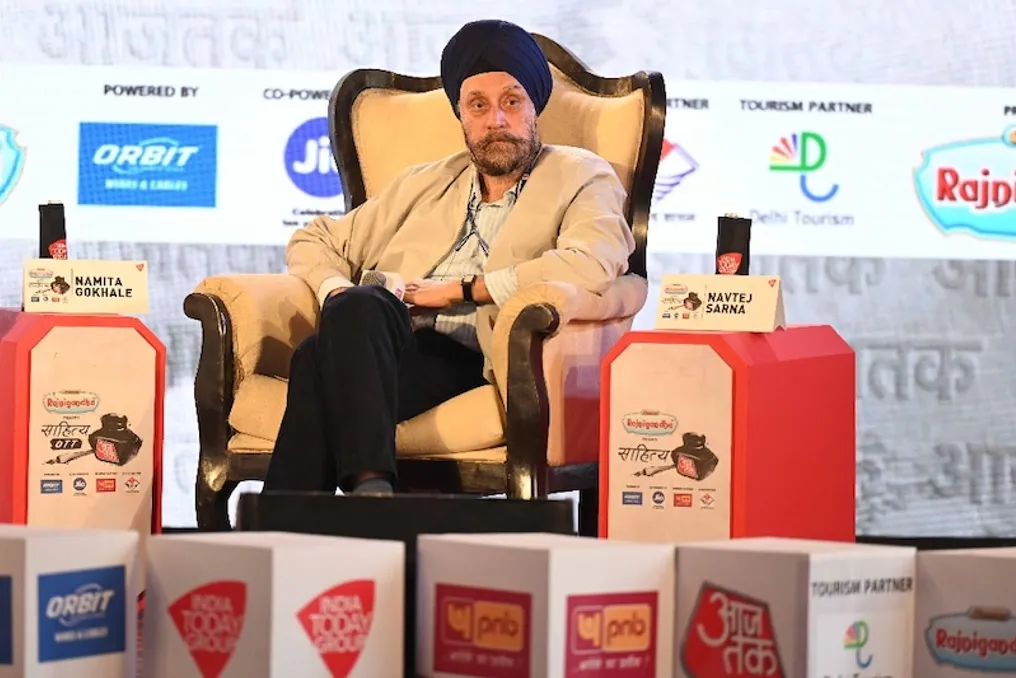
Navatej Sarna speaks on the Jallianwala Bagh and Koh-i-Noor Uprisings, stating that empires do not apologize for their past
Read more
www.aajtak.in

Navatej Sarna speaks on the Jallianwala Bagh and Koh-i-Noor Uprisings, stating that empires do not apologize for their past

During literary discussions held on the third day of the 'Sahitya Aajtak' event in 2026, several authors shared their thoughts on various topics. The session dedicated to the question, 'Why does the past attract writers?' garnered particular interest. Participants included former diplomat and writer Navatej Sarna, renowned writer Namita Gokhale, and former diplomat and writer Lakshmi Puri.

During the conversation, all three highlighted plots from their books and touched upon numerous non-obvious aspects of history, mythology, Indian culture, colonial legacy, and women's empowerment. Important issues were raised concerning the tragedy at Jallianwala Bagh, the return of the Koh-i-Noor, forgotten characters from the Mahabharata epic, the ecological crisis in the Himalayas, and the role of women in Indian traditions.

The authors emphasized that the past enriches not only their creativity but also provides perspective for understanding the present and improving the future.

Former diplomat and award-winning author of the 'Sahitya Akademi,' Navatej Sarna, presented his views on questions such as: 'Why has the British government still not offered an official apology for the Jallianwala Bagh tragedy? Why has the Koh-i-Noor not been returned to India?' He discussed British colonialism, lesser-known pages of history, and the responsibility of writers through the lens of his works in detail.

Refusal of the Koh-i-Noor Project

Navatej Sarna recounted that he was initially supposed to be the third author of a book about the Koh-i-Noor, written by William Delrimple and Anita Anand. He was slated to write the third book, and the contract had already been signed. However, during this period, he was appointed as the High Commissioner of India in Britain. This placed him in a moral dilemma: if he wrote such a book and traveled to Britain, it could complicate the task assigned to him by the Government of India. For this reason, he withdrew from the project himself.

Cannot Wait for Apologies

Addressing the Jallianwala Bagh tragedy and the return of the Koh-i-Noor, Navatej Sarna noted that the injustice committed during colonial rule cannot be denied. Nevertheless, he stated that one cannot simply wait for the Koh-i-Noor to return or for an apology for Jallianwala Bagh to be issued in order to move forward. He recalled that Britain expressed deep regret on the centenary of the Jallianwala Bagh tragedy. At that time, he wrote an article arguing that a mere expression of regret is insufficient. Sarna concluded that it is sad that empires do not apologize for their past. He added that India's dignity lies in the fact that regardless of whether the opponent apologizes for its mistake or not, India must move forward.

Justifications for Refusing the Return of the Koh-i-Noor

Navatej Sarna pointed out the numerous arguments put forth by Britain regarding the return of the Koh-i-Noor. The question arises as to whom it should be returned, since it belonged to Maharaja Ranjit Singh and was associated with Lahore. Pakistan and Afghanistan have also made claims regarding this. He noted that regardless of whether the Koh-i-Noor is returned, future generations can be told where, how, and under what circumstances it was acquired.

Translating His Father's Stories

Navatej Sarna also shared his experience translating his father's stories about the partition of India. His father wrote about a hundred stories on the partition, from which Sarna selected thirty. Sarna said, 'If you cried reading these stories, I cried translating them. I heard my father's voice.' He explained that his father personally experienced the tragedy of partition and lost his sister. The main goal of his work was to show that there are good and bad people in every religion, and that hope in humanity should not be lost even in the toughest times.

Historical Date of Flags

In his new book, which mentions the history of the national flag, Navatej Sarna clarified that the commonly held belief that the tricolor was hoisted over the Red Fort on August 15, 1947, is incorrect. According to him, the flag was hoisted over the Red Fort on August 16, 1947. The day before, on the evening of August 15, the flag was publicly hoisted at Prince Park near the India Gate. He urged people to respect the national flag and observe the related rules.

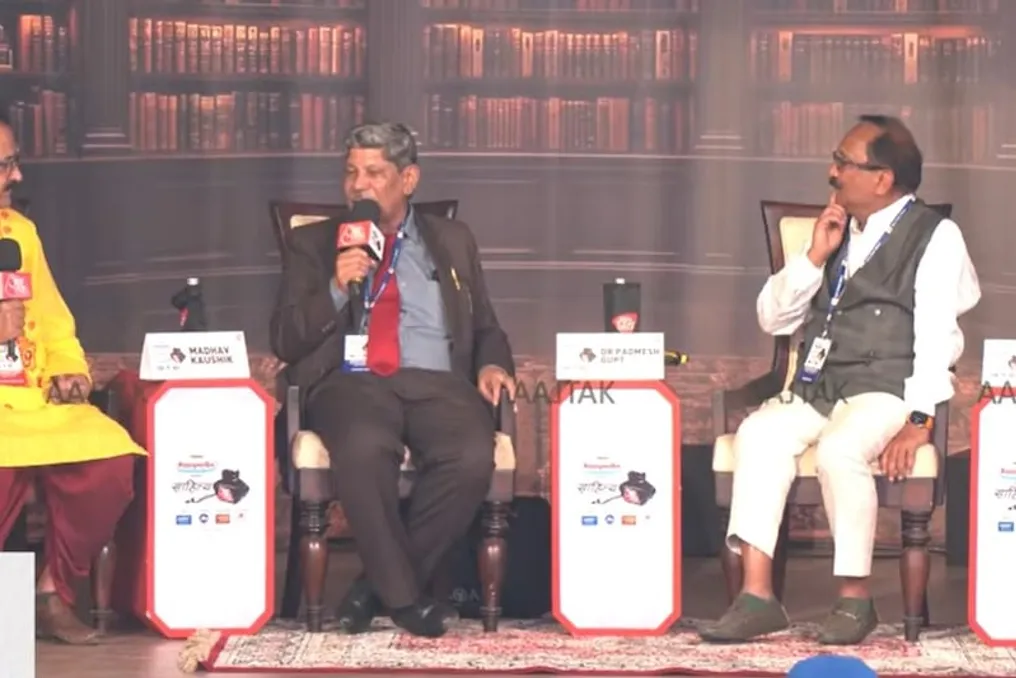
Madhav Kaushik and Padmesh Gupta Discuss the Nature of Writing and Their Creative Journeys
Read more
www.aajtak.in

Madhav Kaushik and Padmesh Gupta Discuss the Nature of Writing and Their Creative Journeys

During the session 'From Page to Pavilion — The Fabric of Books,' held as part of the Aajtak event 'Sahitya Talk,' Madhav Kaushik, President of the Academy of Literature, and poet Padmesh Gupta shared their experiences in beginning writing and their literary paths.

Madhav Kaushik expressed the opinion that writing is an activity chosen by a person's nature. He mentioned his father, who was a scholar and teacher of Urdu and Persian. In his conviction, if nature has destined a person for writing, they should dedicate themselves to this activity.

According to Madhav Kaushik, innate inclinations, family, and environment are important in the development of a writer. He recounted that his home had more books and magazines than relatives, and the guests who visited were also readers and writers. This atmosphere fostered the development of an interest in literature within him.

Padmesh Gupta agreed with Madhav Kaushik's statements but described his journey differently. He reported that at the age of eighteen, he went to study in France and later lived in England, where he did not find a literary environment. He noted that the absence of such an environment became a stimulus for his self-creation.

Padmesh Gupta narrated that after traveling to France, he realized his love for Hindi. Later, in England, he founded an organization and created his own literary environment. He emphasized that language is the best medium for expressing feelings, and poetry is the most beautiful way to convey them. It was the beauty of poetry that inspired him to write texts.

The necessity of literary fairs and events was also raised during the session. Madhav Kaushik explained that the Academy of Literature organizes events in 24 languages of the country and collaborates with various organizations to promote literature. The conversation also began to discuss the role that literary events play in providing platforms for authors and readers.

Popular