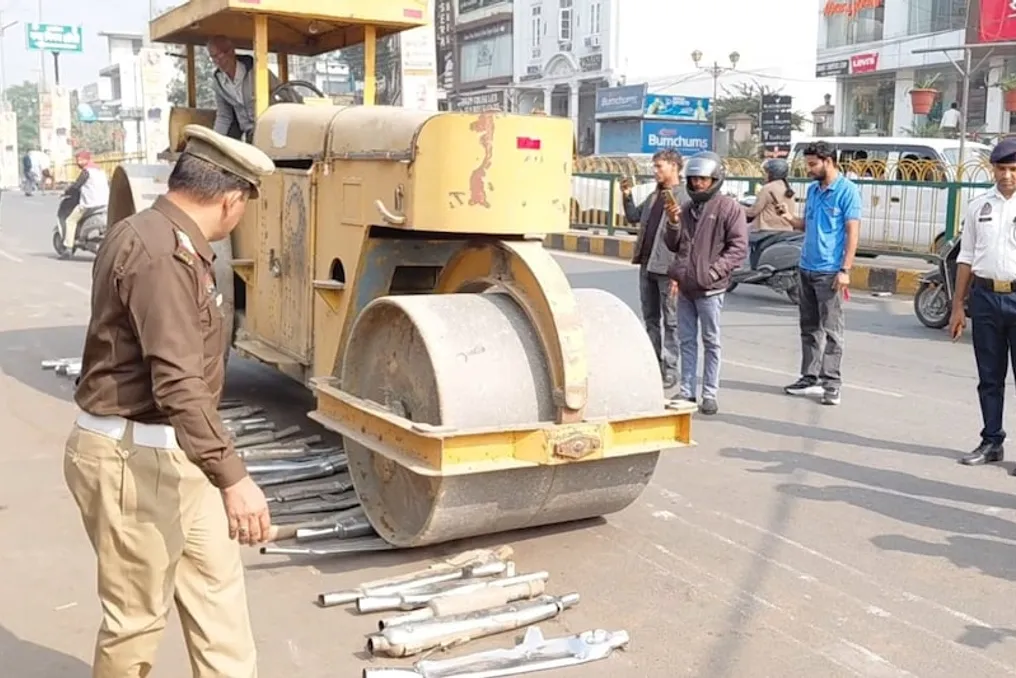
180 modified mufflers and pneumatic horns destroyed in Chhansi due to noise
Read more
Aaj Tak
www.aajtak.in

180 modified mufflers and pneumatic horns destroyed in Chhansi due to noise

In the city of Chhansi, Uttar Pradesh state, the traffic control police conducted a major operation against drivers who were creating noise pollution and driving with loud sounds. During this campaign, 180 modified mufflers and pneumatic horns were confiscated and subsequently destroyed using a road roller.

This action took place at the Elait intersection and attracted a large number of onlookers. The value of the destroyed equipment is estimated at approximately two and a half to three lakh rupees. This measure was part of a special campaign conducted as part of the road safety month.

Under the leadership of the senior police superintendent of Chhansi, the traffic control police are continuously running a campaign against rule violators. During the inspection of two-wheelers and other vehicles, prohibited modified mufflers and loud pneumatic horns were seized.

CO Traffic Ramveer Singh reported that, according to the instructions of the senior police superintendent, 180 modified mufflers and pneumatic horns seized during inspections were destroyed as part of the special road safety month campaign. Their approximate value is around two and a half to three lakh rupees.

He emphasized that the unusually loud sound produced by modified mufflers and pneumatic horns creates problems for ordinary people, increasing noise pollution and affecting the daily lives of residents in the vicinity. The use of such equipment violates traffic rules.

According to the CO Traffic, this operation was carried out in accordance with the directives of the directorate and transport department. The police aim not only to control excessive noise on the roads but also to raise drivers' awareness about traffic rules.

The traffic control police appealed to drivers of two-wheelers and other vehicles not to use modified mufflers and pneumatic horns in their vehicles. Drivers are advised to avoid installing devices that produce unnecessary loud noise and inconvenience ordinary people.

Ramveer Singh stated that obeying traffic rules is the duty of every driver. The police task is not only to issue fines and take measures but also to raise public awareness about safe and organized movement. The traffic control police clarified that the campaign against environmentally polluting and illegally used devices will continue, and called on citizens to cooperate in creating a safe, quiet, and orderly city of Chhansi.
Similar stories

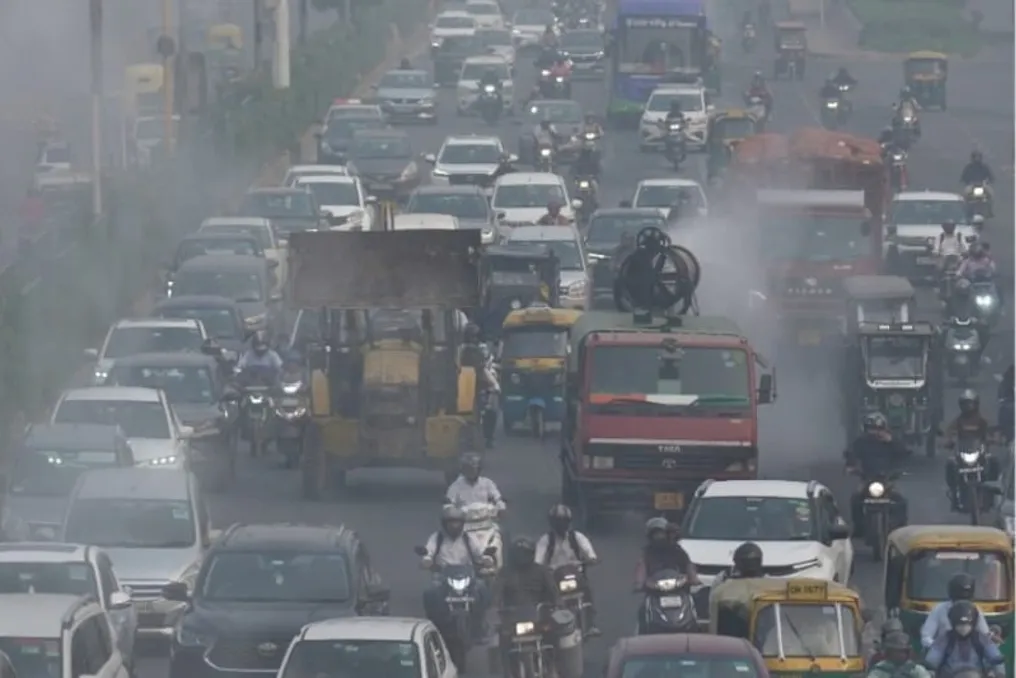
Air pollution measures tightened in Delhi: 25 thousand vehicles fined, 2446 enterprises closed
Read more
www.aajtak.in

Air pollution measures tightened in Delhi: 25 thousand vehicles fined, 2446 enterprises closed

Amid rising air pollution in Delhi, the government has intensified measures against vehicles and industrial facilities that violate environmental standards. In the first 17 days of November, 25,610 vehicles were fined for lacking a valid Pollution Under Control (PUC) certificate. Additionally, 30,742 vehicles meeting standards below BS-VI were sent out of Delhi.

At a meeting chaired by Minister Chief Minister Reha Gupta on Tuesday, officials presented a report on the steps taken to combat pollution. According to officials, during the first half of November, 2,817 vehicles were fined, incurring a total penalty of 5.42 crore rupees.

According to the Delhi government, from January to November 16, 41,659 old polluting vehicles were confiscated, and 64,800 vehicles were sent to scrap. Automatic Number Plate Recognition (ANPR) systems identified 7,055 old vehicles with BS-III standards or lower over the last 12 months.

Officials reported that between November 1 and 17, 181,548 vehicles registered outside Delhi meeting standards below BS-VI were inspected. These checks excluded CNG and electric vehicles. Of these, 30,742 were returned, 2,817 were fined, and 189 were confiscated.

The Minister instructed officials to strengthen surveillance at Delhi's entry points and use technology more effectively to identify violators. Police noted that checking every vehicle can cause traffic jams, and monitoring transport arriving on smaller roads at night poses a challenge.

The implementation of a Multi-Lane Free Flow (MLFF) system is planned for 154 entry routes in Delhi, including nine national highways and 20 major toll plazas. The Minister also demanded an acceleration of efforts to increase parking spaces.

Action has also been taken against environmentally polluting industrial facilities. The government reported that 709 illegal and polluting facilities operating in designated industrial zones were closed. During inspections of 11,415 facilities in undefined industrial zones, 1,762 air-polluting and 684 water-polluting facilities were identified. A total of 2,446 facilities were closed or sealed.

Compliance with the operation of the Online Continuous Emission Monitoring System (OCEMS) and Air Pollution Control Devices (APCD) was also checked. A total of 76 industrial facilities installed APCDs, of which 75 were certified according to established standards.

Between November 1 and 17, 8,874 construction and demolition sites were inspected. Violations were found at 554 sites. Officials ordered the closure of 112 sites, issued 462 notices demanding explanations, and imposed environmental fines totaling over 2.65 crore rupees.

The government directed that green networks, barriers, wind screens, and dust collectors be installed on construction sites soon. Furthermore, it was ordered to intensify regular checks in pollution hotspots, street cleaning, and dust prevention measures at construction sites.

According to the government, compared to last year, the number of anti-smog guns has increased from 376 to 437, water sprinkling sprayers from 271 to 296, and road sweepers from 76 to 106. Instructions were also given to the Delhi Metro to regularly operate anti-smog guns and mist systems from 7:00 PM to 11:00 PM.

Delhi requires 171 large and medium mechanized sweeping machines, but currently only 108 are available. An additional 70 machines are being deployed. The municipality is also purchasing 1000-liter collection trucks, with 600 expected by December 2026 and the rest by January 2027.

To make public transport eco-friendly, 2,395 additional electric buses are planned for this year. 692 electric buses are expected by December. Delhi's goal is to reach a total of 7,680 buses by the end of the current year.

From January to October, 6,000 new charging stations for electric vehicles were installed in the city, bringing the total number of stations to 14,913.

Under the 'Parivartan' program, the goal is set to replace 78,112 environmentally polluting heavy-duty vehicles with cleaner alternatives. As of November 17, 28,995 vehicles were registered in this program, including 25,737 trucks and 3,258 buses.

A subsidy of up to one lakh rupees is provided for the purchase of light commercial vehicles. Additionally, a scrapping bonus of 50,000 rupees is provided for surrendering a BS-IV category light commercial vehicle for scrap.

Environment Minister Manjinder Singh Sirsa stated that pollution control efforts are yielding positive results. The government has set a target to reduce pollution levels by 10–15 percent annually.

Popular