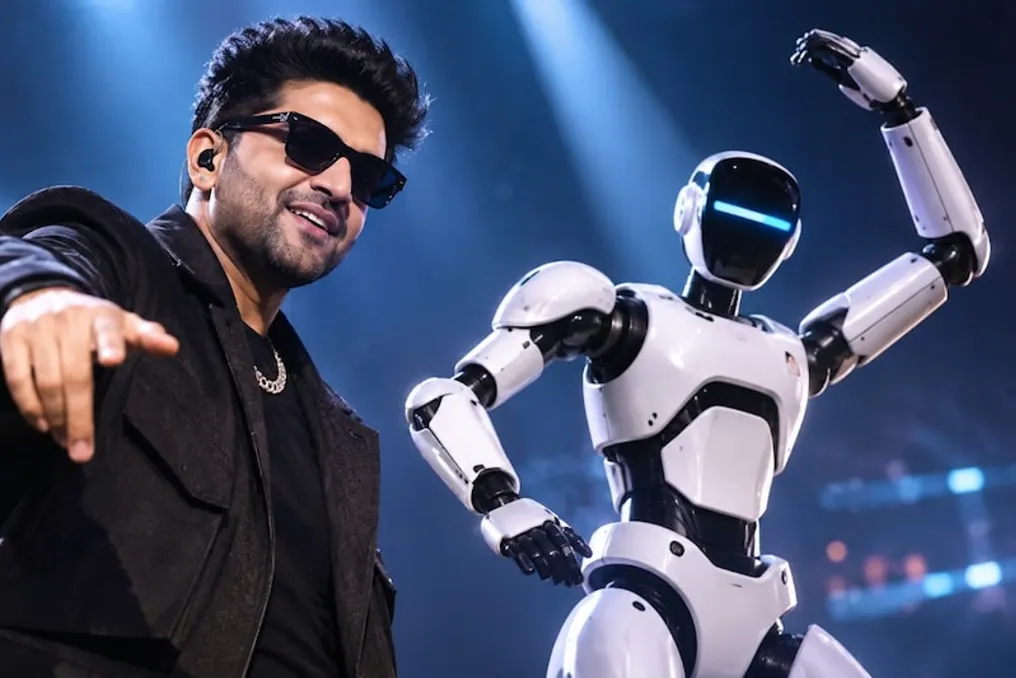
At the upcoming Guru Randhawa concert in Delhi, spectators will be able to see not only music and dance but also robot performances. Special robots are being prepared for the event 'The Sirra Era Live In Concert,' which will take place on December 12th at the Jawaharlal Nehru Stadium.
These mechanical devices are programmed to dance to the rhythm of the songs and interact with the audience. Guru Randhawa is returning to large live concerts in about three years, but the greatest interest is not in a new track or stage design, but specifically in the robots.
Videos of the testing and calibration of the robots for the upcoming concert at the Jawaharlal Nehru Stadium in Delhi have appeared on social media. According to reports, these robots will not just stand and watch the audience; they will dance along with the songs and communicate with people in the fan zone.
Guru Randhawa's management is collaborating with foreign technology experts to organize this show. The robots are being configured to perform movements precisely in time with the music. It is planned that the robots will be able to reproduce Guru Randhawa's signature gesture of rubbing hands.
Previously, a live concert was associated with a large stage area, impressive lighting, screens, dancers, and the artist's live vocals. However, modern entertainment companies strive to offer audiences an experience that goes beyond simply listening to music.
Robots are becoming part of these changes. A robot capable of dancing with an artist, moving across the stage, and approaching the audience for entertainment can make the concert more interactive. This can also benefit both artists and organizers, as ticket prices for large concerts are high, and viewers pay not only to see their favorite performer live but also for a unique experience unavailable when watching videos at home.
Robots, large LED screens, AI visualizations, and interactive stages can give this experience a completely new dimension.
In India, robot dancing is not an entirely new concept. Last year, at the Techfest 2025 event at IIT Bombay, a humanoid robot performed a dance to the viral song FA9LA from the movie 'Dhurandar.' This performance gained wide circulation on social media. The robot synchronized its arm and leg movements with the rhythm of the song, adopted various poses, and coordinated its body with the music. Attendees were amazed, and many recorded the performance.
At Techfest at IIT Bombay, this was a demonstration of robotics capabilities. According to the institute, balance, motion control, and coordination between different body parts are critically important in such shows.
Thus, robots are no longer limited to performing tasks in factories or laboratories; they are beginning to find a place in the world of music, cinema, and entertainment.
It is natural for a human to dance to a musical rhythm, but for a robot, it is an extremely complex task. The robot's body is equipped with numerous motors, sensors, and control systems. It needs to understand when to raise an arm, where to place a foot, how to lean, and then regain balance without falling.
When a robot moves its arms and legs quickly, the distribution of its body weight changes, requiring constant balance maintenance. This is why a robot's dance is not just a reproduction of recorded movements; it requires motor coordination, balance, and timing.
Sensors built into the humanoid robot help it perceive its surroundings and the movement of its own body. The control system determines the robot's next step and how to avoid falling.
The combination of robots and live music is not limited to India. In China, it has also been observed that humanoid robots perform alongside artists at major music events. At such shows, robots execute movements synchronously and are part of the choreography with humans. This allows robotics companies to demonstrate their technologies in real-world conditions.
A robot's performance on stage differs from laboratory tests. The stage presents many factors: bright lights, loud music, the stage surface, the presence of spectators, and the movements of other artists. The robot's operation in such an environment is a significantly more complex technical challenge.